
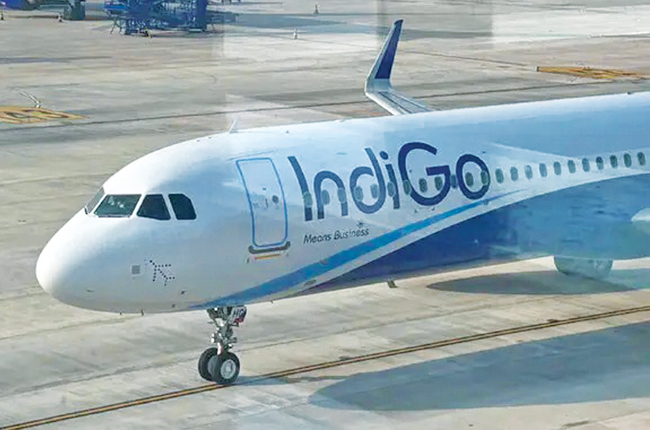

By P.K.Balachandran/Daily News
Colombo, December 9 – On June 12 this year, an Air India Boeing Dreamliner crashed immediately after take-off from Ahmadabad airport killing 260 passengers. Last week, 1600 of the 2000 flights of IndiGo Airlines, India’s biggest passenger carrier, were cancelled leaving tens of thousands of passengers stranded in airports across India.
IndiGo had an undisputed position in Indian aviation with a 61% share of the market. It was rated highly in terms of its service and affordability and was considered too big to fail. And yet it failed, manifestly and tellingly.
The government has appointed a high-level inquiry committee. Be that as it may, the collapse appears to have stemmed from a set of inter-related factors or basic ills in the aviation sector.
These are as follows – the sheer size of the airline’s operations; its monopolistic hold on the aviation sector with no competitors to compel rectification of deficiencies; an over-riding profit motive; sloppy management practices; the high cost of fuel; a faulty pilot recruitment policy; and the poor state of the maintenance and repair sector.
Size of Operations
India’s aviation sector grew phenomenally partly due to Prime Minister Narendra Modi’s pledge to throw open flying to all classes of people. In October 2016, he launched the UDAN scheme. UDAN is an acronym or “Ude Desh ka Aam Nagrik” (Let the Common Citizen Fly). Modi said, “I want to see people who wear hawai chappals [flip-flops] flying in a hawai jahaaz (aeroplane).”
The number of airports went up from 74 to 157 and is projected to exceed 200 by 2030. Today, India is the world’s third-largest domestic aviation market. It witnessed a 15% increase in air passengers, year-on-year.
However, despite the growth, the aviation sector has remained unequal. Because of the high cost of tickets (partly due to the rise in cost of fuel), the sector ended up serving a small, affluent section, leaving the vast majority behind. The finances of the airlines bore a question mark.
Crippling Taxes
Taxes were a major cause of fare hikes. The Aviation Turbine Fuel (ATF) cost accounted for 45% of air ticket prices. By mid-2024, jet fuel prices in cities like Delhi and Mumbai were nearly 60% higher than in global hubs like Dubai, Singapore and Kuala Lumpur. In addition, passengers were charged a variety of fees, with the proceeds going to the government rather than the airlines.
Gaps in Pilots Recruitment
The ambition to expand the sector was not matched by the creation of infrastructure in terms of technical facilities and manpower. There was a shortage of experienced pilots (Commanders’ level) though flying schools were churning out hundreds of pilots.
India will need 35,000–40,000 new pilots in the next decade, with at least 7,000 required by 2026. And supply isn’t negligible, the website CORE says. The Directorate General of Civil Aviation (DGCA) issues around 1,200–1,500 commercial pilot licences each year. Flying schools across India produce hundreds of would be pilots annually. If numbers alone were the issue, the gap is bridgeable.
And yet there is a “shortage” because airlines are not recruiting! According to “Core” there are 36 academies producing pilots but many who pass out of them (in some cases 50%) are forced to opt for other jobs. The reason is a freeze in recruitment by the Airlines.
This is partly because India’s Airlines now badly need experienced pilots who can be Commanders and not fresh entrants. The shortage is also due to recruitment by foreign airlines which offer better terms.
Regulation of Pilots’ Services
Given the absence of fresh recruits, the existing pilots are over-worked, causing fatigue and possibly accidents too. The UK’s paper “Independent” said that the turmoil in IndiGo is a regulatory system known as “Flight Duty Time Limitations” (FDTL) imposed by the Directorate General of Civil Aviation (DGCA).
The FDTL drastically cut the number of hours pilots and crew could fly; mandated longer rest periods; limited night-time landings; and redefined night duty periods. The new standards increased the mandatory rest period for pilots by 12 hours a week to 48 hours and stated that pilots could make no more than two night-time landings in a week, down from six earlier.
Government had given the Airlines 18 months’ time to implement the FDTL. In contrast to other airlines, IndiGo was way behind schedule in implementing the new rules. The Civil Aviation Ministry said in a statement that last week’s disruptions arose primarily through “misjudgement and planning gaps” in IndiGo’s implementation of the new rules.
The Federation of Indian Pilots said that all other airlines had provisioned pilots adequately and remained largely unaffected and that the cancellations in IndiGo were “the direct consequence of its prolonged and unorthodox lean manpower strategy.” Hiring less pilots and making them work more.
In the wake of last week’s disruptions, IndiGo sought time until February 10 to implement the provisions. On Friday, government agreed to withdraw a part of the rules with immediate effect to enable the IndiGo to clear airports of thousands of passengers waiting and seething with anger.
But the pilots were not happy. The President of the pilots’ union, C.S. Randhawa, said, “You cannot compromise safety for commercial interest.”
Repair and Overhaul Facilities
For a country that is the fastest-growing aviation market in the world and is already the third largest domestic market globally, India’s aviation sector has an “Achille’s heel” said a expert. All meaningful aircraft maintenance is done overseas. Experts say that 80 to 90% of these services are being done in Singapore and the United Arab Emirates (UAE).
IndiGo told the government that 90% of the firm’s expenditure on aeroplane Maintenance, Repair, and Overhaul (MRO) went to foreign firms. IndiGo alone allocated US$ 300 million towards MRO annually, with US $270 million flowing out of the country.
Therefore, there is an urgent need to create MRO facilities in various parts of India, so that repairs and maintenance are done quickly and at less cost.
Monopoly Model
The monopolistic structure of the aviation sector in India with just two companies, IndiGo and Air India, accounting for 91% of the market, is one of the causes for the glitch seen in IndiGo’s services last week. Given the extent and the high integration of a big service provider, a single glitch can impact the entire system.
The Leader of the Opposition Rahul Gandhi highlighted the monopoly angle in his reaction to the disruptions. Referring to his column published in “The Indian Express” last month, Rahul Gandhi blamed the “IndiGo fiasco” to the Modi government’s “monopoly model” and asserted that “India deserves fair competition in every sector, not match-fixing monopolies. Due to the monopoly model, ordinary Indians are made to pay the price in delays and cancellations”.
Emergence of Monopolies
The closure of many airlines over the years had created space for the emergence of a monopoly in the Indian airline sector. According to “India Today”, nine airlines had vanished from Indian skies in the past 25 Years. Their disappearance had helped IndiGo capture the market, the weekly said.
Air Sahara, which expanded ambitiously across northern India and later to international destinations, disappeared without a trace. In April 2007, Jet Airways acquired it and rebranded it as JetLite. But both JetLite and Jet Airways collapsed together in April 2019.
In 2003, Air Deccan introduced a system wherein anyone should be able to fly for the price of a railway train fare. With ATR 42 and 72 aircraft connecting smaller cities, Air Deccan became the airline of the common man. But finances could not keep pace with rapid expansion. Kingfisher Airlines acquired it in 2008, but Kingfisher also did not last. High fuel prices, overspending, and inefficient fleet planning triggered a snowballing financial crisis. Kingfisher’s licence was suspended in October 2012.
Paramount Airways offered premium seats at competitive prices. With Embraer E170/190 aircraft and an all-business-class pitch, it targeted southern business travellers. However, legal disputes, unpaid dues, and financial mismanagement led to a licence suspension in 2010. The airline never returned to the skies.
Founded in 1993, Jet Airways grew into India’s premier private airline and acquired Air Sahara in 2007. As low-cost rivals increased pressure and debt spiralled out of control, Jet could no longer sustain operations. In April 2019, all flights were halted. In November 2024, the Supreme Court ordered its liquidation.
TruJet focused on regional connectivity. Launched in 2015 with ATR aircraft, the brand tapped into Tier-2 and Tier-3 travel demand. But pandemic-era losses and continued financial strain forced a shutdown in February 2022. Go First (GoAir) had severe engine supply issues with Pratt & Whitney. Half its fleet was grounded. The ultra-low-cost carrier faced liabilities of INR 65210 million. The National Company Law Tribunal ordered its liquidation in 2025.
Vistara was launched in 2015 by a Tata Sons and Singapore Airlines partnership, but the brand officially ceased to exist in November 2024 when it merged into the Tata’s Air India. AIX Connect (formerly AirAsia India) disappeared more quietly. After the Tatas took over Air India, it merged Air India Express and AIX Connect under the single Air India Express brand.
High operating costs, volatile fuel prices, lean margins, and regulatory pressure, made many airline ventures go bust, enabling the emergence of monopolies such as IndiGo.
END
