

By P.K.Balachandran/Sunday Observer
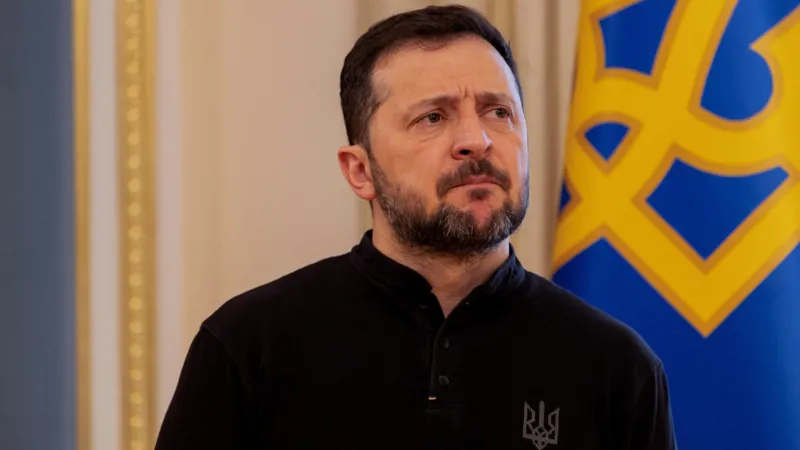
Colombo, February 22 – Ukrainian President Volodymyr Zelenskiy is being harried by continued Russian aggression, US President Donald Trump’s unabashed attempts to dictate policy and Europe’s inability to help. But massive and unbridled corruption at home is the more serious threat, as it will devour the very vitals of Ukrainian society and sap the will of the people to fight.
Given inadequate military and economic support from the US and Europe, the Russian military campaign continues. Having failed to get Zelenskiy to agree to his politico-economic deal to end the war, President Trump is embarrassing Zelenskiy by asking him to prove his domestic political standing by holding the long-overdue election to the Ukrainian Presidency.
More critically, Zelenskiy’s support base within Ukraine is shrinking due to his inability to rein in avaricious Ukrainian oligarchs, many of whom he had promoted.
He had 91% support after the Russian invasion began in 2022. But persistent problems both on the domestic and international fronts had brought down his popular rating to 61% in December 2025, according to the Kyiv International Institute of Sociology.
Some believe that he would struggle to be re-elected in a post-war vote, which Trump insists should be held this year. Zelenskiy is dragging his feet on holding elections, saying that, as per the Ukrainian constitution, polls could not be held during a war. He also argues that polls cannot be demanded in the absence of a security guarantee from Brussels and Washington.
Mounting Scandals
In late 2025, Ukraine was shaken by a major corruption scandal, prompting searches and arrests involving senior figures and scrutiny of Zelenskyy’s inner circle, including longtime chief of staff, Andriy Yermak. Yermak resigned.
Public demonstration broke out when Zelenskiy appointed a crony as the Prosecutor General to control investigations and cases handled by the National Anti-Corruption Bureau of Ukraine (NABU) and the Specialised Anti-Corruption Prosecutor’s Office (SAPO).
The latest scandal centred around the energy sector, which is particularly jarring for Ukrainians, considering that Russia’s attacks on infrastructure have left millions without electricity, water or heat in freezing conditions. Many soldiers and veterans are not getting paid or receiving adequate healthcare, while politicians are profiteering.
The recent detention of former energy minister German Galushchenko in a high-profile money laundering probe is the latest in a series of corruption scandals, AFP said.
In January 2023, there was a string of dismissals of top officials fired over a scandal about the purchase of foodstuffs for troops. Among those held were five regional Governors, four Deputy Ministers and two officials from a government agency, as well as the deputy head of the Presidential administration and the Deputy Prosecutor.
In May 2023, the president of the Supreme Court, Vsevolod Kniaziev was arrested following a bribery inquiry. Ukrainian billionaire Kostiantyn Zhevago was suspected of trying to bribe the court to issue a ruling allowing him to keep control of the shares of a mining company. Zhevago, whom Ukraine tried to extradite from France, transferred US$ 2.7 billion to lawyers, including US$ 1.8 million to persuade judges at the Court.
In August 2023, Zelenskiy sacked officials over a scam which allowed conscripts to dodge army service. In September 2023, Defence Minister Oleksiy Reznikov resigned over purchases of overpriced uniforms and food for the army.
In May 2024, Agriculture Minister Mykola Solsky resigned and was jailed, amid accusations for seizing State land worth more than 6.9 million Euros while working as the head of a major farming company. In the same month, a former deputy head of Zelensky’s office, Andriy Smyrnov, was charged with making illicit gains worth almost US$ 400,000 to purchase property, land and luxury vehicles.
In April 2025, two defence ministry officials and the director of a defence manufacturing plant and his deputy were arrested on suspicion of supplying tens of thousands of faulty shells to the army. In the autumn of 2024, at least 100,000 dud shells had to be withdrawn from the frontline. Some factories had used low-quality materials to maximise profit, with the complicity of military officials.
In June 2025, Deputy Prime Minister Oleksiy Chernyshov was suspected of being part of a large-scale corruption scheme in the construction sector. He was part of Zelensky’s inner circle. He was fired in July.
In November that year, Presidential aide Andriy Yermak resigned after his house was targeted in one of 70 anti-corruption raids. The raid uncovered embezzlement of US$ 100 million in the energy sector.
NABU said the graft scheme had forced state nuclear operator Energoatom contractors to routinely pay kickbacks on contracts, to avoid facing payment delays or losing their supplier status.
A former business associate of Zelenskiy’s, Timur Mindich, was accused of masterminding the scheme. Mindich, a co-founder of the Kvartal 95 entertainment company with Zelensky, has been named as a suspect and is accused of being the scheme’s ringleader. A former Ukrainian official revealed to Fox News that Mindich’s apartment was allegedly fitted with golden toilets.
Mindich, who is understood to have fled Ukraine for Poland last week, shared a well-documented close friendship with Zelenskiy. Zelenskiy used Mindich’s armoured car during his 2019 presidential campaign. The two also own properties in the same building.
The scandal pushed Justice Minister German Galushchenko and his replacement Energy Minister Svitlana Grynchuk to step down. Galushchenko was arrested as he tried to flee the country.
Wars Fuel Corruption
War creates perfect conditions for corruption, giving politicians free rein to use their power to promote their own interests. Half of the countries in the bottom quartile of Transparency International’s latest Corruption Perceptions Index are undergoing conflict, according to studies.
In Syria, the Bashar al-Assad regime enabled members of the ruling class to benefit from the political chaos, enabling people like Rami Makhlouf, the cousin of Bashar al-Assad, to get rich. Mahklouf was a key figure in the black markets.
War industries are major sources of illegal funds given the urgency of forced by operational requirements. Just as war nurtures corruption, corruption perpetuates war. The American military-industrial complex, founded by President Dwight Eisenhower in the 1950s, is meant to make money from war. The military contract system is a major part of that, and it is based on kickbacks.
War gives rise to political bribery. In Afghanistan, the US-backed Afghan government made warlords rich across the country in exchange for support to fight the Taliban. Like the Russians in Syria, Americans in Afghanistan allowed US-linked figures like Erik Prince to cooperate with Afghan warlords. Prince was an American businessman, a former US Navy SEAL officer and the founder of the private military company “Blackwater”. Foreign-inspired corruption, through military contractors, corrupt the local economy also. .
Whether there is war or not, a kleptocratic government tends to buy off powerful opponents with public contracts and concessions. It will co-opt organised criminals to suppress dissent. Corruption breeds political conflicts, often leading to insurgencies. Weak institutions and poorly trained and paid officials discredit the formal system and create disaffections.
After a bloody fight against the Soviet invaders, many ordinary Afghans, who fought across the ranks of the US-backed Mujahideen resistance movement, wanted to return to their normal lives. But when they came back to their villages, they were forced to deal with local governments run by corrupt leaders and warlords. Eventually, most of them joined the Taliban.
In Syria, a similar situation played out. First, clashes in Syrian cities like Daraa, the ‘Cradle of the Revolution’, were triggered by local resentment against corrupt officials.
Giorgio Spagnol, a former Italian general and political analyst, said that impunity on crime may encourage citizens to take the law into their n hands in attempts to effect jungle justice, which could further lead to conflicts and crime.
Another factor concerning connections between conflicts and corruption is related to autocratic tendencies. Countries that appear in the bottom quartile of the Corruption Perceptions Index are disproportionately autocratic. Bangladesh under the autocratic regime of Sheikh Hasina bred corruption massively. The banks and financial institutions were looted and the proceeds stashed away abroad. Defaults were high due to this, and those with no political connections found it difficult to get bank loans.
By definition, autocracies only serve a minority within a population. The inequities this perpetuates create escalating pressures within a society. Autocracies are also not receptive to reform and, therefore, lack the self-corrective capacity.
Ukrainian Corruption will be exploited Russia and US
Now the Kremlin and the White House will try to exploit the corruption scandal to impose even more punishing terms. Meanwhile, the compromises that Ukrainians could be asked to accept will be even less palatable at home when delivered by a President who let corruption erode his domestic standing.
Elections Are Remote
Zelenskiy is dragging his feet on holding elections, saying that as per the Ukrainian constitution, polls could not be held during a war. He also argues that polls cannot be demanded in the absence of a security guarantee from Brussels and Washington. Ukraine is thus stuck in a morass.
END
