

By Asiri Fernando/The Sunday Morning
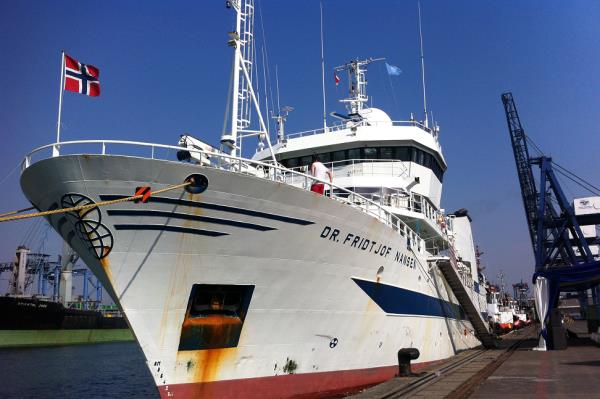
Colombo, June 29 -Sri Lanka has missed the boat on gaining valuable data needed to ensure the island’s food security and exports due to the loss of the fish stock assessment which was to be conducted by the United Nations-linked research vessel R/V Dr. Fridtjof Nansen between July and August, it is learnt.
The research vessel is linked to the United Nations Food and Agriculture Organization (FAO) and the Norwegian Agency for Development Cooperation (NORAD) through the Ecosystem Approach to Fisheries (EAF)-Nansen Programme on improving fisheries management and operated by the Institute of Marine Research (IMR) in Norway.
The Nansen Programme has assisted Sri Lanka with multiple surveys since the 1970s. A 2018 research by the programme had seen Sri Lankan scientists get the opportunity to work and study on board the research vessel and the survey data had delivered valuable input to manage fish stocks and plan the island’s Blue Economy interest. Sri Lanka had requested a follow-up survey, which was then scheduled for 2025.
“Delays in granting approval for the survey has cost us the opportunity this time. Our indecision and delays in communicating our approval caused this. The request for the survey was received in 2023,” a senior Government official close to the matter told The Sunday Morning on terms of anonymity. “The blame game has started now and the Government is in damage control mode.”
Ministry in the Dark
Last week, the Ministry of Foreign Affairs (MFA) scrambled to respond to reports of the Dr. Fridtjof Nansen dropping Sri Lanka from its planned Indian Ocean survey plan for 2025 and the opportunity being afforded to Madagascar.
“Sri Lanka has granted clearance for the FAO research vessel scheduled to commence research engagements in Sri Lankan waters from 15-20 August,” Ministry of Foreign Affairs Public Diplomacy Division Director General Thushara Rodrigo stated last week.
However, when contacted about the reports that the FAO-linked research vessel would not conduct the survey, Rodrigo said: “I feel that it is their problem. They have not informed us. If they are clear and transparent, they have to inform us. I don’t think they have informed us.”
Multiple attempts to contact Minister of Foreign Affairs Vijitha Herath and Deputy Minister of Foreign Affairs Arun Hemachandra for comments about the process of granting approval to the research vessel failed.
The FAO office in Colombo would not comment on the research vessel’s agenda. Attempts to contact the EAF-Nansen Programme to verify if Sri Lanka had clearly lost the opportunity this research season were futile.
However, a senior Government official, when asked about the loss of the research opportunity with the Dr. Fridtjof Nansen, told The Sunday Morning that the Government would attempt to reach out to the FAO in Europe to try to “salvage the valuable opportunity” next week, with directives to be given to the Foreign Ministry and the Fisheries Ministry to expedite communication with FAO leadership in an attempt try to persuade them to stay the course and conduct the research.
Sri Lanka’s fumbling of the research opportunity to improve its marine resource management and ocean governance comes in the wake of the island nation opting to sign on to the United Nations agreement on Biodiversity Beyond National Jurisdiction (BBNJ), which Sri Lanka is in the process of ratifying.
Bungling bureaucracy
The organisation of the research, data sharing, and analysis of the FAO-linked Nansen Programme in Sri Lanka is coordinated by the Ministry of Fisheries and the National Aquatic Resources Research and Development Agency (NARA). It is reliably learnt that the 2023 research plan and request for approval from the Dr. Fridtjof Nansen came via the Fisheries Ministry and NARA.
It is learnt that the moratorium on foreign research vessels conducting surveys in Sri Lankan waters and its Exclusive Economic Zone (EEZ, up to 200 nautical miles from the coast), introduced in 2023 by the Ranil Wickremesinghe administration following geopolitical pressure on Sri Lanka about collaborative Chinese Marine Scientific Research (MSR) surveys in the Indian Ocean, was ended by the National People’s Power Government on 31 December 2024 and the the failure to address the MSR issue to date has contributed to the delays in granting approval.
Foreign Minister Herath in January stated that a ‘committee’ would be appointed, led by him, to draft a new national policy on foreign MSR and to draft a new Standard Operating Procedure (SOP) to grant permission for MSR requests and regulate them.
This, despite the previous Government reviewing the existing SOP and enacting a new SOP in consultation with India, the US, and other powers who were concerned about Chinese MSR vessels in Sri Lankan waters.
Six months since the Foreign Minister stated that the committee would be appointed, it is learnt that the appointed committee had only held its first meeting this month. When asked if the committee had met to discuss the drafting of a national policy, Rodrigo stated that the first meeting had been held this month.
However, he would not disclose the composition of the committee, adding: “There are some agencies which are part of it but we are not saying which ones; it is in the national interest.”
Essential Survey
Meanwhile, Minister of Fisheries, Aquatic and Ocean Resources Ramalingam Chandrasekar, when asked about the issue and if Sri Lanka could request the FAO to reconsider providing the island the research opportunity, acknowledged the importance of the research.
“Yes, we had requested this survey. It is an essential one for us. We have no objection to it. However, our Government is of the view that we need to have a sound policy on managing research vessels and develop a schedule for them. Therefore, we have appointed a mechanism for it. I think within a week or two we can develop this.”
When asked about the Foreign Ministry-appointed committee to formulate the said ‘national policy,’ Minister Chandrasekar stated that he was part of the committee.
He acknowledged that the loss of the survey would cost Sri Lanka valuable data to plan its fisheries management. He expressed confidence that Sri Lanka may be able to convince the Dr. Fridtjof Nansen to return.
Meanwhile, it is learnt that two scientists from NARA who had been dispatched to Mauritius for a two-week training programme with the Dr. Fridtjof Nansen and the Nansen Programme are to return to Colombo this week.
The vessel is expected to traverse around Sri Lanka in late August as it makes its way to the waters off Bangladesh for a survey.
Opportunity Lost
Sri Lanka, recovering from an economic crisis, having faced a period of food insecurity, is battling a serious Illegal, Unreported, and Unregulated (IUU) fishing crisis in its northern waters.
Fish make up about 50% of Sri Lankans’ animal protein intake and is a resource which needs to be managed effectively and in a sustainable manner.
How Sri Lanka will do so by missing such valuable opportunities to map its marine living resources by international experts such as those onboard the R/V Dr. Fridtjof Nansen is a question the Government should answer.
END
