


By P.K.Balachandran/Daily Mirror
Colombo, February 11: When the repressive 15-year regime of Sheikh Hasina was overthrown by a two-month-long violent mass movement led by university students, the expectation was that sanity, peace and the Rule of Law would prevail in Bangladesh.
But that faith has eroded or is fast eroding both among law-abiding Bangladeshis and their well-wishers across the world.
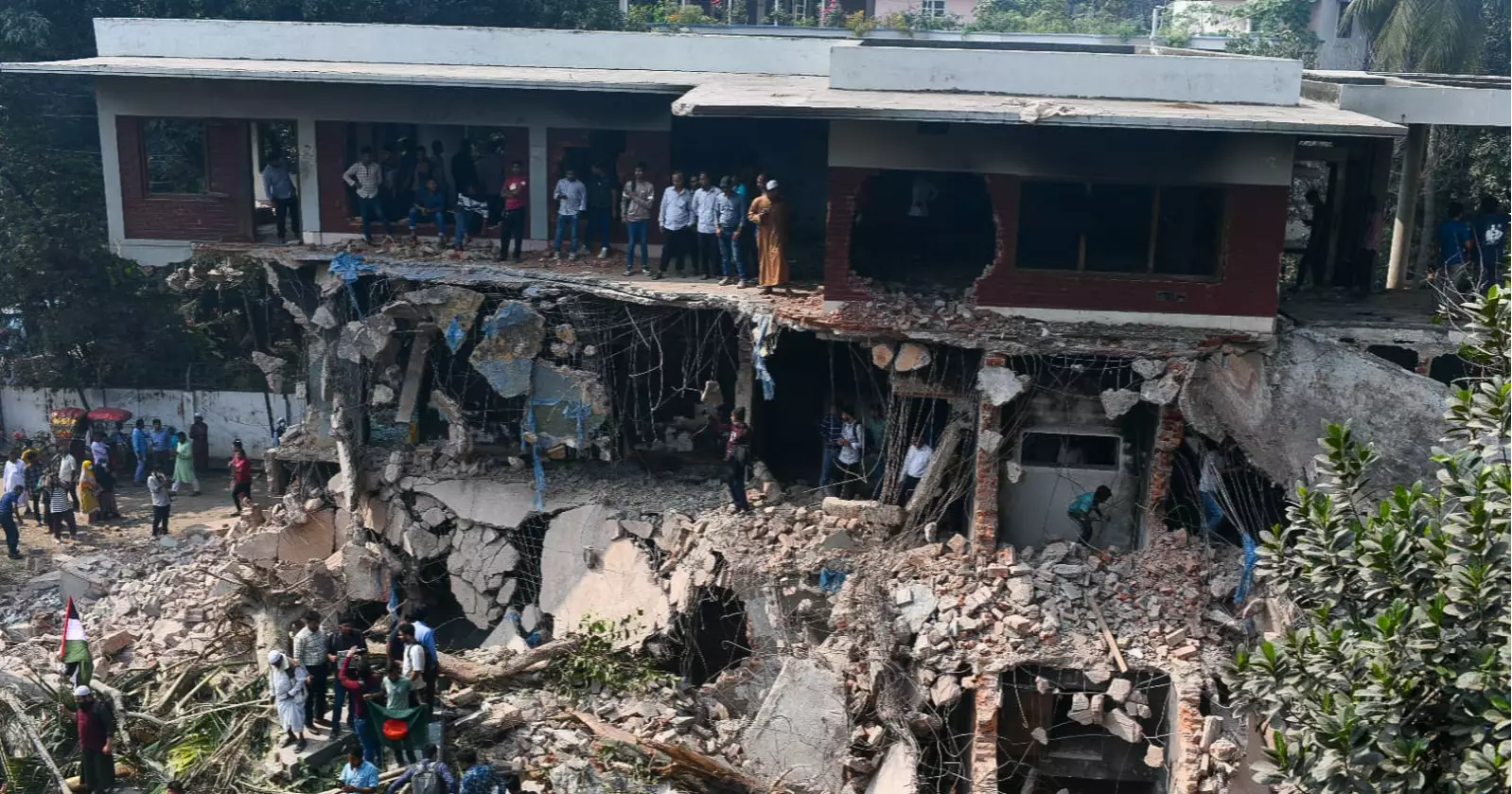
What marks Bangladesh today, six months after the “revolution against fascism”, is chaos punctuated by insane vandalism. All symbols of Sheikh Mujibur Rahman, the founding father of Bangladesh, have been burnt down or vandalised. His house turned into a museum in Dhaka, which had witnessed key developments in Bangladesh’s struggle for independence from Pakistan and the subsequent events which led to his assassination in August 1975, were pulled down with government-owned bulldozers and set on fire by student mobs.
The Yunus government did issue a “stern warning” to stop the attacks but that was more than 48 hours after mayhem had engulfed the country.
It did little to stop the vandals who torched the houses of other Awami League leaders in various parts of Bangladesh as Chief Advisor, Nobel Laureate Dr. Muhammad Yunus and the army looked on passively.
In a stinging attack on what is going on in Bangladesh, political commentator Subir Bhaumik re-Christened Bangladesh ‘Vandaldesh’ where mob justice, rather than court-administered justice, has become the order of the day.
Indicating the rise of Islamic forces, mobs chanting “Naara e Takbeer” (Allahu Akbar or God is Great) attacked universities and cultural centres in seven places across the country to destroy murals of Sheikh Mujib. Anyone who shouted the Bangladeshi slogan “Joy Bangla” (Victory to Bangladesh) was beaten up.
Hasnat Abdullah, a key figure in the agitation that ousted Sheikh Hasina and believed to be close to interim government chief Prof Yunus, justified these attacks as being the “erasure of the tombs of fascism.” Hasnat had earlier threatened the media with severe consequences if they gave space to Sheikh Hasina’s speech made online from Delhi. “Doing that is tantamount to facilitating her agenda,” he told a news conference.
Members of the Advisory Council justified the vandalism saying that it was a reaction to Sheikh Hasina’s online speech describing Bangladesh after her ouster as a “terrorist state”. She declared that houses could be destroyed but history could not be, meaning her father’s and her own contribution to Bangladesh, could not be erased from memory.
Meanwhile, student members of Yunus’ Advisory Council have declared that Hasina’s Awami League would not be allowed to contest the parliamentary elections, that are expected this year or in the middle of 2026. “There is no room for fascists or the fascist ideology in Bangladesh,” they said.
The beating up of people who raised the slogan “Joy Bangla” which rang during the independence struggle in the 1970s and after, indicates that today’s Bangladeshis have turned their backs on their independence struggle in the 1970s. Many are voicing the urge for an alliance or reunion or confederation with their erstwhile tormentor Pakistan to confront India. That India had fought a war against Pakistan to help the Bangladeshis establish an independent country is now being erased from memory.
History had turned topsy-turvy in Bangladesh. There is a yearning to return to the past in the hope that the past will ensure a good future. Bangladeshis are ignoring the dictum or truism that “those who ignore history will be condemned to repeat it.”
The Bengali Muslims’ relations with the Pakistan movement from 1906 to 1947 and the Pakistan State after 1947 had not been very pleasant. There was a nine-month violent struggle in what was then East Pakistan which led to the death of thousands and the formation of Bangladesh in December 1971.
Islamic Resurgence
The day before these orchestrated attacks on Mujib’s symbols, Islamist radicals marched to Kashimpur prison under the leadership of Ataur Rahman Bikrompuri heading the “Free Jail Movement”. They confined the jail warden and forced him to release a convicted Islamist terrorist Mohibullah, who started off in Harkat-ul-Jihad al-Islami (HUJI) and came to head a new radical Islamist group Sharqiya Hindal.
Bikrompuri has led similar successful marches before to free convicted Islamist radicals from prisons across the country. 700 radicals freed from jails are now at large, reports journalist Subir Bhaumik in Eurasia Review.
Neither Yunus nor the Islamist groups like Jamaat-e-Islami want an early election to the parliament because a free and fair poll would either help the Bangladesh Nationalist Party (BNP) ride to power and the Awami League to stage a comeback or at least as a leading Opposition party, using the groundswell of popular disenchantment with the Yunus regime. Understandably, the BNP criticised the attack on the museum as “an attack on democracy.”
“The pitch for reforms Yunus wants to bring about is seen by some as an excuse to delay the elections and by others as downright illegal because any fundamental change to the existing polity requires a popular mandate. A few have argued that while Yunus and his ‘students brigade’ lambasted Hasina for rigging elections, they have found a way to stay in power without having to face any elections”.
“While Hasina was blamed for using the state apparatus to silence opponents and detractors, Yunus and his cohorts are using the mobs to silence detractors and terrorise them into submission. One of his advisors, Asif Mahmud, has openly talked of plans to ban the Awami League, whose student wing Chhatra League has already been banned. For Bangladeshis, many of whom enthusiastically joined the July-August agitations hoping to herald a new dawn, the revolution has degenerated into a reign of terror,” Bhaumik says.
Harmful Cross-border Political Rhetoric
The ouster of Hasina on August 5, 2024, has become a domestic political issue in India too. Hindu nationalists and even others are viewing the ouster as an anti-India move engineered by Pakistan, the US and even China.
New Delhi was very close to Hasina as she was helpful in controlling cross-border terrorism as well as in fulfilling India’s need for development projects against stiff competition from China.
But in Bangladesh, India was seen to be perpetuating Hasina’s rule for its own selfish and geopolitical ends. The anti-Hasina movement became an anti-India movement too. The refuge given by India to fleeing Hasina only added grist to the propaganda mill.
As Michael Kugelman of the Wilson Centre put it, India is particularly perturbed by the collusion of Pakistan and the Yunus government and their perceived closeness to China. It is also worried about Islamisation and the determined bid of Islamists to seize power through extra-constitutional actions to overcome their failure to come to power through the ballot box.
While a leading international affairs expert in Bangladesh and a Dhaka University Professor is openly asking for “nuclear cooperation” with nuclear-armed Pakistan, military cooperation with Pakistan is being put into effect. Trade links and direct flights are being resumed.
While Bangladesh’s present relations with the US are not known, there is an open wish in Bangladesh to strengthen military ties with China (which are already there in the form of arms). A Pakistan-China-Bangladesh military deal will threaten India as an attack could be launched in the West, North and East as Bangladesh has a long border with India in all directions except the South.
India has a very tenuous geographical link with its seven North Eastern States of Assam, Meghalaya, Mizoram, Nagaland and Tripura and that link is the very narrow “Chicken Neck” in Siliguri in North Bengal. It is between Bhutan and Bangladesh. The neck is seriously threatened by China which borders tiny Bhutan.
Bangladesh would like India to ask Hasina not to make any hostile statements on developments in Bangladesh. In return, India would seek certain guarantees from Bangladesh. But the million-dollar question is: Is the Yunus government which is weak and unelected, and controlled by radical student agitators and Islamists, in a position to give any guarantees at all?
END
