
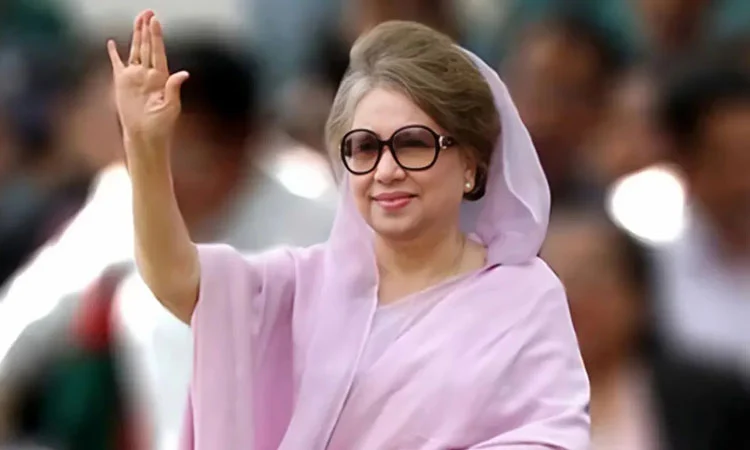

Dhaka, December 30 (TOB)- The Chairperson of the Bangladesh Nationalist Party (BNP) and three-times former Prime Minister Begum Khaleda Zia passed away on December 30. She was 80.
She breathed her last at 6am on Tuesday while undergoing treatment at the Evercare Hospital in the capital.
Her death was confirmed by BNP’s Information and Technology Affairs Secretary AKM Wahiduzzaman and Begum Zia’s former Press Secretary, Maruf Kamal Khan.
Earlier, at 2am on Monday, Dr AZM Zahid Hossain told the media, “Begum Zia is passing through a very critical time. Therefore, in this situation, on behalf of her family, all we can say to the nation is to pray to the Almighty for her recovery.”
Former prime minister Khaleda Zia was admitted to the Evercare Hospital in Bashundhara on 23 November. On 27 November, she was transferred from a cabin to the Critical Care Unit after developing a lung infection.
The 80-year-old Khaleda Zia had been suffering from various complex and long-term health complications. These included liver complications, kidney complications, heart disease, high blood pressure, diabetes, arthritis, and infection-related issues.
Khaleda Zia was born on 15 August 1945 in Dinajpur. Her father, Iskandar Majumder’s home was in Shreepur village of Parshuram, Feni district. Her mother, Taiba Begum, was born in Chandanbari, Boda Upazila, Panchagarh district. She was the third of their three daughters and two sons.
After her birth, she was named ‘Khaleda Khanam’. As she was very beautiful, family members called her ‘Putul’. That became her nickname. She received her primary education at St Joseph’s Convent. Later, she passed her Matriculation from Dinajpur Government School and Intermediate (Higher Secondary) from Dinajpur Surendranath College.
Khaleda Zia was one of the most prominent figures in Bangladesh’s political history and the country’s first female prime minister. Over her long and eventful career, she took oath as prime minister three times. Rising from the anti-autocracy movement, the BNP chairperson’s three chapters of state leadership are summarised below.
First Term (1991–1996)
Following the mass uprising of the 1990s that led to the fall of HM Ershad, the fifth national parliamentary election was held on 27 February, 1991. In that election, the BNP won 140 seats on its own. Later, with the support of Jamaat-e-Islami, the party formed the government.
On 20 March, 1991, Khaleda Zia took oath as Bangladesh’s first female prime minister. In the Muslim world, she was the second female prime minister after Pakistan’s Benazir Bhutto. One of the major achievements of her tenure was the transition from a presidential system to parliamentary democracy. On September 19, 1991, she signed the 12th Amendment Bill, which restored the parliamentary system of government in the country.
Second Term (February 1996)
Khaleda Zia’s second term was very short-lived. Amid the boycott of the opposition parties, including the Awami League, demanding a caretaker government, the sixth national parliamentary election was held on 15 February, 1996. In that election, the BNP won an absolute majority.
However, due to massive public protests, this parliament did not last long. The caretaker government bill was passed in the sixth parliament. Subsequently, on 30 March, 1996, Khaleda Zia resigned from the post of prime minister. During this term, she served for only 12 days (from 19 March to 30 March).
Third Term (2001–2006)
On 1 October, 2001, Khaleda Zia led the four-party alliance in the eighth national parliamentary election. In this election, the alliance won a two-thirds majority. The BNP alone secured 193 seats, while the alliance collectively won 216 seats. On 10 October, 2001, she took oath as prime minister for the third time. During this tenure, she completed a full five-year term in office and handed over power on 29 October, 2006.
In her illustrious political career, she contested elections five times — 1991, February and June of 1996, 2001, and 2008) — standing from three to five different constituencies each time, and won in all of them. She never lost a seat, an exceptional record in the country’s history.
END
Chairperson of the Bangladesh Nationalist Party Khaleda Zia passes away
