
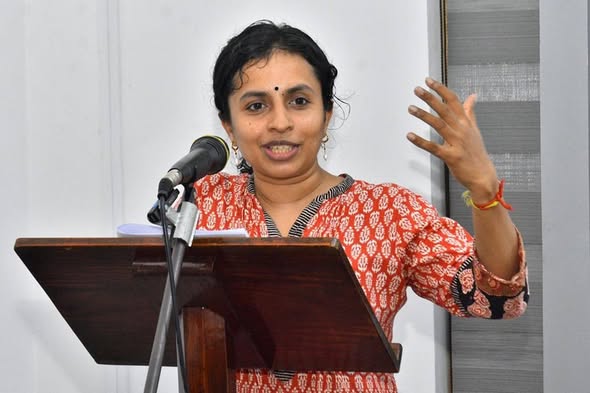

Here is the English text of the Sanmugathasan(Shan) Memorial Lecture Delivered by Trade Unionist.Lawyer and Activist Swasthika Arulingam at the Colombo Thamil Sangam,Wellawatte on 8th February 2026. Courtesy – www.dbsjeyaraj.com
Dear Comrades,
I am going to refer to you all as Comrades today. I am going to imagine this hall is filled with people who are radical thinkers. I am going to imagine that all of you are here today because we are all realising that the systems and structures which were created and imposed on us since colonialism are not only unravelling but have been killing our people and our planet. I am going to imagine that all of us are here to listen but also to think together and search for radical alternatives.
A radically different world was theorised by Karl Marx and Friedrich Engels many moons ago. A radically different world was fought for and operationalised in the times of Vladimir Lenin, Rosa Luxemburg, Mao Zedong and our own Nagalingam Shanmugathasan. But these revolutionaries are long gone. We are left with their ideas and thoughts and the historical lessons they imagined and wrote about.
I was born into a generation where the left of this country was full of great ideas but too weak to organise and fight to transform society. As I grew older and when I finally entered the trade union movement, the Left was a fringe movement, only capable of critiquing the neoliberal status quo. This was and is not good enough for me.
So today I ask the question: why is it essential, in fact existential, for my generation to strategise to bring about the end of capitalism? This is what I will try and answer in the next few minutes.
Today, I cannot breathe in Colombo. We have been struggling to breathe for the last two months if you think about it. Every other person I know who takes public transport is sick. I can only imagine the situation of sanitary workers, trishaw drivers and delivery workers who are exposed to this polluted air. A recent news article was headlined ‘Sri Lanka’s cities are choking’. This new year dawned with the Air Quality Index at ‘unhealthy’ levels. Transboundary air pollution from India coupled with intense vehicle emissions in Sri Lankan cities have resulted in even a most basic human need, clean air, being denied to ordinary people.
One might have thought that this Government would rush to talk to New Delhi, informing them of the urgency of this matter. One would have thought the Government would place strict regulations on the number of vehicles entering and exiting Colombo. No such dialogue was held between the Sri Lankan Government and the Indian Government.
And since 2025, we have restarted importing vehicles. The vehicle import bill for the year 2025 came to around USD 2.047 billion for a country which is yet to settle its crushing foreign debt. Why isn’t ‘unhealthy’ air quality a national crisis? Is it because those close to the Government do not step out of their vehicles when they travel the streets?
Recently our country suffered one of its worst ever environmental crises – the Ditwah cyclone. “The hills are crumbling and crushing us,” one friend declared when she saw the landslides, rubble and sand burying families in the hill country. More than 750 people are either dead or still missing.
Around 240,000 people are displaced. More than 20,000 properties were damaged. We suffered an estimated economic damage of USD 4.1 billion. Nearly 380,000 workers lost their incomes, amounting to around USD 48 million per month. This was a natural disaster not seen in our country since the tsunami.
As usual it was the people who came together in their thousands, volunteering to help, to cook, to clean houses, to collect and distribute clothes, to rescue stranded people and animals. Our people came together, even while they struggled under the weight of their own economic struggles, to help those who were left stranded in the wake of the floods and the landslides.
With the floods emerged to significant issues which have been simmering for decades in this country. As you are aware, plantation workers unlike other workers are tied to the plantation lands they work on. Even as the plantation regime transitioned between nationalisation and privatisation after serving as an essential component of the colonial economy, the plantation workers’ lives themselves remained unchanged. Ditwah destroyed what remained of the centuries old line houses they live in. This is why the decades-long demand, land for the plantation workers, has emerged once again.
However, to date this Government, like its predecessors, has not dealt with this urgent issue. Member of Parliament Ambika Samuel, an elected representative from the Malaiyaha Tamil community, is periodically given time in Parliament to remind us that this Government is different, that this Government is building better houses for plantation workers, that this Government does not display nepotism and is not corrupt. However, to date Ms. Samuel or this Government she is part of has not given an explanation as to why they have not allocated lands together with legal titles to plantation workers.
We know the answer. Everyone knows the answer, even though no one says it out loud. So long as people are tied to the land, the plantation company Dons can fill their fat pockets further with the surplus from exploited cheap labour.
And what about the wages of the plantation workers? May Day in 2024 was a day of celebration for plantation workers. On that day, the then President Ranil Wickremesinghe and his Labour Minister Manusha Nanayakkara declared that the daily wage of the plantation workers will be increased from 1,000 to Rs. 1,700. Within weeks of making this announcement, the plantation companies ran to court weeping tears and telling sad stories. “We are already running at a loss! The industry will collapse!”
the Dons of the plantation companies wailed. We have heard these stories a hundred times over. The Labour Minister wasted no time in whipping out his handkerchief to wipe their crocodile tears. Mr Nanayakkara immediately withdrew the Government gazette increasing the wages. What a betrayal.
Given the injustice of this move, and given their previous commitments to plantation workers and the Malaiayaha Tamil community, I was hopeful that the NPP Government would increase the wages as promised to Rs. 1700. But the NPP Government, consisting of Trade Union leaders, has come up with an ingenious plan. The Government will subsidise the wages of the plantation workers!
For decades neoliberal economists and Governments have preached to us that “We must cut subsidies!”, “The poor and the working class are lazy!”, “Our coffers can’t support free handouts any more” and “we must bring an end to the ‘welfare economy’”. And now the private sector is being subsidised for wages! The private sector which we are told is the ‘engine of growth’ needs public subsidies to pay their workers’ wages!
And where is this money coming from? Taxes. That, too, from indirect taxes which form 75% of our tax base. Which means ordinary working people, like the plantation workers, are taxed on their food, medicine, transport and even their children’s books for school, and from these taxes which they are paying to the government Rs. 200 is then paid back to them. I cannot begin to explain the cruelty of the deception this Government has subjected plantation workers to.
The appalling way this Government has decided to treat plantation workers can be seen in its stance towards garment sector workers as well. A few days ago, it was reported that at a Wages Board meeting the apparel sector employers have ‘lamented’ that they are unable to pay the legal minimum wage of Rs. 30,000 to their workers due to ‘tough economic conditions’.
In 2024, at an election stage of the NPP, the DSI Chairman in a widely publicised speech declared that Marxism and Leninism was outdated. The NPP leaders sitting in the front row, no doubt desperate for the funding, support and approval of the business community, clapped their hands shamelessly. Many of them members of the JVP itself, loudly cheering on this self-serving declaration of a capitalist.
When one sees the spectacle unfolding across the two main industries which bring the most foreign exchange to our country, I am reminded of the basics of Marx’s labour theory of value – that profit is, after all, only a reflection of suppressed wages and exploited labour. We are living and seeing Marx’s analysis through the condition of workers in this country. So long as capitalism remains, so long as extracting profits for capital remains the primary goal of an economy, Marxism can never be dead. It has been and continues to be the most incisive language that can explain why workers are exploited and dispossessed and remain in that state.
I fear the members of the NPP who cheered the Chairman of the DSI Company in 2024 have now begun to believe that capitalism is the only way of survival. I believe the NPP fears that disturbing the neoliberal economic status quo would risk their tenure in holding state power. How else can I explain the silence of the Government after the Trump tariff saga?
In April 2025, US President Donald Trump slapped a 44% tariff on Sri Lankan exports to the US as part of a global revision of US tariffs. President Anura Kumara Dissanayake rightfully chose the diplomatic path and avoided the catastrophe of mass unemployment due to factory closures if the tariff went ahead. This worked to his favour and to the favour of the manufacturing export sector. The tariff was reduced to 20% a few months later and everyone was happy.
Now, I would think the tariff saga would finally awaken our Government to the perils of relying heavily on the US to keep our economy afloat. One would think the Government would in the least have discussions on alternative economic models, discussions with other third world countries, especially the many countries in similar situations to ours, and be prepared. I had even hoped that the Government was perhaps doing this confidentially.
However, two days ago a news report read that Sri Lanka is preparing to expand bilateral trade relations with the US. Similarly, when a handful of us demanded that the Government sever Sri Lanka’s ties with Israel on account of the horrifying genocide it is inflicting on the Palestinian people, or in the least not enter into new labour agreements, Mr. Bimal Rathnayake, Chairman of the Sri Lanka Committee for Solidarity with Palestine and a senior member of cabinet, declared that “our economy will crash” if we break ties with Israel.
When did our economy become so dependent on Israel? When did we stop being friends of the Palestinian people? Are we to continue in this manner in a world where the United States has once again emerged from behind the smokescreen of diplomacy, baring its teeth and unleashing violence on third world states? On its own citizens?
We are living in a world where an elected leader of a third world country, Venezuela, has been kidnapped by the United States Government. We are living in a world where the US President is telling us without any pretence that he did this to take control of the oil resources of Venezuela. We are living in a world where the genocide of the Palestinian people unfolds before our eyes and citizens in the US, UK and EU are being detained as terrorists for questioning their governments’ complicity in this genocide.
The United Nations is unravelling metaphorically and literally. Only last week the UN Secretary-General declared that the UN is facing an ‘imminent financial collapse’ due to member states including the US withdrawing from paying their dues.
Following World War II, the European States came together to build a new world which entrenched their economic power upon the remaining peoples. When the third world was birthing new states, wanting to break free from the yoke of colonialism and demanding control of its own resources, human rights were benevolently promised to us. That world is coming to an end. Today the European States no longer pretend to be the moral bastion of human rights.
See for instance the text sent by Emmanuel Macron the President of France to Donald Trump. “My friend,” he states, “We are totally in line on Syria. We can do great things on Iran. I do not understand what you are doing on Greenland.” What does this text remind you of? The Belin Conference of 1884-1885 where the European powers gathered and decided how to divide Africa, draw artificial borders and continue to plunder its resources and exploit its peoples.
So, this is the new world order, where citizens are terrorists, migrants are caged and deported, third world states are destabilised to plunder and a paedophile and a rapist is the President of the global imperial hegemon. Do we think that we can survive in this new world order by just bowing to the bully? What are we doing to prepare to fight back? Are we going to rely on sectors such as the garment sector indefinitely which contributes 8-10% to carbon emissions? What is our responsibility to the planet?
And have we got our own house in order? Our people are being dragged through the IMF torture house of austerity, taxes and high cost of living. Mothers are still looking for their missing children 15 years after the civil war ended. Our youth are surviving one day at a time, consuming drugs so that they can do one more shift, one more hire without falling asleep. We are told that things are better – things were worse before but now things are better. But it doesn’t feel like that.
These are hard questions and hard realities, and we need a radical Government and a radical people to imagine new answers to old problems. Unfortunately, the Emperor has wrapped himself with the clothes weaved and given to him by the financiers and the industrialists. The same men, who hid millions of dollars in offshore accounts and drove this country to bankruptcy today sit around our President as advisors and tell him that people can eat cake if bread is short. As a result, the Executive President of Sri Lanka begs an imperialist paedophile to keep the country’s economy afloat without any exit strategy in sight.
So, what shall we do as people to come out of this sordid predicament which we find ourselves in? As good leftists, siting on the sidelines and crying has never been our strategy. So, we look to history for inspiration and direction.
In October 1963 Comrade Shanmugathasan was expelled from the Communist Party of Ceylon. In protest he declared a five-point plan for the struggle to continue. I set them out below:
(a) the publication of Sinhala translations of important Marxist theoretical works;
(b) the publication of Kamkaruwa and Thozhilali as high-quality weeklies and making them daily papers within one year;
(c) the publication of good-quality Sinhala and Tamil Marxist theoretical periodicals;
(d) building up the unity of the trade union movement and establishing a united trade union centre as quickly as possible; and
(e) mobilising peasants and creating a worker-peasant alliance.
In these times of chaos and crisis, we must draw strength from each other, from our people, from our workers, from our peasants, from our fishers and from our revolutionaries like Comrade Shanmugathasan who have left us with a wealth of knowledge and lessons. We must educate and arm ourselves with revolutionary theories and ideas which have the power to transform our thinking and our action.
The status quo theories based on free market competition and unfettered worship of capital, which this Government too seems to be hellbent on following, will not take us out of this predicament and if continued will result in the extinction of the human race. Education, dissemination of information and organising should be our strategy against the status quo. And fight we must against the status quo, for our existence, because today we are choking and we can’t breathe.
END
