

By P.K. Balachandran/Daily News
Colombo, April 8 -Sri Lankan President Anura Kumara Dissanayake, leader of the Janatha Vimukthi Peramuna (JVP) and the 21-party ruling alliance, the National Peoples’ Power (NPP), has historically been associated with strong anti-India sentiments. While direct quotes of his anti-Indian public statements are few and far between, there is no dearth of anti-Indian statements made by the JVP.
In 1987-89, the JVP, of which Dissanayake was an active member, vehemently opposed the Indo-Sri Lanka Accord of July 1987. It accused India of “expansionism” riding rough-shod over Sri Lanka’s sovereignty.
“Indian dogs go home!” was among the graffiti scrawled on Colombo’s roads in protest against the deployment of the Indian Peace Keeping Force (IPKF) to implement the Accord in the North-East where the Liberation of Tamil Eelam (LTTE) had refused to comply.
During the 1987-1989 JVP bloody insurrection in South Sri Lanka, Dissanayake fought “Indian expansionism” as well as Sri Lankan “class enemies”. The struggle left thousands dead including 60,000 JVP supporters allegedly.
Before his Presidency, which began in September 2024, Dissanayake had criticized Indian economic projects in Sri Lanka, notably the Adani Group’s wind power project in Mannar in North Sri Lanka. He stated that such deals violated Sri Lanka’s “energy sovereignty” and were examples of “foreign exploitation”. He swore that the JVP will not allow Sri Lankan resources to be handed over to foreign entities like the Adanis.
He has consistently opposed the full implementation of the 13th Amendment to the Sri Lankan Constitution, which was introduced under Indian pressure as part of the 1987 bilateral Accord, primarily to devolve power to the Tamil minority in the Northern and Eastern provinces. To Dissanayake devolution would nullify Sri Lanka’s Unitary structure.
“The 13th Amendment was forced upon us, and it does not reflect the will of the Sri Lankan people,” he argued.
Power Softens
But since becoming President, Dissanayake has softened his rhetoric, and is emphasizing cooperation with India. During his December 2024 State Visit to India he assured Indian Prime Minister Narendra Modi that Sri Lanka’s territory would not be used against India’s security interests, a pledge he reiterated on April 5 this year in the presence of the Indian Prime Minister.
Dissanayake’s current approach is diplomatic and pragmatic. In line with the bonhomie demonstrated during Modi’s recent visit, Dissanayake appears likely to strike a compromise with the Adanis too. There are arguments both for and against the contentious tariff issue, with the Adanis contending that a higher tariff of 8.26 cents per kWh is reasonable, because the plant is huge ( 484 MW) as is the investment (US$ 740 million).
The change in Dissanayake’s stance was clear April 5, when he addressed the media with Modi by his side. He said that the Indian Prime Minister’s visit reflected “the deep-rooted closeness and friendship that have existed between Sri Lanka and India for ages.”
Heaping praise on India, Dissanayake said “We sincerely applaud the way India has positioned itself not only as a regional power but also as a global leader. It is important to emphasize that our admiration is genuine and heartfelt. Sri Lanka and India are neighbours bound by deep historical, religious, and cultural ties that span over 2500 years. Our enduring relationship that has withstood the test of time is founded on shared values, mutual respect, and common aspirations,” Dissanayake said.
This was meant to chime with India’s characterisation of the relationship as “civilizational”.
In a fulsome tribute to Modi as a leader, Dissanayake said, “Prime Minister Modi’s leadership and transformative initiatives, which have elevated India to the global stage, along with his personal friendship with Sri Lanka, have brought immense benefits to us in the areas of economic reforms, infrastructure development, and social empowerment. I am also deeply grateful for the support of the Government of India throughout the debt restructuring process.”
Dissanayake said that he “sought the support of the Government of India and Prime Minister Modi to encourage increased Indian investments in Sri Lanka, particularly in key areas of mutual interest.”
He said he was particularly pleased to join the virtual ceremony with Prime Minister Modi to lay the foundation stone for the Sampur Solar Power Plant, which will contribute 120 MW to the national grid.
Additionally, Modi launched a project to provide solar power systems to 5,000 religious sites across Sri Lanka, and inaugurated the Dambulla Temperature and Humidity Controlled Agro Cold Storage complex, the only temperature-controlled agricultural warehouse in Sri Lanka.
Dissanayake said that he was deeply grateful to India for its generous cooperation and support in realizing these “people-centric projects.”
Assures Defence Cooperation
Referring to defence cooperation, a goal critical for regional power India, Dissanayake said, “We had detailed discussions on the further development of the already existing defence cooperation between our two countries. I reaffirmed our commitment that Sri Lankan territory will not be used for any purpose that could undermine India’s security or regional stability.”
Mithra Vibhushana Award
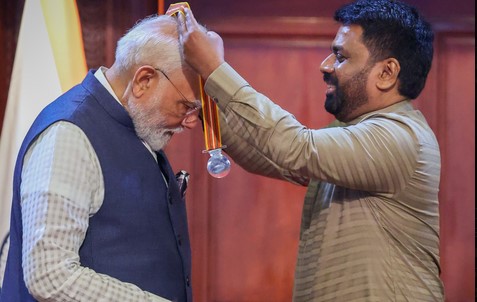
In a personal tribute to Modi, Dissanayake said, “I am pleased to announce that the Government of Sri Lanka has decided to confer upon Prime Minister Shri Narendra Modi the highest Sri Lankan honor, the ‘Sri Lanka Mitra Vibhushana,’ as a symbol of the enduring friendship and unwavering, multifaceted support that he has consistently extended to Sri Lanka and its people.”
Touchy Issues Raised but Gently
Dissanayake touched on touchy issues too, but gently. On the issue of Tamil Nadu fishermen poaching in North Sri Lanka waters, Dissanayake drew Modi’s attention to the “serious environmental damage caused by bottom trawling, a prohibited practice in both our countries.”
He also sought India’s help to enable Sri Lanka secure its share of the Continental Shelf.
But being an astute politician, Dissanayake avoided mentioning the Tamil minority’s demand for devolution of power under the 13 th. Amendment of the constitution, a demand that is stoutly opposed by JVP’s main political constituency, the Sinhalese majority in South Sri Lanka.
Modi, however, took up the devolution issue as it is a part of the 1987 India-Sri Lanka Accord. He urged Dissanayake to implement the 13 th., Amendment and hold Provincial Council elections.
Why the Shift?
After a failed 1971 uprising, which was but a putsch, the JVP turned to electoral politics, only to realize that rigid ideology would not win votes. Alliances—like the 2004 partnership with the United Peoples Freedom Alliance, yielded 39 seats. But going it alone got it only 3.84% voter support in 2020.
In 2019, the JVP rebranded itself as the National People’s Power (NPP), a broad coalition of 21 left-leaning and liberal groups, softening its image to appeal beyond its left radical base.
The JVP realised that it could not any longer turn a blind eye to the effects of economic liberalization of 1978 on Sri Lankan society, values and politics.
The 2022-23 economic crisis—marked by a default on foreign loans—further forced a new reckoning on JVP. India’s US$ 4.5 billion bailout underscored the folly of blind hostility to the neighbour.
Public despair with corruption-ridden governments for decades, created a demand for a new force. And Dissanayake was seen as a Camelot. He was voted to power by a cross section of Sri Lankans. India too shed its old inhibitions and held out a hand of friendship to the JVP.
END
