

By P. K. Balachandran/Sunday Observer
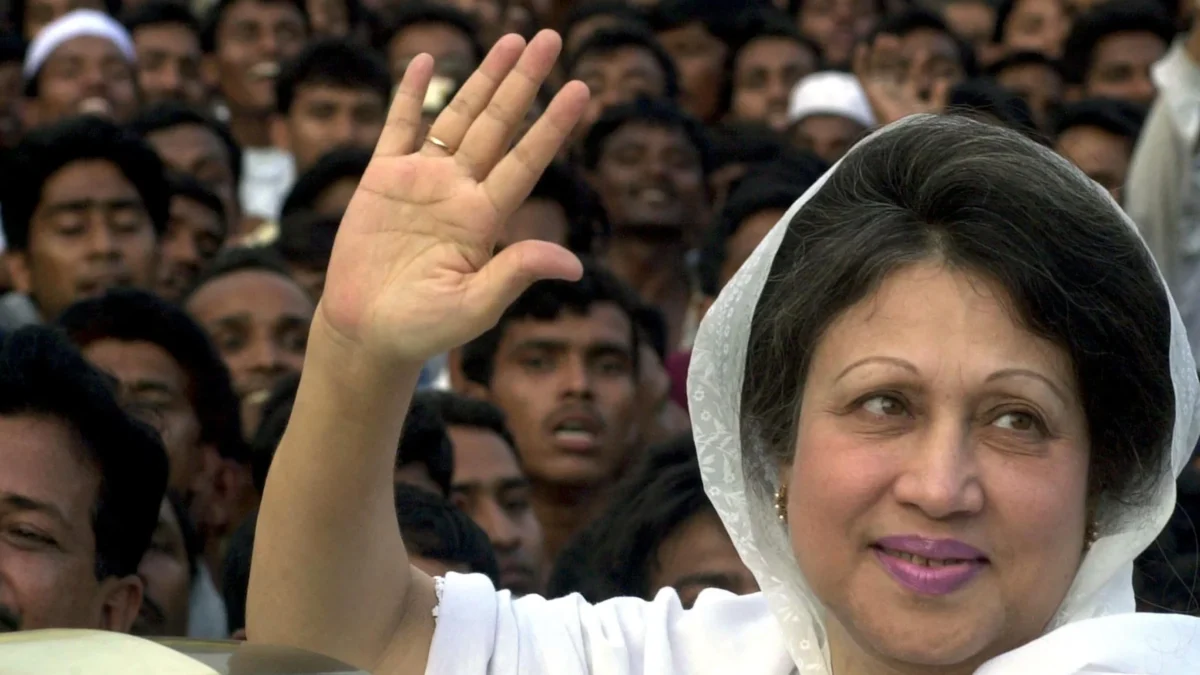
Colombo, January 4 – Bangladeshi leader, Begum Khaleda Zia, who died of multiple illnesses in Dhaka on Tuesday at the age of 80, had a packed 44-year political career marked by both achievements and controversies.
But there is no gainsaying that she was a fierce nationalist and a valiant fighter for democracy, who brought about key constitutional changes, educational and economic reforms, and foreign policy initiatives.
Wife of army officer turned Bangladesh President, Gen. Ziaur Rahman, Khaleda was a home maker till 1982, when she was suddenly thrown into the whirlpool of politics following the assassination of her husband by a bunch of disgruntled army officers in May 1981.
Instead of withdrawing into the shell of widowhood, and undeterred by the lack of political experience, Khaleda plunged into the task of restoring the morale of the Bangladesh Nationalist Party (BNP) founded by her husband.
Khaleda joined the BNP as a primary member in January, 1982. When the then military dictator H.M Ershad imposed Martial Law on 24 March, Khaleda hit the streets. Draped in the black veil of mourning, she became a symbol of resistance to dictatorship.
In 1983, under her leadership, a seven-party alliance was formed to resist Ershad. As a result of her uncompromising stance she was in jail in 1983, 1984, and 1987. For years, she was confined to her residence.
Because of the historic mass uprising of 1990, in which Khaleda collaborated with Sheikh Hasina of the Awami League, Ershad was forced to relinquish power on December 6, 1990.
In the 1991 parliamentary elections, the BNP won a majority. Contesting from five constituencies, Khaleda Zia won all. She then went on to become Bangladesh’s first female prime minister. In her First Term (1991–1996) she instituted the transition from a Presidential to the parliamentary system of democracy. On September 19, 1991, she signed the 12th Amendment Bill, which restored the parliamentary system of government in the country.
There were two general elections in 1996: one in February and another in June. The BNP won the February election overwhelmingly, securing around 278 seats out of 300 in parliament. However, the election was heavily boycotted by major opposition parties, including the Awami League, due to allegations of bias under her incumbent government, resulting in a voter turnout of only about 21%. This led to widespread protests, strikes, and a non-cooperation campaign by the opposition demanding her resignation and fresh polls under neutral oversight.
Facing intense pressure Khaleda resigned on March 30, 1996, just weeks after being sworn in, to pave the way for a Caretaker Government and new elections. Before dissolving parliament, Khaleda got a constitutional amendment to establish the non-partisan Caretaker Government for future elections.
The subsequent June 1996 election was the first to be overseen by a Caretaker Ggovernment. It led to a victory for the Awami League under Sheikh Hasina.
In 2001, Khaleda led the four-party alliance in the eighth national parliamentary elections. Her alliance won a two-thirds majority. The BNP alone secured 193 seats, while the alliance collectively won 216 seats. On 10 October, 2001, she took oath as Prime Minister for the third time. This time, she completed a full five-year term in office and handed over power on 29 October, 2006 to a Caretaker Government.
In 2007, during the military-backed Caretaker Government period, Khaleda was arrested again. There was also a move to exile both Khaleda Zia and Sheikh Hasina from politics. But Khaleda refused to go abroad. She remained in prison till she was released in 2008.
The Awami League led by Sheikh Hasina returned to power in 2009, but only to unleash repression on the BNP. Multiple cases were foisted on Khaleda. In 2018, in the Zia Orphanage Trust case and other cases, she was sentenced to 17 years in prison.
Falling ill in prison, Khaleda repeatedly sought permission to go abroad for treatment, but the Hasina government denied it. She was not even allowed to seek care in private hospitals within the country. Her health steadily deteriorated. Finally, in 2020, during the Covid-19 pandemic, the government suspended her sentence by executive order and released her on the condition that she should not engage in politics nor travel abroad.
On 5 August, 2024, after the fall of the Awami League government, Khaleda was acquitted of all cases in court. From that day, she was a free woman, though by then her health had severely declined.
Achievements Over Three Terms
During her three terms as PM, Khaleda championed free-market reforms, girls’ education, free primary education, and achieved food self-sufficiency. Leftists and the Awami League criticised her pro-business policies, though public sector undertakings had failed to deliver.
Under Khaleda, Bangladesh entered the era of satellite cable networks in 1992. Using new technologies, Bangladesh Television (BTV) began broadcasting programmes from internationally renowned channels like CNN and BBC. But leftists and Islamists slammed her for these foreign intrusions. Her government faced criticism for the rise in Islamic militancy and the grenade attack on opposition leader Sheikh Hasina.
Khaleda had taken a controversial decision – to align with Islamist groups like the Jamaat-e-Islami to consolidate her power. But the alliance with the anti-India Jamaat strained relations with India
Relations with India
According to observers, Khaleda adopted an adversarial posture towards New Delhi, a stance that shaped bilateral ties for over a decade. She consistently opposed the overland transit and connectivity initiatives proposed by India. She argued that such arrangements would compromise Bangladesh’s security and sovereignty. She went further to claim that toll-free movement of Indian trucks on Bangladeshi roads amounted to “slavery”.
Her resistance also extended to diplomatic agreements. Khaleda opposed the renewal of the 1972 Indo-Bangladesh Friendship Treaty, widely regarded by strategic experts as significant from a military standpoint. She argued the treaty had “shackled” Bangladesh and constrained its independence.
Positioning her Bangladesh Nationalist Party (BNP) as a “protector of Bangladesh’s interests”, she often framed her policies as a defence against what she described as Indian domination. This rhetoric was evident even years later. At a rally in Dhaka in 2018, when Sheikh Hasina was Prime Minister, and she was Leader of the Opposition, Khaleda criticised Hasina for exempting India from paying transit duties.
Another major source of friction during Khaleda’s tenure was India’s Farakka Barrage, operational since 1975 to divert water from the Ganges into the Hooghly River through a feeder canal. While the barrage helps reduce silt, improves navigability around Kolkata Port and supplies fresh water to the city, she maintained that it deprived Bangladesh of its rightful share of Ganges water. In 2007, she accused India of deliberately opening sluice gates to aggravate flooding in Bangladesh.
In 2002, Khaleda actively pursued defence cooperation with China. India viewed this as a direct strategic challenge and responded by increasing diplomatic pressure. Delhi accused the BNP government of sheltering separatist groups and terrorists operating in India’s northeastern states. Khaleda had earlier described insurgent outfits in Assam and Nagaland as “freedom fighters”.
India alleged that anti-India terror groups operated freely from Bangladeshi soil. The 2004 Chittagong arms haul, intended for Indian insurgents, minority violence within Bangladesh, and the near-total absence of cooperation on counter-terrorism further strained relations.
However, Khaleda’s stance towards India showed signs of evolution after 2012, when she visited Delhi to meet the then Prime Minister Manmohan Singh. During the visit, she pledged that any future BNP government would act against terrorist groups using Bangladeshi soil to target India. The visit, undertaken at India’s invitation, was widely interpreted as a strategic shift in BNP thinking ahead of the 2014 elections.
That outreach continued after 2014, including meetings with Prime Minister Narendra Modi. PM Modi met Khaleda in Dhaka in June 2015 during his visit to Bangladesh, when she was serving as Leader of the Opposition.
Despite these engagements, underlying tensions persisted. Between 2016 and 2024, Khaleda repeatedly returned to anti-India rhetoric, accusing New Delhi of backing Sheikh Hasina’s authoritarianism and drawing attention to unresolved issues such as border killings.
A noticeable thaw emerged after August 2024, following Sheikh Hasina’s ouster, when the BNP signalled a commitment to “equal and respectful” relations with India and distanced itself from the Islamist Jamaat-e-Islami. With her son, Tarique Rahman, now heading the BNP, India-BNP relations have changed for the better.
Indian PM Mourns
Significantly, Indian Prime Minister Narendra Modi on Tuesday recalled Khaleda’s contributions to the India-Bangladesh relations in the past. Modi said he was “deeply saddened” to have learnt of her passing.
Taking to X, PM Modi wrote: “Deeply saddened to learn about the passing away of former Prime Minister and BNP Chairperson Begum Khaleda Zia in Dhaka. Our sincerest condolences to her family and all the people of Bangladesh. May the Almighty grant her family the fortitude to bear this tragic loss.” He also acknowledged Khaleda Zia’s role in fostering the India-Bangladesh diplomatic ties and said that her “important contributions” would always be remembered.
“We hope that her vision and legacy will continue to guide our partnership. May her soul rest in peace,” PM Modi wrote.
END
Bangladesh, Khaleda Zia, Democracy, Natinalism, Changing relations with India,
