
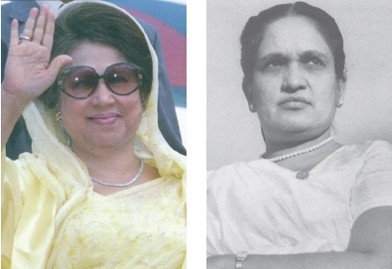

By P. K. Balachandran/Counterpoint.lk
Colombo, December 31 – The Bangladeshi leader Khaleda Zia, who died of multiple illnesses in Dhaka on Tuesday at the age of 80, was akin to Sri Lanka’s leader Sirimavo Bandaranaike.
Both women came from similar backgrounds and were pitchforked into power by the hand of fate. But when ensconced in office, they proved to be very effective and innovative both on the national and international front. They were resolute defenders of their countries’ interests when confronted by foreign powers. Both became Prime Minister three times.
Khaleda and Sirima (short for Sirimavo) brought about key constitutional, educational and economic reforms. Both were persecuted by those in power, Khaleda Zia much more than Sirima. While Khaleda was imprisoned multiple times, Sirima was denied her civic rights.
Neither Khaleda nor Sirima had attended university. They were housewives with no political involvement prior to their entry into politics. They were married to national heroes, Khaleda to President Ziaur Rahman who fired the first shot in the armed revolt against Pakistan and declared the independence of Bangladesh in March 1971. Sirima was married to SWRD Bandaranaike, an iconic anti-British nationalist who removed British military bases from the island, then known as Ceylon.
Both Khaleda and Sirima were thrust into politics after their husbands were assassinated by elements who they themselves created – militant Buddhists in the case of SWRD Bandaranaike and a rebellious junior army officers, in the case Ziaur Rahman.
Instead of withdrawing into the shell of widowhood, and undeterred by the lack of political experience, Khaleda and Sirima plunged into the hurly burly of their countries’ violence-prone politics with gusto. Khaleda led the Bangladesh Nationalist Party (BNP) and Sirima, the Sri Lanka Freedom Party (SLFP), with panache, both parties founded by their late husbands.
While Sirima smoothly inherited the Prime Ministership from her husband SWARD Bandaranaike and became the world’s first woman Prime Minister, Khaleda had a rougher passage. She had to lead a mass movement to overthrow the incumbent, military dictator Gen. H.M.Ershad. When Ershad imposed Martial Law on 24 March, Khaleda hit the streets draped in the black veil of mourning. She became a symbol of resistance. As a result of her uncompromising stance against dictatorship, she was jailed in 1983, 1984, and 1987.
Because of the historic mass uprising of 1990, in which Khaleda collaborated with Sheikh Hasina of the Awami League, Ershad was forced to relinquish power on December 6, 1990. In the 1991 parliamentary elections, her Bangladesh Nationalist Party (BNP) won a majority. Contesting from five constituencies, Khaleda Zia won all. She become Bangladesh’s first female Prime Minister.
Khalida’s Achievements
In her First Term (1991–1996) Khaleda instituted the transition from a Presidential to the parliamentary system of democracy. On September 19, 1991, she signed the 12th Amendment Bill, which restored the parliamentary system of government in the country.
During her three terms as PM, Khaleda championed free-market reforms, girls’ education, free primary education, and achieved food self-sufficiency. But her government faced criticism for the rise in Islamic militancy which was attributed to her opportunistic alliance with the Jamat-e-Islami. There was a grenade attack on opposition leader Sheikh Hasina which nearly killed her.
Sirima’s Achievements
In contrast to Khaleda’s free-market reforms, Sirimavo implemented a series of socialist-oriented economic policies, primarily during her second term (1970–1977), which aimed to increase State control over the economy and reduce wealth inequality. Her governments pursued extensive nationalization, transferring private sector assets into public ownership. She nationalized the banking and insurance sectors, creating institutions like the People’s Bank to provide services to unbanked communities and spur local development.
Industries, foreign trade, and media organizations were also nationalized. The Business Undertaking Acquisition Act of 1970 allowed the state to nationalize any business with more than 100 employees. The Ceylon Petroleum Corporation was established to bypass monopolistic oil pricing and import oil from non-Western nations, leading to the nationalization of all oil distribution and supply in 1964.
Bandaranaike’s administration implemented significant land reforms to break up large estates and redistribute land to the landless. The Land Reform Act of 1972 imposed a ceiling of 20 hectares on privately owned land. The Land Reform (Amendment) Act of 1975 further targeted large plantations owned by public companies for nationalization.
The State became the largest plantation owner, though these reforms were criticized for disrupting agricultural productivity of key export crops like tea and rubber.
Her policies aimed to reduce socio-economic disparities, but often led to economic stagnation, high unemployment, and inflation. She famously promised and provided a subsidized weekly rice ration to households. However, the inability to consistently import sufficient rice often led to austerity measures and cuts in subsidies, causing public discontent.
Khalida’s Relations with India
Khaleda adopted an adversarial posture towards New Delhi. She consistently opposed the overland transit and connectivity initiatives proposed by India. She argued that such arrangements would compromise Bangladesh’s security and sovereignty.
Khaleda opposed the renewal of the 1972 Indo-Bangladesh Friendship Treaty, arguing that the treaty had “shackled” Bangladesh. Positioning her Bangladesh Nationalist Party (BNP) as a “protector of Bangladesh’s interests”, she often framed her policies as a defence against “Indian domination.”
Another major source of friction during Khaleda’s tenure was India’s Farakka Barrage, operational since 1975 to divert water from the Ganges into the Hooghly River through a feeder canal. She maintained that it deprived Bangladesh of its rightful share of Ganges water. In 2007, she accused India of deliberately opening sluice gates to aggravate flooding in Bangladesh.
In 2002, Khaleda actively pursued defence cooperation with China, India’s rival. India accused the BNP government of sheltering separatist groups and terrorists operating in India’s northeastern states. Khaleda had earlier described insurgent outfits in Assam and Nagaland as “freedom fighters”.
However, in 2012, when she visited Delhi to meet the then Prime Minister Manmohan Singh, there was change. During the visit, she pledged that any future BNP government would act against terrorist groups using Bangladeshi soil to target India. But killing of Bangladeshis on the border by Indian police to control infiltration, embittered Khaleda.
Her outreach continued after 2014, including meetings with Prime Minister Narendra Modi. Modi met Khaleda in Dhaka in June 2015 during his visit to Bangladesh, when she was Leader of the Opposition.
A noticeable thaw emerged after August 2024, following the ouster of the pro-Indian Prime Minister Sheikh Hasina’s ouster. The BNP, now under her son Tarique Rahman, signalled a commitment to “equal and respectful” relations with India and distanced itself from the anti-India and Islamist Jamaat-e-Islami. India-BNP relations have changed for the better.
In a further sign of improvement, on Khalida’s death on Tuesday, Indian Prime Minister Modi recalled Khaleda’s contributions to the India-Bangladesh relations in the past. Modi said he was “deeply saddened” to have learnt of her passing.
Taking to X, PM Modi wrote: “Deeply saddened to learn about the passing away of former Prime Minister and BNP Chairperson Begum Khaleda Zia in Dhaka. Our sincerest condolences to her family and all the people of Bangladesh. May the Almighty grant her family the fortitude to bear this tragic loss.” He also acknowledged Khaleda Zia’s role in fostering the India-Bangladesh diplomatic ties and said that her “important contributions” would always be remembered. We hope that her vision and legacy will continue to guide our partnership. May her soul rest in peace.”
Sirima’s Foreign Policy
As a key leader in the Non-Aligned Movement, Sirima secured aid, trade deals (such as concessionary oil from Iraq), and loans from a variety of countries across the political spectrum, including China, the Soviet Union, and Britain, while maintaining neutrality during the Cold War.
She did not take sides when India and China fought a war in 1962 though India’s junior minister for External Affairs Lakshmi Menon visited Colombo several times to sway Sirima to India’s side. And during the 1971 India-Pakistan war over Bangladesh, Sirima allowed Pakistani military planes to refuel in Colombo.
She confronted India head-on over the Kachchatiovu island issue and secured it for Sri Lanka. She also partially solved the Indian plantation labour issue by making India take back several hundred thousand Indian origin workers
But despite all the tension, both Khaleda and Sirima developed good ties with India by the end of their political careers.
END
