

By Christopher M. Schroeder/Subtrack
I went to China last month for the first time in six years. I was there at the invitation of a fascinating group that includes CEOs from China and America to meet in Beijing. But this was also an excuse to get back on the ground and look around, and delve into the culture, tech shifts, history and people of this astounding culture(s).
It is inherent in my nature that when conventional wisdom blows unified in one direction to seek what other winds may be out there. The winds toward China – certainly in Washington and Silicon Valley – have unified as a gale force. It is the one truly bi-partisan issue in the former, and activity there has shrunk to near insignificance (perhaps outside of outsourcing) in the latter.
I tried to park two biases on this visit, one going over and one coming back.
The bias arriving was to avoid putting every meeting and observation into the framework of who is winning or losing. Similarly, on the return, I wanted to avoid the “game over” meme that executives often spin up from a recent visit. In fact, as I landed The Telegraph reported that American executives that were there when I was returned “terrified.”
As the Zen proverb says, “If you want to get hold of what it looks like, do not be anti or pro anything.” My goal was to carefully watch and listen without trying to fit experiences into a pre-determined framework.
I met with CEOs, investors, writers, tech executives and workers, and policy/academic advisors. I listened carefully to DiDi drivers through translation apps and staff at hotels and restaurants. I met a dozen young parents navigating the shoals of their kid’s futures. I spoke with students themselves. I did the traditional Beijing/Shanghai run but wanted to see second tier cities and had deeply rich conversations in Xi’an and Nanjing.
While barely scratching the surface, what I experienced was strikingly consistent and fascinating. Here is what I saw –
Six Years is a Lifetime
Six years ago was the 75th anniversary of the nation’s founding, a few months before Covid and GPT was on no one’s radar. Most economic indicators were up and to the right, and there was a palpable buzz in the streets of China’s place in the world. The hotel lobbies, restaurants and streets had many westerners still seeking opportunity even considering a decade or more of rising obstacles. The market remained just too big and was growing, 6% reported that year.
The most visible change was how few Americans and westerners I saw in any city. Even at heavily touristed sites like the Terracotta Warriors, I was one of seven from the West in a sea of tourists, and the only American. Of westerners I saw more broadly, Russians were the plurality. More traffic, subway, and restaurant signs appeared in English but I was surprised even in service areas how little fluent English was spoken. I needed a translation app in two excellent hotels at the front desks. One general manager told me that US travel was down 50% after Covid and has been 50% lower since then.
The economy was described to a person – to a person – as “shit,” “horrible” and “sucks” and there was a heaviness to most conversations on current prospects. I visited many shopping malls, lowly trafficked but for the restaurants, though I was reminded repeatedly that everyone shops now online for everything.
American and western luxury brands, especially in wealthy areas in places like Shanghai were frequently and beautifully marketed. But other than iPhones, when I asked people what American brands they now cherished, few came up with the exception of celebrities like Taylor Swift (though in the same breath as K-Pop) and an occasional NBA star. American and European car designs were repeatedly described as “old” or “dated.”
Coke products, once a staple here, are being increasingly replaced by Chinese healthy, tasty, energy brands like Chi Forest. With billions in revenue in China and extensive expansion in the region – over 40,000 retail locations in Indonesia and roll out across Japan, Korea, Thailand and Singapore – they just announced a deal for almost 600 Costco locations in the States.
I asked many people upon what they believed Europe most competes on in the 21st century and heard repeatedly some version of “high end luxury brands and museums.”
A Tale of Two (and Familiar) Economic Cities
It was the best of times, it was the worst of times, it was the age of wisdom, it was the age of foolishness, it was the epoch of belief, it was the epoch of incredulity, it was the season of light, it was the season of darkness, it was the spring of hope, it was the winter of despair.” — Charles Dickens, A Tale of Two Cities
Conversations on the economy had surprisingly resonant themes back here at home, divided clearly between significantly wealthy and tech worlds and everyone else. The bet in both countries is the former will unleash and not weigh down the latter.
The tech worlds – robotics, AI, deep tech in particular – could not be more ebullient. I was reminded repeatedly, as Nvidia’s Jensen Huang says publicly every chance he can, that in market size, innovation and sheer numbers of engineering talent and capital, China is already at or near toe-to-toe with America. Technology is ever more embedded in all aspects of daily life, cash is truly all but gone now, and products from EVs, solar panels, consumer transactions, banking, AI applications, energy tech and more are ubiquitous.
At the same time, unemployment of young people in their twenties is likely 25% or greater and I am told many are no longer looking and living at home. For a country that seeks greater consumption, most indicators suggest people are feeling the pinch and spending much less.
Real estate prices in most cities are down at least 30% both residential and commercial. This chart on office occupancy, if even directionally true, should give anyone pause:
I asked several real estate investors if a drop from a possible bubble told me much about economic weakness and was told: “It matters a lot. Real estate represents nearly 30% of the GDP. In China, real estate is like the bank where most people save for their futures. We still are not out of the debt crises of massive real estate developers and the collapse of massive players like Evergrande.”
I heard repeated stories, especially in third and fourth tier cities of extensive foreclosures. Few investors felt they had reached a bottom to invest significantly, though a few deals have been made. And at the highest end, new, world class multi-use buildings continue to find buyers. An executive once with Otis told me there will be economic opportunity in refurbishment of all buildings and infrastructure. Apparently over one million buildings that should have an elevator do not.
Manufacturing overcapacity, requiring at least in the short and medium term extensive exports, weighs heavily. And the conversation has taken on compounding meaning in an era of unpredictable American tariffs and Europe thinking twice about Chinese EVs and reliance on Chinese manufacturing and markets.
Most of the people I met conceded that overcapacity is troubling, especially in sectors like EVs. They hope over time with rising economic potential and better demographics of young populations across Latin America, South East Asia, The Middle East and Africa will be part of the answer.
Many Americans think Chinese are fantasizing that the global south – a term I hate in its over generalization of highly diverse countries and locales – will have a material impact on their issues of exports, debt, demographics and more. One analyst told me total Chinese trade with these markets may be over $2.5 trillion. But there isn’t close to the additional demand China needs to absorb existing excess capacity.
At least in the short term.
It was clear to me that China believes they can help accelerate economic growth in these markets because that is what they did over time in China only a few decades ago. Most Americans at the time never fathomed the scale and speed of the rise of the middle class there, and China sees this happening widely. If Nigeria gets even half their performance a decade from now…
I also have learned in my travels more broadly that we often underestimate that China, as a former emerging market, speaks the language of the complexity of growth in new markets better than the West. They understand their unique challenges and how to address them.
China, of course, has its own hubris and while rising markets may embrace it in many ways they have also learned – with examples like European over-reliance on Russian oil; the world on Taiwan chips; the world on rare earths – that dependence is a bad thing. China in “rare” earths has 60-70% of the extraction and 95% of chemical separation with heavy requirements in energy, water and chemicals. All with leading tech.
The issue for most countries is not about “choosing” in a Cold War sense as between the US and China but rather hedging by distributing risk more broadly. That’s a balance of US, Europe and China but also within rising markets. It is a world of greater choice from India, the Gulf, Latin America, Africa and more.
More interestingly, when I raised overproduction of solar panels, I was told to visit the western part of the country. “You will see solar panels to the horizon, and the best in wind technology. Never has it been easier to move electricity anywhere more affordably. So not only is over capacity being absorbed here, but it is contributing to China being the most efficient and cost-effective producer of electricity anywhere.”
The scale is hard to identify in the data and many reports suggest the West has been better on emissions performance than China. Xi’an I was told is still 85% coal, but with some of the cleanest capabilities and that number will drop in coming years.
But as demand for power will only increase due to AI and other technologies, China believes it has both a strategy and advantage. Already, through subsidies but also operational efficiency and latest technology, the cost of electricity can be much cheaper – half than the West and rapidly decreasing. As the Financial Times noted, one of the key advantages the country has in catching up and excelling in AI and chips is its energy strategy.
As Germany shuts off its last nuclear reactor, China has 58 operable reactors, 33 under construction and 43 planned. It has technological breakthroughs enabling these capabilities, and some of the leading innovation in SMR’s is there. The west has something to learn here, and energy potential is indicative of their fundamental potential economic strength now and over time.
My friend Jens Eskelund of both Maersk and President of the European Chamber of Commerce sits on a LOT of data and has been on the ground in China for three decades. He reminded me that for all China’s economic troubles without China world growth is about zero. Global exports in container terms were up 9% last year. It would have been zero without China. This year, to Europe up almost 10% while Europe to China by the way is down 8%. Global trade with the US is down in both directions but not that consequential as the numbers remain large. “This is NOT some era of deglobalization.”
He also instructed me that the real story is in the containers. “In 2019 China had 31.9% of all export containers; in 2024 36.2%; three weeks ago over 37% – they have had an increase of 1% of global market every year for five years.”
Another friend told me that Chinese debt has risen from 100% of GDP to 300% in recent years – “a kind of their own massive QE of sorts” – and that is hard to sustain. I forgot to ask him what that means for America that, including personal debt, is in or around 700%.
You Say You Want an Involution?
“Involution means basically the internal elaboration and rigidification of a basic pattern, rather than a change from one pattern to another.” — Clifford Geertz in Agricultural Involution: The Processes of Ecological Change in Indonesia
One of the best books of many on China I read in preparation for this trip was a best seller just translated into English last month, “I Deliver Parcels in Beijing” by Hu An Yan. Started as a blog, the author tells the journey of working in multiple enterprises in the gig economy in China from delivery to ecommerce warehouses. It is an eye-opening look at China from the ground, and the work demands there. It is at the same time very funny and also poignant as he explores his own attitude to work, value in society, whether to work hard as in “996” or seek life balance.
It is an excellent primer to an aspect of Neijuan or “involution” in China – a significant reassessment of the hyper competition, long work hours, cultural and life demands that has both fuelled much of Chinese success but also a rising sense of hopelessness and questioning. Many in China have argued that the hyper brutal Darwinian competition in each sector – multiple competitors pushing each other to innovate, increase efficiency, and lower cost – is driving a “rush to the bottom.”
My sense is aligned with one of my favorite analysts of China, Yanmei Xie currently with MERICS who argues thoughtfully that this competition is at the heart of China’s ability to take on or crush global competition. She notes: “China now makes 55 percent of the world’s steel, 57 percent of commercial vessels, 76 percent of lithium-ion batteries, more than 60 percent of EVs, and 80 percent of photovoltaic products, despite chronic involution gripping these sectors. This manufacturing prowess means Beijing has little incentive to overhaul its system of economic governance beyond periodically pruning the excess of state-directed investment.”
One of the most compelling arguments for the strength of this competition I heard many times, especially from executives, is that China is in a “period of testing our historic resilience.” They note that the recent hyper growth years spawned many bubbles and challenges and getting back to first principles is essential for the long run. They note, in fact, resilience is deep in the culture of China for centuries.
They believe that not only are they emerging with the greatest technology driven innovation and industrial base at the lowest cost, but that this could be a ten-to-15-year journey, something the West and particularly America is less willing to accept in terms of more short-term political incentive. One executive looked over my shoulder, “whatever challenges we face, we have seen SOOO much worse.”
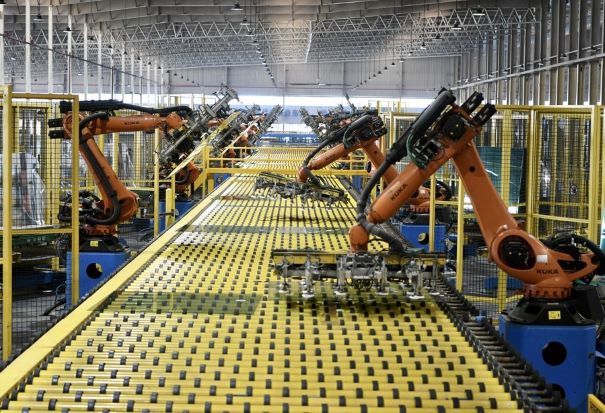
I saw an example of this visiting a Xiaomi automotive plant, a massive, fully integrated facility of over 720,000 square meters and over $9 billion in investment. It is heavily autonomous to the tune of over 90% – not one of the fabled “dark factories” without any workers at all, but significantly greater than Tesla’s there at about 65%.
They can assemble a car – and I timed this – in 20 seconds, spitting out the final product every 76 seconds. There are over 407 robots in the body shop, interestingly many manufactured in Japan, and offer a wide range of beautifully designed cars across many price points starting at $30,000. There is no overcapacity here. Despite the economy, there is a two-year waiting list. Apparently some people when they buy them resell them instantly for a 30%+ margin. One could pretty much eat off the floors. I was reminded by experts that these capabilities “are dwarfed by BYD.”
Tik Tok videos have recently shown car batteries blowing up and this was greeted with a shrug. “We won’t be saying that shortly.” One investor told me, “In the end these companies are truly battery and energy companies, and the structural, technological and cost advantages are China’s.”
I was also greeted with a shrug when I asked how European car manufacturers were going to be able to compete with what I’m seeing. One auto exec told me that Mercedes had effectively handed a plant over to them to refurbish and, again, shrugged. “No one has made an argument of how this is not game over for the US and the West except that they will keep our products out. But Japan and Korea will be better also. Will they keep them out over time?”
As I wrote here, one of my greatest takeaways visiting TSMC in Taiwan last year was the importance of the ecosystem of world class providers of the supply chain. One of the greatest challenges in their launch of a facility in Arizona was that there was little ecosystem as there had not been a need for these players when everything was supplied by Taiwan. Literally they had to ship chemicals from Taiwan to Arizona because they didn’t exist there. They also had to ship back the chemicals’ waste because there were no operators to process it.
What has been so striking to me is the extent of ecosystem building around the core, scaled products and services in China. I had a beer with the head of a large chemical maker there who underscored just this in the progress China is making around AI chips. “There is so much opportunity in supply chain management here, but even here the competition is brutal.” A VC told me that the ecosystem for robotics – the full stack nature of the operations themselves – are “without parallel certainly outside of the United States.” And he reminded me that a strong ecosystem not only creates synergies and competitive costs – it helps ensure that China need not rely on anything or anyone.
Rui Ma of Tech Buzz China is a very thoughtful analyst on the innovation and startup scene in China. Her recent trip notes aligned with mine. The speed and scale across cities, the increasingly greater connection and integration between software and hardware, the common use of AI and integration of both foreign and domestic chips are remarkable. Ali Baba, Baidu and others have been in chips for some time, are able to scale significantly if even lower quality than America and believe catching up sufficiently is a matter of time if conceding it will be “a long way to go.”
Many investors told me that the quality of entrepreneurs has never been better for a very specific reason. Historically, great entrepreneurs were often launched by their experiences in a previous scaled success. For years in America, it was called the “PayPal Effect” as so many successful entrepreneurs like Elon Musk, Reid Hoffman, Max Levchin and others spun out from that learning. Across the globe I’ve seen similar instances from Mercado Libre, Nubank, Careem, Grab and more. But now in China people describe the “AI Effect” among a new, AI-first generation. They join DeepSeek or other AI enterprise for six months or so, learn and leave to do their own startup.
A significant question in America’s assessment of AI in China is that they are willing to access massive data sets that so far we will not due to concerns ranging from privacy to sensitivity using genetic and health data. It became clear to me that we must be candid and blunt on the trade offs where China can excel, accelerate and compete globally in crucial sectors from national and domestic security to drug discovery and health services with this data.
A Different New Generation Coming
“Unique and different is the new generation of beautiful… You don’t have to be like everybody else. In fact, I don’t think you should.” – Taylor Swift
I had dinner one night with millennial CEO’s and founders and to a person lit up on a subject debated similarly in their circles in America: Gen Z. “We never thought we were that different, but we are. They drive me crazy. They want to come to work at 11:00 and leave at 5:00. I can’t give them feedback without telling them how wonderful they are. What the hell?”
I also, however, mostly met astounding twenty-somethings willing to work all hours and dedicate themselves to a mission. But in exchange they wanted a sense of purpose – in what they are doing overall but also to be explained why things are as they are in a given task.
Many told me, especially women, that they had no interest in marriage but wanted to focus on building their careers and making changes where they can mocking their parent’s vision of being “left over” if not soon married.
They talk openly about their personal challenges, not a few about how important their life coaches and counselors are. “Stigma is still enormous in mental health in China,” one entrepreneur building a platform for families to find counselors for their children, “but technology is making it more accessible and private.” One executive told me that in many larger schools there may be one counsellor for 1,000 students and AI offers real hope where estimates suggest 20% are suffering from depression. It took me ten minutes talking with one founder before I realized that her “counselor” was actually a co-authorship between a human and GPT. “I can’t get more than 50 minutes with her a week, but GPT doesn’t charge me at 2:00 AM and is very good.”
The significant and aging demographic problem was discussed with me often and without pause. One education expert noted that schools, even private schools, are having trouble filling a class. One told me that even a private school with a capacity of 250 students has 45. The answers are limited.
Some optimists suggest robotics will fill the employment need without taking on the risk of migration required and problematic in many countries in the West. But overall, this is a significant issue without a clear solution, especially with a new generation prioritizing marriage and kids less.
Six years ago, nearly every family I met hoped their kids would go at least for a time to an American university. I heard some of this among students, but much less of this from parents now, in part because of the changes in visa policy but also a questioning of what the return will be. “It’s not clear to me anymore,” said one father, “what $500,000 for four years in America really will return in this changing world.”
And many parents express an anxiety often heard in the States about what skills their kids should build, what paths they should pursue, in a world of AI and hypercompetition. “How much stability or growth in sectors and traditional jobs have in the future? Banking and consulting would mean much less. Is it better to be “influential” as part of the resume? Are we really betting on the company or just multiple jobs in the right sector?”
There are two phenomena that might be very instructive to what may be brewing bottom up in China that will come of age when many of our current presumptions may differ wildly. The first ties to the young generation asking questions. I saw this not only in Gen Z, but parents often described how their younger kids don’t do what they did – pretty much take what a parent and teacher says at face value – but push for understanding and explanation. One parent told me admiringly, “they dare to doubt.”
This, for me, may be a sign of independence and critical thinking not in a political sense but in a sense of agency and potential for creative problem-solving. Americans don’t fully appreciate this if they have not recently travelled to China. One night in Shanghai, I was taken to a large area of clubs and restaurants for young people and was struck by how everyone had their own fashion style, very individual, very much a stance of conviction.
The second is I had the opportunity to meet some senior government leaders at the local and city level. These – in their thirties and forties still but still a new generation – to a person adhered to protocol and political reality. But once the formalities were done, I was struck by how open they were about their challenges, the technocratic and superb questions and innovation to find solutions. At some meetings where they could have easily left after the welcome, they stayed sometimes for hours and asked and probed. They wanted to get things right. They wanted to show where they have had success and learn to do better. They wanted results. They were strikingly humble.
I expressed this to a friend there, a well-regarded consultant in the intersection of tech, business and policy. He looked at me like I had two heads: “You Americans somehow think Chinese are all about rote learning and towing one line. It is a very rich and complex collection of societies, and the challenges require innovative and creative solutions from many places. This is a great strength. I’m from Hunan, and if you ever go there you will see immediately that no one is shy to tell you exactly what they think. This is part of a new playbook for China.”
How We View Each Other
“To know what you know and what you do not know, that is true knowledge.” – Confucius, The Analects
In all my travels, one of my favorite questions to ask is what they think Americans most misunderstand about their country; and what does their country most misunderstand about America.
I found most Chinese I was with, albeit often English speakers who often worked or studied in America, assume that China has a better handle on America than we do on them.
To a person they are confused as to why Americans assume that every engagement is zero-sum. I was told repeatedly that China’s first goal is always China, and its stability over time. One American expert told me they have a point. “In many ways they are the most clear and predictable adversary we have ever had. They see their interests in their terms, and too often we see them on how we wish it. Their global ambition is in service of greater independence from an existing order.” To which I heard repeatedly from the ground, “why should we accept blindly an order whose rules we played near no role in creating?”
I asked how creating another order – say with BRICS – excluding the West is not its own statement of aggression. The answers were never clear. One analyst there told me, “This is a counterweight to perceived American dominance – your ability to tell actors what to do. You are stuck in a Cold War mind set of wanting countries to be for or against us and if they choose to act in their own interests they risk being sanctioned by you.”
Another added that a real asset America once had was being the “predictable and stable” partner even with our perceived high-handedness, but now that is progressively China’s place in rising markets. “You think we go to emerging markets for cheap labour and resources – but labour will be less cheap in time, and as those economies grow their ability to spend only increases. We are there as their partners in that journey and meet them on their terms. We are still a rising market, so we speak a similar language. They will benefit from our high quality and affordable products, and here lies the longer-term solution to overcapacity.”
One Chinese investor told me that most executives are working under the assumption that US and European investment in China was on the path “of being gone.” China is in the process of adapting accordingly, which has compounded their efforts to partner with rising markets. There was particular and regular enthusiasm about the Middle East, especially the Gulf. As I wrote in a previous post, America, China and a World of Choice, Saudi and UAE leaders have told me repeatedly how solicitous, fast moving, customer service oriented Chinese partners are now, and always 30 percent cheaper or more. No surprise that apparently the massive UAE sovereign wealth fund has opened offices in China.
One investor told me, “Not everything is about you. It is about self-sufficiency. America has become energy self-sufficient for very sound reasons. We share those. We have all learned that putting too many eggs in any basket can be catastrophic.”
Another told me Americans think “central planning” in today’s China is the Soviet Union. “You miss the core of what is happening here. This is a fight against vulnerabilities. We know where we are behind, but that success is first and foremost about innovation by, for and within China.” Chips are exhibit A. “Your actions clarified for us the cost of over reliance on any one provider for anything. Reliance on others for core capabilities risks instability.”
I raised often the recent 60 Minutes episode about Chinese penetration in our rural electrical grid, or a report from Norway that China can remotely shut down the vehicles they manufactured, or IP theft more broadly. Responses varied and were predictable. They pushed back on American desire to keep them down or that it is normal that massive nations test each other – America bugged the phones of their allies, they noted – and these dynamics are real but addressable.
One friend there, very thoughtful and engaged in dialogue east and west, was subsequently more hardnosed. I shared with him my concern on how China has kept Russia’s economy afloat during the Ukraine War, how there are recent reports of China and the drug cartels. We watched together the 60 Minutes interview with Anduril founder Palmer Lucky on China’s military threat and autonomous weapons and how. He replied: “He’s not wrong.”
I was pushed provocatively about our allies. One said, “You certainly have “better” allies than we – you have NATO, and Latin America and more and we have Russia, Iran and North Korea. But what does it tell you that most of your allies have China as their number one or two trading partner?”
Many told me that America over indexes on internal restrictions within China, especially politically, and misses that for those trade-offs they can move much faster as a “leap frog” society that is open to loosening any restrictions that does not threaten political stability.
Equally interesting to me was answers to what China gets wrong about us and the answer was virtually always the same: “That America’s best days are behind it. That has been said repeatedly over the years, and your ability to self-correct is significant and your resources, market, technology and innovation still remain formidable.”
Others told me, “Especially in the tech worlds we underestimate how hard Americans work.” Another, “We believe these times call for resilience and that is a core strength in China – but too often we underestimate the resilience in the States.” One smiled at me and said, “We share some similar challenges in our societies today. In both China and America things are rarely as good or as bad as people think.”
Taiwan, Tech and “Winning”
“Here’s my strategy on the Cold War: We win, they lose.” — Ronald Reagan to Richard Allen, 1977.
Taiwan didn’t come up often, as it remains as it has for decades that elephant in the room people recognize is there but won’t say much new about it. Those who did discuss it were predictably reductionist and unsurprising – it is China already now, American policy has always acknowledged it, and actual integration is not a matter of whether but when.
What surprised me were two specific premises.
The first is that America would not accept casualties to fight that far away – “anyone who saw our military parade and yours, anyone who follows our advances in defence tech knows that China cannot be beaten,” one Chinese defence analyst said to me.
The second, and related, is that discussion of a Normandy-like invasion scenario while so focused upon by American military strategists is unlikely because integration will happen without a bullet being fired. Just over time.
To the first I noted that I’m not an expert in military engagement and would never speak for any government, but I might relook at the assumption. History shows that others have believed America won’t step in but when a national interest like oil is involved we repeatedly have. Chips are the 21st century oil. And not just for America but a swath of the world in the process of re-arming.
The second surprised me in the consistency with which I heard it. The scenario looks like this. The current ruling party in Taiwan, The Democratic Progressive Party (DPP) who most strongly pushes back on China, is in political trouble, likely to lose local elections later next year. The opponent, the Kuomintang (KMT) party has welcomed closer relationships with China, especially with its new party chair Cheng Li-wun.
Peaceful integration is simply inevitable with time. As one person said to me, “Taiwan is not a bird that is flying away. Any timing and integration strategy is ours, and certainly not set by any President in Washington.” Several senior business leaders enthusiastically and openly told me there is significant mutual economic opportunity in integration as soon as possible.
I wondered throughout this trip, as I have for some years in my travels, what and how America has leverage in the world over time and how leverage must evolve in a world of choice. A US tech executive long engaged with China said to me, “I think the risk in our leverage is simply decreasing politically and in business; that as China seeks self-reliance they will generally conclude they do not need anywhere as much as we think from us or even the West. And that may mean they simply are willing to take more pain than we in the short and medium term to the end of not just decoupling but moving strategically on parallel paths.”
By all means America cannot move fast enough in unleashing its innovation in the service of being competitive at home and abroad, and to have the strongest security capability both technologically but also knocking away any regulatory barriers to that end. As I wrote here, and stealing from the Romans, nothing assures peace better than being prepared for war and all the money and innovation in the world won’t serve us if we gum up our capabilities in looking back and ignore cumbersome regulation.
We can rage against the Gods of China subsidies and practices, we can argue ad nauseum about whether they are truly innovative and ten feet tall or weaker than they think, but in the end they are here and do what they do.
For me seven core questions seem essential – for business and policy – in any strategic consideration in a very new era. They are perhaps obvious but too often left in the abstract:
What does it mean to “win,” especially in AI, quantum and other rapidly rising tech? It is surprising how hard it is to get a clear answer from anyone in the public or private sector. For some it is a backward view of desiring American hegemony of the 1990s or increasing isolation and self reliance. For others it is about maintaining lead in key tech sectors. For others it is about boxing China out of technological infrastructure around the world. For China it appears to be about building the best capability, do so and in the most tech-forward, efficient low cost possible, be beholden to no other nation except in service of itself and compete accordingly. Which sounds most “winning?” And what is to be done? To steal from great television series The Wire, in some respects this is not even a war because wars end. Innovation keeps on coming. And it inevitably surprises.
If China is increasingly toe-to-toe technologically and economically focused on greater independence, what leverage does America and its allies have in the world and to what end? And is there reason to decide that in some areas it is no longer worth trying to compete and who decides? Is some combination of leading capability with massive barriers a strategy for the world as is coming? Will global partners continue to be pushed to “choose?”
What are we willing to do not merely to check or contain China but unleash the best of our capabilities and endurance and ability to digest short term pain to get us there? Competition by sanction may be at times effective today, but also a declining asset over time. A senior Singapore figure once asked me what is the best way for America to compete in the new world, and answered his own question: “to compete.” He meant the best products and services, the most trusted long term engagement and customer service at the best price – from the public and private sectors. The question begs focus on what is needed to compete not today but where the world is going; what stands in the way of competing in sectors essential and not “game over”; sectors that can leapfrog. It means brutal action upon regulations in the new competitive environment that slows us. It means a new engagement with partners with their own increased agency meeting on their terms better than the alternative.
What industries – defence tech, energy, AI/Quantum, advanced chips and other – should be prioritized and why? These themselves are fairly broad. It requires a blunt, forward-looking assessment about priority, capability and the talent required and skills built today (dare I add immigration strategy). It means paying close attention to the ecosystem and supply chain required. Not for the coming year, but decade.
What is our best engagement with a rising world with limitless access to technology, possessing critical resources, and potential rising middle classes optimizing for their own agency and over reliance on no one? Nearly every key nation’s number one or two trading partner is China. China’s bet over time is that many of these markets will become much stronger and demographically strong over time. What is our proposition of alternative? I just spent a week in Argentina and they are steely eyed about China. I was told they lose over $3 billion a year to Chinese fishing in their own waters but are more than pleased to sell a larger share of meat, soybeans and lithium to them. At the same time, they do not want to have their eggs in one basket. I hear some version of this across the world. What is our proposition?
What concisely are America and China’s shared interests? And there are many. Discussion continues on, as examples, borderless threats of pandemic, weather patterns, violence from non-state actors, rising migration but also trade and best practices to solve problems we share at home. What entirely new dynamics in technology – AI and robotics and bio tech and their societal impacts – require shared learning and engagement? Not only in preventing unintended consequences and crises, what solutions have we each discovered in health, wellness, education, city infrastructure, poverty that can unleash talent and society wherever it may be and to mutual benefit?
How can we possibly stay on top of any of these questions if we do not communicate, get on the ground, more broadly? How can we better understand and clarify the premises we have for each other and maintain room to maneuver if we stop meeting each other bottom up from the tech, business, education and other sectors.
History is a story of great powers seeking an edge and trying to come out on top. The ramifications and result have been often debatable. Maybe that is inevitable also today. The nature and speed of technological advancement, the global access to it, and rise of economic opportunity and scale because of it, is without historical precedent. Thus, for me, the most likely scenario is this: we are all here and need to figure out how to deal with each other in very different challenges.
In the foreseeable future, the United States and China will set many rules of the road especially in technology, but India, Europe, The Gulf and other rising nations often of massive size who may step up and into the new economy will play a more significant role than at any time in recent history. I’d be building my scenarios heavily on this reality. In business and investment, I already have.
My trip was the beginning of the investigation into these questions and whether and where engagement is possible or desirable. I remain in favour of room to maneuver.
A Final Note
One of the most provocative books I’ve read in recent years is by the historian Thomas Fleming, “A Disease in the Public Mind”. It unpacks the period building up to the US Civil War and does not so much refute the well-studied causes but adds a new dimension.
He noted that at some point the sides at all levels lumped each other in one narrative without nuance, no longer heard each other. There were many creative efforts to end slavery short of war with, say, compensation – as the British had done in the Caribbean and Thomas Jefferson’s grandson had had some success in engaging the Virginia legislature.
They may have failed and war was right and inevitable anyhow. But one thing was clear: when sides stopped understanding each other, boxed each other into their own perceptions of who they are and what they wanted, there was no room to maneuver.
I think about this dynamic in today’s politics in America. And it has stuck with me seeing so few Americans in China and returning to Washington for the continued talk of Thucydides traps if even punctuated by potential tariff and trade deals.
There are rumours that Presidents Trump and Xi may meet three and perhaps four times next year. That may be an opportunity if viewed realistically, and with answers to my questions above clearly understood. They do not substitute for the decreasing time spent by business, technology and business leaders – and students, tourists and more – spend on the ground.
Few Americans know the Tang Dynasty poet Du Fu – as important to China and Asia as Shakespeare is to the West. I am fascinated by this period in the 7th and 8th centuries because in less than a century it went to one of the most enlightened periods in world history – open to ideas, debate and innovation – and ended in civil war that likely killed as many as thirty million.
I was pleased to discover him during my travels to the places he once walked and to be astounded by his utterly relatable and very human descriptions of unforeseen circumstances, unintended consequences, and terrible outcomes. In one of my favorite poems, The Army Carts, he concludes with a cautionary note useful for today.
“Go ask the Emperor –
What sin have the people committed
To deserve such endless war?”
END
