

By P.K. Balachandran/Daily News
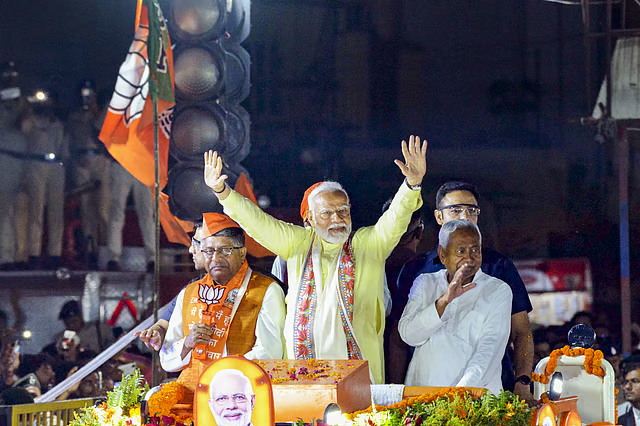
Colombo, October 28 – Bihar, a large North Indian State with a population of 104 million, is going to elect a 243-member State Assembly on November 6 and 11. Results will be declared on November 14. The Bihar elections are critical for the future of the National Democratic Alliance (NDA) government in Bihar, the NDA regime in New Delhi and its supremo, Prime Minister Narendra Modi.
The results will set the tone for a string of State Assembly elections next year. Assam, West Bengal, Kerala and Tamil Nadu are to go to the polls in May 2026. Except in Assam, the ruling parties in these States are non-NDA, known generally as the INDIA bloc at the national level and the Mahagathbandan (MGB) in Bihar.
In the current Bihar State Assembly, the NDA has 132 seats in the House of 243 and the MGB has 111. The competition in Bihar is so stiff and the issues raised in the campaign are of such national importance that Prime Minister Narendra Modi opted to campaign in Bihar rather attend the ASIAN and East Asia summit in Kuala Lumpur Malaysia held between October 26 to 28, where he could have met US President Donald Trump and sorted out the tariff issue.
Perhaps Modi wanted to avoid making even a verbal commitment to Trump to open up the Indian dairy and agriculture sectors to US products, a sensitive matter in rural India.
Critical Issues
In Bihar, the key issues are poverty, the competition among the various castes for representation and the disenfranchisement caused by the recent Special Intensive Revision (SIR) of electoral rolls by the Election Commission of India (ECI).
While the Indian constitution guaranteed universal adult franchise, the SIR put conditions that disenfranchised 48 lakh voters. Everyone who wanted to vote had to prove that he or she was a citizen of India and give proof of birth and residence according to a list of documents authorized by the ECI. But many did not possess such documents (even birth certificates) as Bihar is an under-developed State.
The ECI had disallowed the “Adhaar” IC card (which most Indians have) on the grounds that many non-citizens also had it. Later, the Supreme Court asked the ECI to accept the Adhaar card but only by way of a suggestion.
The opposition and civil society alleged that the SIR was a device to disenfranchise large sections of the population particularly Muslims, Dalits and tribals which might not vote for the NDA in great numbers. Opposition leaders also pointed out that the ECI had no constitutional mandate to determine citizenship.
Initially 65 lakh voters were removed from the roll. But thanks to intervention by the Supreme Court, the final figure came down to 48 lakhs.21 lakhs had been added to the list. A total of 7.41 crore (74 million) voters were declared eligible to cast their ballot. But this was also challenged in the Supreme Court as the details of the deleted persons had not been made public. The next hearing in this landmark case is on November 4, two days before polling in Bihar, and too late to stop the election.
Caste Configurations
The status of castes and caste interests are major criteria for voting in Bihar. The Dalits and Tribals have constituencies reserved for them. The other castes are divided into Upper Castes, Other Backward Classes (OBCs) and Extremely Backward Classes (EBCs).
The Bharatiya Janata Party (BJP)- a major constituent of the NDA – is banking mainly on the votes of the Hindu majority as its Hindu nationalist ideology has traction in Bihar. As expected, the BJP has not fielded a single Muslim. But its ally, the Janata Dal United (JDU), has fielded four Muslims. The Rashtriya Janata Dal (RJD), a constituent of the MGB, has fielded 18 Muslims as the party draws support from Muslims and Yadavs. The Congress has announced the candidature of four Muslims. But still, Muslims, who are 18% of the population, are under-represented.
The ticket distribution in JD(U) is heavily skewed in favour of the OBCs and EBCs. State Chief Minister Nitish Kumar’s own caste group – the Kurmis – has been allotted 11 tickets. The OBCs and EBCs are being targeted by parties since, together, they comprise over half of Bihar’s population. According to the 2023 Bihar caste survey, the EBCs constitute 36% of the population and the OBCs 27%.
The EBCs are seen as holding the key to electoral success especially in close contests. The EBCs could determine electoral outcomes in over 120 seats in Bihar. Chief Minister Nitish Kumar of JDU is well placed in relation to the EBC as it was he who granted 18% reservation for them in jobs and education in 2005. This has paid him dividends since.
However, the 2023 caste census revealed that the EBCs were excluded from powerful political posts and were lagging behind in government jobs in Bihar. They might, therefore, evaluate the NDA from this point of view and the INDIA bloc might get some votes of the disgruntled sections.
The Rashtriya Janata Dal (RJD) has nominated 35 candidates from the Yadav community because its leader and Chief Ministerial candidate Tejaswi Yadav, is a Yadav, one of the dominant castes in Bihar.
Spoilers
The MGB and the NDA have some “spoilers” in this election. They are Prashant Kishor’s Jan Suraaj Party (JSP), the Majlis-e-Ittehadul Muslimeen (MIM) led by Asaduddin Owaisi and the Aam Admi Party (AAP) led by Arvind Kejriwal. The JSP has already shown that it can hurt the NDA and the MGB. In the by-elections for four Assembly seats in Bihar in November 2024, the JSP secured 10 % of the vote.
Give Aways
In a poverty-stricken State like Bihar, freebees and give aways play a key role in determining election outcomes. The NDA government in Bihar recently launched the “Mukhya Mantri Mahila Rojgar Yojana”, offering INR 10,000 each to 75 lakh women to support self-employment and livelihood initiatives. This could be scaled up to INR 2 lakh depending on the success of a woman’s enterprise.
There had been similar welfare-driven poll strategies in States like Madhya Pradesh, Maharashtra, and Karnataka. While the impact of the new initiative remains uncertain, the move clearly signals the NDA government’s intent to strengthen its support among women voters.
In Madhya Pradesh, the BJP’s “Ladli Behna Yojana”, which offered INR 1,250 per month to women, was seen as a “game changer”in the 2023 elections. In Maharashtra, the BJP-Shiv Sena-Nationalist Congress Party (NCP) coalition introduced a similar scheme named “Ladki Bahin Yojana” providing INR 1,500 to women, which proved effective. These women-oriented scheme were replicated in Chhattisgarh and Odisha ahead of the polls.
The Congress too did it in Karnataka, launching the “Gruha Lakshmi Scheme,” offering INR 2,000 to women, which was seen as a key factor in the party’s electoral victory. The Jharkhand Mukti Morcha (JMM) government in Jharkhand used a similar strategy to secure another term in 2024.
Unpredictable Outcome
Be that as it may, it is still not clear which factors listed above will work in Bihar this time. But the general impression is that the NDA is better placed in terms of caste coalitions and leadership. The NDA was also able to resolve, faster than the MGB, seat sharing challenges within their coalition.
But the most important factor is Prime Minister Modi’s direct involvement on behalf of the NDA. His Indian nationalistic credentials were seen in the way he refused to bend before an armed challenge from Pakistan in May and the tariff war initiated by US President Donald Trump. Besides that, the BJP-NDA’s Hindu nationalism has significant traction in the Bihar. Therefore, a good chunk of Hindus might support the SIR’s undeclared intention to weed out Muslims on the grounds that many among them could be “infiltrators” from Muslim Bangladesh.
However, it is not clear if the masses have grasped the full implications of the SIR. The NDA is touting it as a necessary measure to clean the voters list while the MGB is bringing out the “disenfranchisement of Muslims and other weaker sections on specious grounds to benefit the NDA.”
END
