
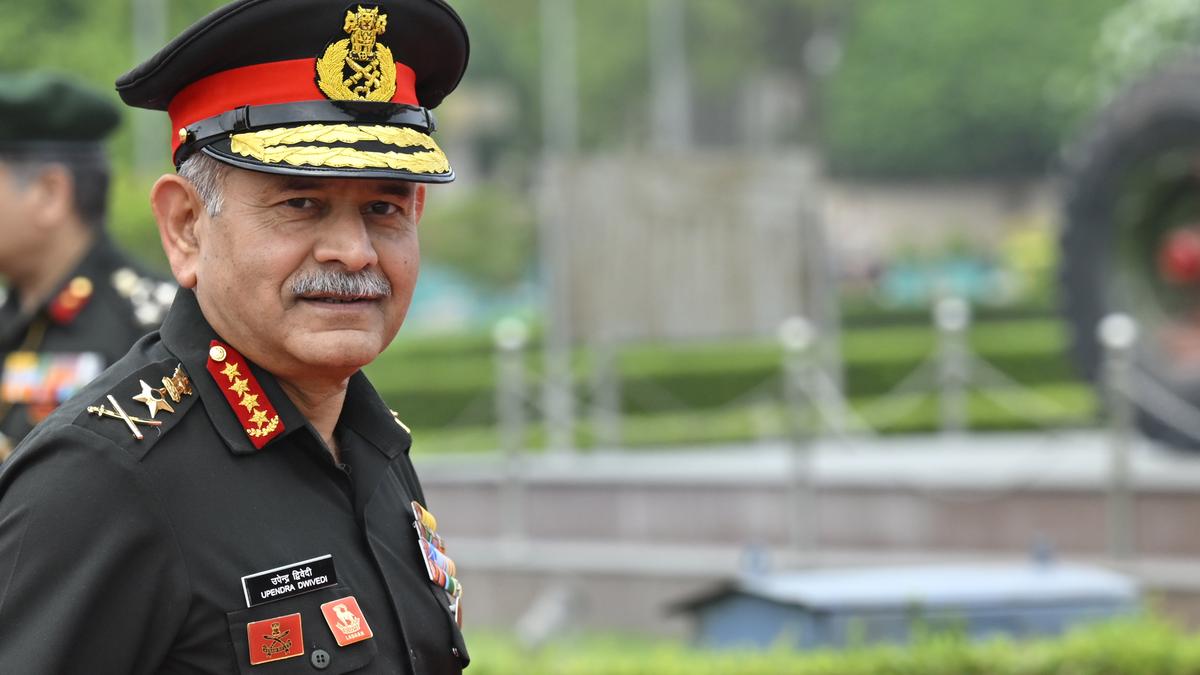

By Gabriel Dominguez/Japan Times
New Delhi, October 6 – The Ukraine war is not the only conflict military planners worldwide have been closely watching — this year’s brief clash between India and Pakistan has also provided valuable lessons on the evolving nature of modern warfare.
Featuring drones, precision strikes, joint operations and real-time battlefield monitoring, the May 7 to 10 encounter — the most significant between the two nuclear-armed adversaries since 1971 — has resulted in numerous operational and strategic takeaways, particularly for India’s military, army Chief of Staff Gen. Upendra Dwivedi told The Japan Times in an exclusive interview.
“We have drawn a number of lessons from Operation Sindoor, not only on the role of joint, multidomain operations, but also the importance of standoff weapons and the use of crewed and uncrewed systems in a contested environment,” the four-star general said in New Delhi.
Operation Sindoor is India’s designation for the military activities it conducted against targets inside Pakistan and Pakistan-controlled Kashmir in the aftermath of an April terrorist attack linked to Islamist militants that killed 26 civilians in Indian-controlled Kashmir.
The four-day clash “established a new normal” in India’s approach to Pakistan, particularly in terms of its rules of engagement and deterrence strategy, Dwivedi said, warning that any future attacks would be met with a similar full-scale conventional response.
But these weren’t the only lessons. Just as important were efforts to calibrate the military response in order to prevent a broader escalation spiral.
“War requires a whole-of-nation approach,” Dwivedi said. “Nations go to war, not just militaries, so one must also know when to end a conflict” once the objectives have been met.
The punitive operation included strikes against nine sites that New Delhi says were part of “terrorist infrastructure,” as well as India’s response to Pakistani counterattacks, particularly aerial strikes.
Experts say the military actions crossed previous thresholds in terms of their geographic reach, the systems employed and the level of coordination between the different armed services branches.
At the same time, the encounter provided lessons in information warfare as it generated unprecedented levels of misinformation that continue to cloud public understanding of what actually transpired, with each side claiming victory and disputing the other’s claims.
Then-Pakistan Prime Minister Imran Khan sits in the cockpit of the Chinese J-10 C combat aircraft as he is briefed during an induction ceremony at the Pakistan Air Force base in Kamra, Pakistan, in March 2022.
Then-Pakistan Prime Minister Imran Khan sits in the cockpit of the Chinese J-10 C combat aircraft as he is briefed during an induction ceremony at the Pakistan Air Force base in Kamra, Pakistan, in March 2022. | Pakistani Prime Minister’s Office / via REUTERS
This has included New Delhi’s rejection of Pakistani claims that PL-15E missiles, fired from Chinese-made J-10C fighter jets, downed several Indian Air Force Rafale aircraft in one of the world’s largest air battles in decades.
“We found the weapon systems used by Pakistan to be highly inaccurate,” Dwivedi said. “We have even recovered largely intact PL-15E missiles on Indian soil, which clearly indicates they either failed to strike the target or did not explode as intended.”
Pakistan fields a large inventory of foreign-made equipment. These include tanks, warships, artillery guns, aircraft, armed drones, as well as air-defense radars and satellite communication systems.
In fact, over the past five years, China has supplied 81% of Pakistan’s major arms imports, according to the Stockholm International Peace Research Institute.
When asked about how these performed in the clash, Dwivedi didn’t go into detail but said that India was able to penetrate Pakistan’s Chinese-supplied air defense network and use the airspace above the battlefield to strike select targets.
“The performance of their equipment has clearly shown that it is not of the standard as claimed by the original equipment manufacturer,” he added.
This doesn’t mean, however, that India isn’t worried about Islamabad and Beijing’s growing military— and defense-industrial cooperation, especially as the close partners are believed to also be in talks over the potential sale of several next-generation systems.
Pakistan has also forged strong military-industrial ties with both Azerbaijan and Turkey, the latter of which has provided warships and aircraft as well as attack drones and loitering munitions to Islamabad, further raising concerns for New Delhi.
Paramilitary troopers stand guard near posters of Operation Sindoor displayed during an exhibition organized by the Bhartiya Janta Party, held to laud party leader and Indian Prime Minister Narendra Modi in Srinagar, India, on Sept. 22.
Paramilitary troopers stand guard near posters of Operation Sindoor displayed during an exhibition organized by the Bhartiya Janta Party, held to laud party leader and Indian Prime Minister Narendra Modi in Srinagar, India, on Sept. 22. | AFP-JIJI
The clash was not just about what equipment was used, however, but rather how it was deployed, with Operation Sindoor marking the first time since 1971 that all three of India’s military branches worked together to strike Pakistan.
Of particular significance were the precision strikes launched against the nine “terrorist bases,” two of which were taken out by the Indian Air Force, with the remaining seven being struck by the Indian Army using a mix of artillery guns, combat drones and loitering munitions.
“Pakistan was not expecting to be struck so precisely deep within its own territory,” the army chief said, pointing out that some ground targets were hit “about 100 kilometers into the heartland of Pakistani Punjab.”
After all, he noted, the aim was not to initiate a conflict with the Pakistani state, but rather to degrade what New Delhi views as terrorist networks operating in the country.
Dwivedi stressed that once the political and military aims were outlined, New Delhi gave the military commanders a free hand in terms of how to respond.
“There was clarity in the political leadership’s strategic guidance,” Dwivedi said, with experts pointing out that this explains the calibrated use of force and why, unlike in prior crises, no public nuclear threats were issued by either side.
“We ensured that there was no collateral damage, i.e. no civilian casualties,” Dwivedi said.
On the operational side, the Indian Army chief highlighted the importance of having all three military branches work in unison.
“Tri-service synergy has enhanced our operational capabilities exponentially,” he said, pointing to not only the combined strike power, but also the joint role the services played in defending against Pakistani drone and aircraft strikes.
This included the use of surface-to-air missile systems such as the locally made Akash and Russian-made S-400, the latter of which even succeeded in downing a Pakistani aircraft over 300 km away, he added.
“A key lesson was the importance of fielding advanced and multilayered air defenses to dominate the air littoral,” Dwivedi said.
“This turned out to be critical in a situation where both sides are vying to maximize the use of aerial domain with loitering munitions drones and counterdrone systems,” he added.
But this dominance would be incomplete without also having an edge in the electromagnetic domain, with the brief conflict seeing an unprecedented use of drones by both sides.
Dwivedi said that at least 600 drones of various sizes and roles are believed to have been deployed near the Line of Control, the 740-km-long de facto border dividing the Indian and Pakistani-administered parts of Kashmir.
Among other things, India used combat and surveillance drones, which alongside radars as well as air— and space-based sensors such as satellites helped provide a real-time picture of the battlefield.
“The Russia-Ukraine war has taught us that we need to have an edge in how we combine assets of different generations and origins,” he said.
From foreign-made drones and air-defense systems to locally developed tanks, attack helicopters and aircraft, Operation Sindoor showed how New Delhi has sought to make the best possible use of its diverse assets.
This comes as the country ramps up military indigenization efforts and introduces emerging technologies such as artificial intelligence-enabled and autonomous systems into its forces.
Another important lesson, though, is that there always is room for improvement.
Indian Defense Secretary Rajesh Kumar Singh was quoted as highlighting last month that the conflict served as a “reality check” for the armed forces as it also revealed capability gaps in areas such as drones and electronic warfare.
To enhance both its military and defense-industrial capabilities, India is going beyond traditional partners such as Russia, France and Israel and expanding cooperation with the United States and Japan.
Speaking on the latter, Dwivedi highlighted India’s increasingly close defense ties with Tokyo, noting that talks are under way to cooperate on several joint development projects, including engines for light tanks, as the partners also expand their participation in each other’s military exercises.
END
