


New Delhi, October 5 (The Hindu) – Indian Army Chief General Upendra Dwivedi on Friday issued a sharp warning to Pakistan, saying that if it continues state-sponsored terrorism, it may have to “reconsider its place on the world map”.
Addressing troops in the forward area of Anupgarh in Rajasthan’s Sriganganagar district, Gen. Dwivedi reviewed operational readiness and urged soldiers to remain fully prepared for action. “India is fully prepared this time and won’t show the restraint we exhibited during Operation Sindoor 1.0. This time we will take a step forward and act in a manner that will make Pakistan think whether it wants to remain on the world map or not,” he said.
Calling on soldiers to maintain constant vigilance, he added, “Keep yourselves fully prepared now, if God wills, the opportunity will come soon.”
Referring to Operation Sindoor, launched after the April 22 Pahalgam terror attack, the Army chief said India had struck nine terrorist sites inside Pakistan — seven by the Army and two by the Air Force. “We had identified only terrorist bases. We have no complaints against ordinary Pakistani citizens, but as long as the country sponsors terrorism, we will strike those who support it,” he said.
Gen. Dwivedi noted that India had provided proof of all destroyed targets this time, countering Pakistan’s past denials. He also cited a list of casualties mistakenly released by Islamabad, which included over 100 Pakistani soldiers, in addition to the terrorists killed.
Highlighting the global support India received after Operation Sindoor, the Army chief said the world had recognised New Delhi’s right to act against terror.
During his visit, Gen. Dwivedi also interacted with senior leadership, veterans, civil dignitaries and troops. He reiterated the Army’s commitment to modernisation, technological upgradation and operational excellence, underlining the importance of integrating unmanned aerial systems (UAS) and counter-UAS capabilities to meet evolving threats.
The Army chief said history bears witness that during the 1965 and 1971 wars, ordinary citizens stood shoulder to shoulder with the soldiers. “We would want them to join us in the days ahead as well. I want to thank them — their zeal boosts the morale of the soldiers,” he added.
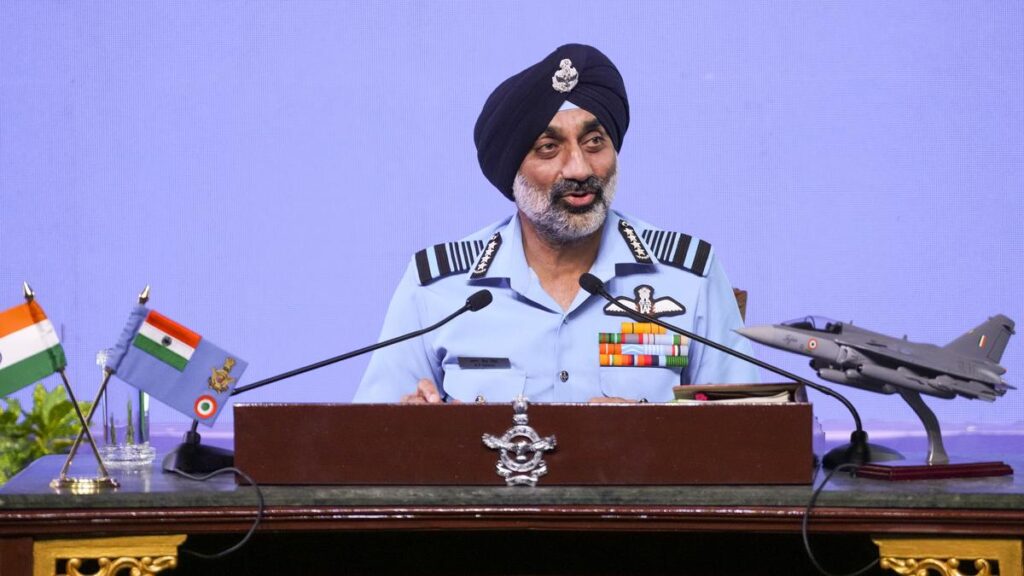
From various Intelligence reports, we have gathered that radars were damaged at four locations, command-and-control centres destroyed at two, and runways at two airfields were hit. Three hangars were also damaged across different stations. Within these hangars and on the tarmac, we have clear evidence of one C-130 class aircraft destroyed, along with four to five F-16 fighter jets that were based at these stations,” the Air Chief Marshal said.
Five Pakistani fighter jets, one aircraft taken down during Operation Sindoor: IAF Chief
He further revealed that evidence indicated the loss of one long-range platform—likely an AEW&C or SIGINT aircraft — struck at a distance of more than 300 km, along with “five high-tech fighters between the F-16 and JF-17 class”.
Dismissing Pakistan’s claims of Indian losses, Mr. Singh called them “manohar kahaniyan (fascinating tales)”. If they think they downed our 15 jets, I hope they are convinced about it and they will cater for 15 less aircraft in my inventory when they come to fight again,” he said.
Pakistani Prime Minister Shehbaz Sharif had recently told the United Nations General Assembly that seven Indian jets were downed, a claim the IAF has firmly rejected.
Indigenous air shield
On the future plans, the Air Chief said all three services have begun work on the Sudarshan Chakra air defence system, announced by Prime Minister Narendra Modi on August 15. The system is aimed at shielding critical civilian and military infrastructure while providing decisive responses to enemy threats.
‘Operation Sindoor’ was a testament of IAF’s combat capability and operational synergy, says IAF chief A.P. Singh
Responding to Tesla CEO Elon Musk’s remarks that drones, not manned aircraft, represent the future of warfare, Mr. Singh countered, “Manned platforms will continue to play a crucial role in combat operations. Fighter jets will remain relevant in the years to come. Elon Musk is a businessman.”
On the Tejas Mk1A, the IAF chief expressed enthusiasm for its induction, saying, “Hungry mouths are ready, waiting for the food now.” He emphasised that the aircraft is expected to meet all performance parameters outlined in earlier requirements.

Failed attempt at restoring lost reputation: Khawaja Asif reacts to Indian military, political leadership’s statements
Islamabad (Dawn) Pakistan’s Defence Minister Khawaja Asif on Sunday reacted to statements made by the Indian military and political leadership, terming them a “failed attempt” to restore their “lost reputation”.
While he did not specify any particular statement that he was reacting to, his remarks follow recent aggressive comments from the Indian side, mentioning terrorism and warning of action. India has long accused Pakistan of cross-border terrorism, an allegation that Islamabad has repeatedly refuted and termed baseless.
“The statements made by the Indian army and its political leadership are a failed attempt to restore its lost reputation,” Asif said on X.
He also referred to a four-day escalation between India and Pakistan in May, during which Islamabad says it downed at least six Indian jets.
Asif said India faced a “decisive defeat with a score of 6-0” in the escalation, and “if they try again [to go to fight], God willing, the score will be much better than the last time”.
“The way the public opinion in India turned against the government after the worst defeat in history, and the way [Indian Prime Minister Narendra] Modi and his group have lost their reputation, it is apparent from their statements that they [are feeling] the pressure,” Asif added.
“This time, God willing, India will get buried under the rubble of its own jets,” the minister asserted.
‘Cataclysmic devastation’
Asif’s remarks come a day after the military warned that any future conflict with India could lead to “cataclysmic devastation” and Pakistan would “resolutely respond, without any qualms or restraint”.
The statement by the Inter-Services Public Relations (ISPR) came in the wake of provocative remarks by top Indian civil-military leadership and stressed that Pakistan would “not hold back” in case of a fresh round of hostilities.
“In the face of highly provocative statements of the Indian defence minister and its army and air chiefs, we caution that a future conflict might lead to cataclysmic devastation. In case a fresh round of hostilities is triggered, Pakistan shall not hold back. We shall resolutely respond, without any qualms or restraint,” the ISPR said.
Indian media outlet NDTV reported on Friday that Indian Army Chief General Upendra Dwivedi had warned Pakistan that it must stop state-sponsored terrorism if it wanted to retain its place on the map. According to the report, Gen Dwivedi said Indian forces would “not show any restraint this time”, potentially hinting at another military incursion.
The same day, Indian Air Force Chief Amar Preet Singh also claimed, without evidence, that his country “downed five Pakistani fighter jets of the F-16 and JF-17 class” during the intense fighting between the nuclear-armed neighbours in May.
Meanwhile, Indian Defence Minister Rajnath Singh delivered a speech earlier this week, with clips posted on his X account, in which he said: “Our soldiers have both weapons and high morale. No challenge can stand before us. Whether it is terrorism or any other kind of problem, we have the capability to deal with and defeat them all.”
In response, the ISPR said in its statement that the military had noted with “grave concern” the “delusional, provocative and jingoistic statements coming from the highest levels of the Indian security establishment”.
It added that such “irresponsible statements” indicated a “renewed attempt at fabricating arbitrary pretexts for aggression”, warning that any such prospect might lead to “serious consequences for peace and stability” in South Asia.
The ISPR concluded its statement, saying: “Earlier this year, the Indian aggression against Pakistan brought two nuclear powers to the brink of a major war. However, India seems to have forgotten the wreckage of its fighter jets and the wrath of Pakistan’s long range vectors. Suffering from collective amnesia, India now seems to be aching for the next round of confrontation.”
May conflict
The May conflict, the worst between the old foes in decades, was sparked by an attack on Hindu tourists in occupied Kashmir, which New Delhi, without evidence, said was backed by Pakistan. Pakistan has denied involvement, with the foreign ministry having questioned the credibility of India’s account of the events, saying it was “replete with fabrications”.
Both sides used fighter jets, missiles, artillery and drones during the four-day conflict, killing dozens of people, before agreeing to a ceasefire. In the immediate aftermath of the conflict, Pakistan said it took down six Indian fighter jets during the conflict, including the French-made Rafale. New Delhi acknowledged “some losses” during the conflict but denied losing six jets.
In August, Pakistan added a new arm to its military, the Army Rocket Force Command, that was tasked with building a long-range conventional strike capability to give the army a sharper edge over arch-rival India.
The timing of the announcement was significant as it came almost three months after the four-day conflict. It was the Pakistan Air Force’s early successes that tipped the balance in Pakistan’s favour, but operational lessons learned during the conflict necessitated the formation of the new fighting arm within the army.
The new command is responsible for operating conventional missiles — including ballistic, cruise, and possibly even hypersonic — designed to hit targets far beyond the front lines. The idea is to strike deep, hard, and without reaching for the nuclear trigger.
END
