

By P.K.Balachandran/Sunday Observer
Colombo, September 28 – US President Donald Trump is determined to retrieve the Bagram airbase in Afghanistan that was abandoned by the retreating US forces in September 2021. He thinks that the changing geopolitical situation in West and Central Asia necessitates a renewed US hold on Afghanistan.
With Iran openly challenging US-Israeli power in West Asia, the phenomenal rise of China as a regional and global power, the unrelenting stubbornness of Russia, and the burgeoning need for critical minerals, Trump sees a pressing need for a strategic presence in Central Asia.
And for this purpose, Afghanistan is the best place to be in to watch developments and influence events in Central and also South Asia bordering Iran and China.
The US had built the world’s biggest airbase at Bagram, a stone’s throw away from Kabul, a base large enough to land a “whole planet” as Trump put it. Trump is now wanting it back from the Taliban.
“We gave it to them for nothing,” Trump claimed speaking in London while on visit. “We’re trying to get it back because they (the Afghans) need things from us. Good. Bagram is worth pursuing”.
And to underline the seriousness of the demand he added – “very bad things will happen,” if the base was not handed over.
Bagram is strategically important because of its proximity to the border with China and to China’s abandoned nuclear testing range at Lop Nur in Xinjiang province. There have been reports of increased Chinese military construction activities in the area, The Washington Post said.
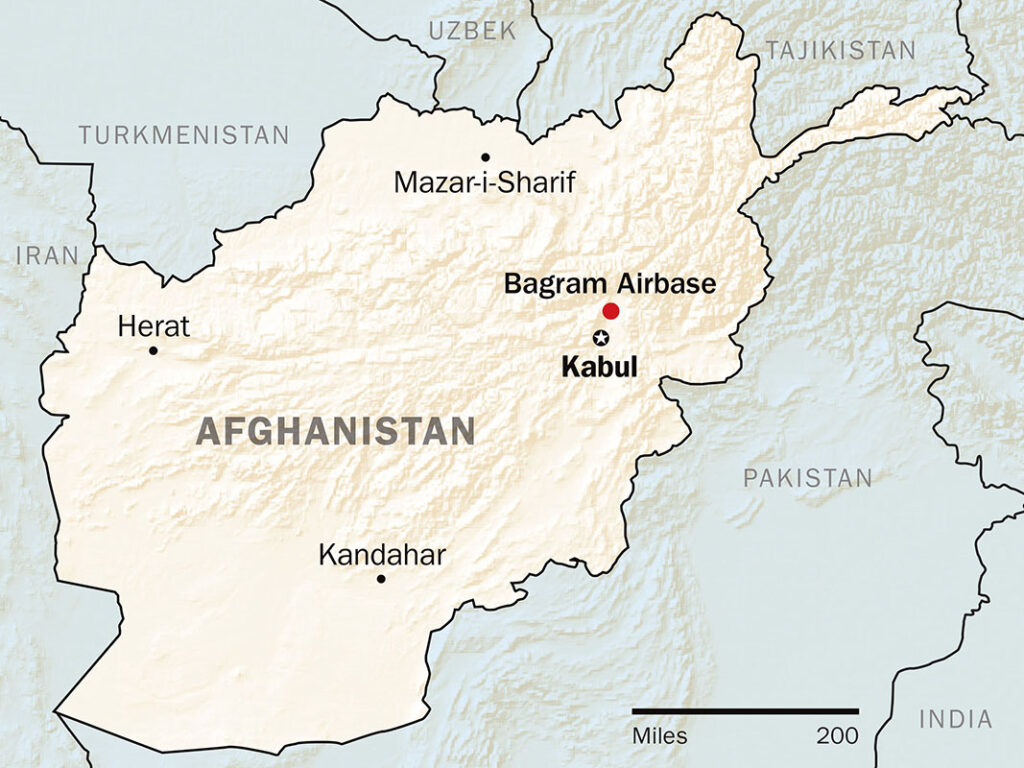
Trump himself said in March that the US should have stayed at Bagram “not because of Afghanistan but because of China, because it’s exactly one hour away from where China makes its nuclear missiles.”
Bagram was “now under China’s influence,” he claimed. But the Taliban denied it and the BBC fact-checked to find no suspicious Chinese activity there in the past few years.
Be that as it may, the “Chinese presence” argument could well be a cover for something else. A military presence at Bagram would allow the US to conduct intelligence gathering and counterterrorism operations in Central and parts of South Asia. The Islamic State-Khorasan (ISK) terrorist group, which is also at war with the Taliban and has its tentacles in Europe, is active in Afghanistan.
Moreover, the US had left behind US$ 7 billion worth of weapons and other military equipment in Bagram, which the US would like to retrieve.
Since Trump said that the Taliban “wants something” from the US. there is speculation that Kabul wants diplomatic recognition and also the US$ 7 billion belonging to the former Afghan government that are in US government’s possession.
After the fall of Kabul in 2021, the Biden administration froze the funds kept in New York, because it was unclear who had the legal authority to access the account. However, in February 2022, President Joe Biden announced that he intended to move US$ 3.5 billion from the account to a trust fund to support humanitarian assistance in Afghanistan, and reserve US$ 3.5 billion for potential legal claims by families of the victims of the 9/11 terror attack on New York.
But there was opposition in the US itself to the seizure of Afghanistan’s funds. It was described as “looting assets legally held by another sovereign government.”
Taliban officials don’t want American troops on their soil but have said that Afghanistan and America need to engage on economic and political relations “based on bilateral respect and common interests.” Thus, Trump has leverage with Afghanistan.
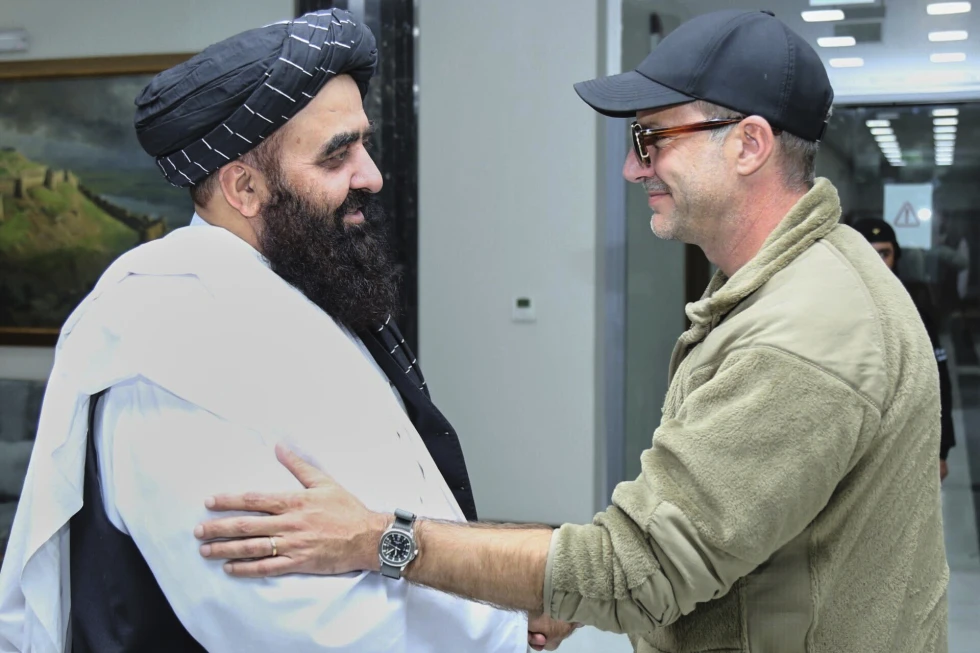
This month, the Taliban’s foreign minister, Amir Khan Muttaqi, and Trump’s special envoy for hostages, Adam Boehler, met and reached a deal on a prisoner exchange. Agreements were reached that led to the release of American citizen George Glazmann, who had been held captive in Afghanistan for over two years.
The designated US negotiator with the Taliban, Zalmay Khalilzad, has also been meeting Taliban officials. In March this year, a US$ 10 million reward for information leading to the capture of Interior Minister Sirajuddin Haqqani was cancelled, signalling potential US openness to selective engagement with Taliban representatives who show flexibility in foreign policy matters.
The Wall Street Journal reported that talks about a small American contingent to be based at the Bagram airbase were in the early stages. On his part, Trump could well release Afghanistan’s frozen funds in exchange for the Bagram airbase.
Battle for Influence
In 2025, the regional dynamics changed with China deepening its influence in Afghanistan through economic and political interactions. Similarly, Russia is expanding its military cooperation with Central Asian States. Although active military conflict in Afghanistan has ended, the strategic battle for influence persists. Bagram could also facilitate intelligence sharing and operational coordination with regional allies old and new.
Quest for Energy
China, Russia, and the US want Central Asian energy. The Turkmenistan–Afghanistan–Pakistan–India (TAPI) gas pipeline is a US project. But it is yet to stake off. Because of TAPI, Afghanistan would an energy bridge and thus key to achieving Washington’s strategic objectives in the Central and South Asian region.
TAPI also allows the US to isolate Iran, which is competing to supply South Asia with the Russia-supported Iran-Pakistan gas pipeline.
However, Afghanistan’s internal security problems complicate attempts to construct the TAPI pipeline. The US believes economic development in the form of TAPI transit fees will blunt the appeal of Islamic fundamentalism in Afghanistan.
While Russia and China are also weary of the fundamentalist threat, they do not want to see the US play a role in the region’s energy transactions, not to mention establish a military presence in Afghanistan, which is in their sphere of influence.
Uzbekistan as a Bridge
In the process of re-establishing U.S.-Afghanistan relations, Uzbekistan can serve as a platform for mediation says Islomkhon Gafarov, Senior research fellow, at the Centre for Afghanistan and South Asian Studies.
Firstly, the United States and Uzbekistan are strategic partners. Uzbekistan has been friendly with the US, Afghanistan and China too. When the Trump administration demanded the return of US military equipment from the Taliban and was met with refusal, Uzbekistan handed over seven US Black Hawk helicopters that had been left on its territory. Uzbekistan’s ties with Afghanistan and China could be valuable for the United States in the context of the Afghan issue.
END
US interest in Bagram airbase in Afghanistan, Continued strategic value of Bangladesh, Keeping an eye on China, Central Asia and Russia, Need to quell Islamic groups, Need for Afghan and Pakistani help in counter terrorism,
