

By Veeragathy Thanabalasingham
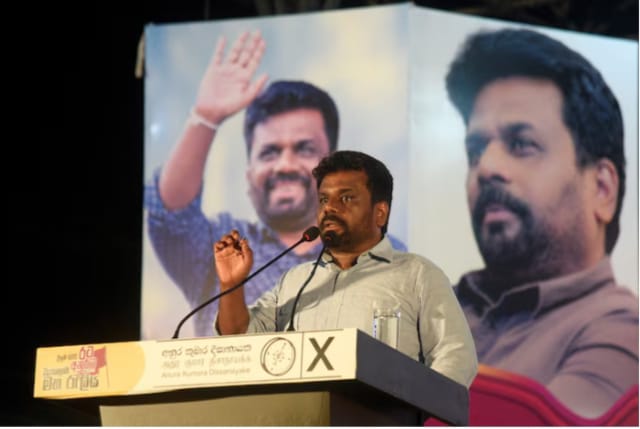
Colombo, September 21 – Sri Lankan President Anura Kumara Dissanayake will complete one year in office as the ninth Executive President of Sri Lanka on September 23. Although he did not receive 50% + 1 votes in the first in the 2024 Presidential election, it was significant that a leader of a left-wing political movement was going to President for the first time in Sri Lanka.
Dissanayake’s victory also made Sri Lanka the second country in South Asia to elect a left-wing political movement that had waged an armed insurrection, after Nepal.
Therefore, the people of Sri Lanka had high expectations from President Dissanayake and his National People’s Power (NPP) government, especially because it was elected following an unprecedented popular uprising in 2022 called Aragalaya.
Even though the leaders of the NPP especially its flagship party, the Janata Vimukthi Peramuna (JVP), only asked voters to give them enough seats to form a stable government, voters gave them more than a two-thirds majority in parliament in the 2024 November general elections.
It is not known to what extent the people believed the promises made by the NPP during the elections, but they clearly expressed their intense hatred for the old traditional political parties and their leaders.
It is against this backdrop that the performance of President Dissanayake’s one-year rule should be viewed.
Hopefully, after a year in office, the President and the other government leaders have understood the impracticality of the massive promises they made during the poll campaign. The large majority of the population, which was expecting quick relief from economic hardships were greatly disappointed.
The NPP promised to renegotiate the agreement with the International Monetary Fund (IMF) as the people were suffering as a result of the economic restructuring measures taken by former President Ranil Wickremesinghe’s government on the advice of the IMF. But the new government had no alternative but to follow the same agreement without any change.
Although international financial institutions such as the World Bank have made positive comments on Sri Lanka’s economic situation, there has been no tangible change in the living standards of the majority of the people.
No one knows when the NPP government will implement its own economic policies. President Dissanayake and other government leaders are careful not to allow their administration to get mired in corruption, as they are well aware of the reasons why voters hated the previous rulers.
The government is also taking legal action against past corruption cases other abuses of power. But on many other fronts, the government’s performance has been lacklustre.
While there is a limit to what we can expect from a government in its first year in office, it is certain that a year’s performance of the NPP government is enough to assess its future direction. Despite various criticisms of the JVP’s past politics, people expect a completely different approach from the government led by it after it came to power through democratic elections.
The leaders of the JVP will now clearly understand to what extent it is practically possible to bring about system change while retaining the state machinery that served the governments of the old traditional ruling class.
The fiery comments made by key JVP ministers, who are angry at officials who are obstructing the government from carrying out its policies, are a clear manifestation of that understanding.
The popular uprising that Nepal saw exposed to the world the failure of the constitutional reforms and other democratic experiments made over two decades by communist parties. It is necessary for the JVP, as a revolutionary left-wing movement that waged two armed insurrections in the space of two decades in the last century, to take the developments in Nepal as an object lesson.
Meanwhile, in Sri Lanka, the new political culture cannot be only about ending corruption, malpractices, abuse of power and family-dominated politics. It must reflect the desire for a change in ethnic relations through a political solution to the national ethnic question that led to three decades of war.
Unlike previous rulers, President Dissanayake is more concerned with extending a hand of friendship to minority communities, especially Tamils in the north. He visited Jaffna several times during his first year in office and declared that his policy is to treat all communities equally.
But the President and the government need to grasp the fact that there is no point in proclaiming equality for all, without taking remedial measures. The minority communities had suffered racist policies and repressive measures implemented by governments in the past.
The JVP has an unsavoury past in which it had vehemently opposed all attempts to find a political solution to the national question through devolution of power. They have not yet demonstrated that they are interested in mending their ways and following a different course. They remain prisoners of communalism..
Sri Lanka’s ethnic divide continues to deepen due to the ways in which ethnic relations and the national question have been handled by the Sinhala polity as well as Tamil polity. The North and the South seem to be two different worlds. To reverse such a worrisome situation, the President and the government must now embark on a path that will not only win the confidence of the minority communities, but also free the majority community from the old ways of thinking.
END
(The writer is a leading Colombo-based journalist)
