

By Dr. Sujit Kumar Datta/The Daily Times of Bangladesh
Dhaka, September 17 – The country of Nepal has sublime valleys with an incredible landscape and culture. However, even under this mountainous monument, it is robbing such political confusion. Since the historic abolition of the 2008-mentioned monarchy, the above have been out of power since then. Nepal has been witnessing the emergence of 14 separate governments in a remarkably short time. Their five-year term remains incomplete and has not been achieved by any administration. Cabinets fall, alliances are formed, and prime ministers are voted out, and the cycle starts all over again. Why does this happen? Why could Nepal not attain sustainable political stability even in 2008, when it was becoming a federal democratic republic? The need to seek the long and chequered route from monarchy to republicanism, and then to party politics, is not established to reach the answers to these questions.
The political battles, Nepal is witnessing today are inextricably linked with the long, arduous road to democracy. Before 1951, the country was ruled under different dynasties, the Rana rulers diffused hereditary power as prime ministers, essentially stripping the monarch of their role except as a figurehead. The democratic movement of 1951, however, led to the Rana regime being overthrown by a parliamentary democracy. This democratic experiment was short-lived. In 1961, King Mahendra, strengthening his own power, banned all political parties and introduced a party-less system known as the Panchayat. This system of absolute monarchy remained intact till 1990 when the ‘People’s Movement’ forced King Birendra to lift the ban on political parties as well as to abolish the system of Panchayat.
The restoration of the multi-party democracy was followed again by turmoil. In 1996, Maoist rebels initiated their armed insurgency, aiming to abolish the monarchy and establish a republic. The decade-long civil war that followed killed thousands of people and scarred the country’s soul. The final nail in the coffin of the monarchy came in 2006, when a tremendous popular movement against King Gyanendra, based on a coalition of political parties and Maoists, forced a surrender of power by the king. In 2008, the monarchy was finally abolished, and Nepal became a Federal Democratic Republic. The last King, Gyanendra, is now an ordinary citizen. The big hopes that attended this historic transition were soon, though, tempered with disappointment.
A significant contributor to Nepal’s long-term political instability is the 2015 constitution. The document, drawn up with the desperate aim of consolidating the gains of the democratic movements, actually created new opportunities for strife. Many of the clauses of the Constitution were seen as ambiguous, especially with the formation and dissolution of the government. The constitution encourages coalition governments, but there are no precise mechanisms in place for such coalition governments to last. As a result, political parties routinely make deals in the back rooms and agree on pacts with each other to share power, which are loose and evanescent.
This, in turn, has meant that there has been a predictable penalty point – a new government is formed, then challenged by no-confidence motions, internal party rifts and constitutional interpretations favouring one party over another. In Nepal, these crises have become a constant on the political scene. A change in government now and then leaves no government with a chance to put in place any long-term policies or even development projects, which also contributes to a desperate population that wants a change as well. National interest is often and very commonly the slave of party interest and personal ambitions. The career of K.P. Sharma Oli can well demonstrate such a phenomenon. His initial stint as a prime minister was in 2015, but his government lasted a year. In 2018, 2021, and again in 2024, he was re-elected. However, each time he was in office, internal feuds marred his tenure, compounded by his lack of confidence in securing votes. This symptom indicates an underlying ailment: solving is a political party whose agenda is more focused on gaining power than on good governance.
This lack of a homogeneous majority has created a scenario in which smaller parties are highly influential to other parties due to their memberships as so-called kingmakers, as they seek to secure vital portfolios for their ministers from the electorate. It is the nature of such continuous political evolution that forms a ladder of slander in the absence of a strong government capable of withstanding the pressures to shift in either direction, both against and in support of the coalition system. The vagueness of some provisions of the constitution has made it vulnerable to constant encroachment of its affairs by the judiciary, which has consequently presented yet another layer of complexity to the political grounds. Supreme Court decisions are sometimes controversial and have been used to resolve political stalemates by interpreting the Constitution. An example is former Chief Justice Sushila Karki, who came to office as interim Chief Justice, when she sought to emphasise the speed of a process that others in the legal republic have deemed unconstitutional. It has raised suspicions about the judiciary’s role in upholding neutrality in political issues.
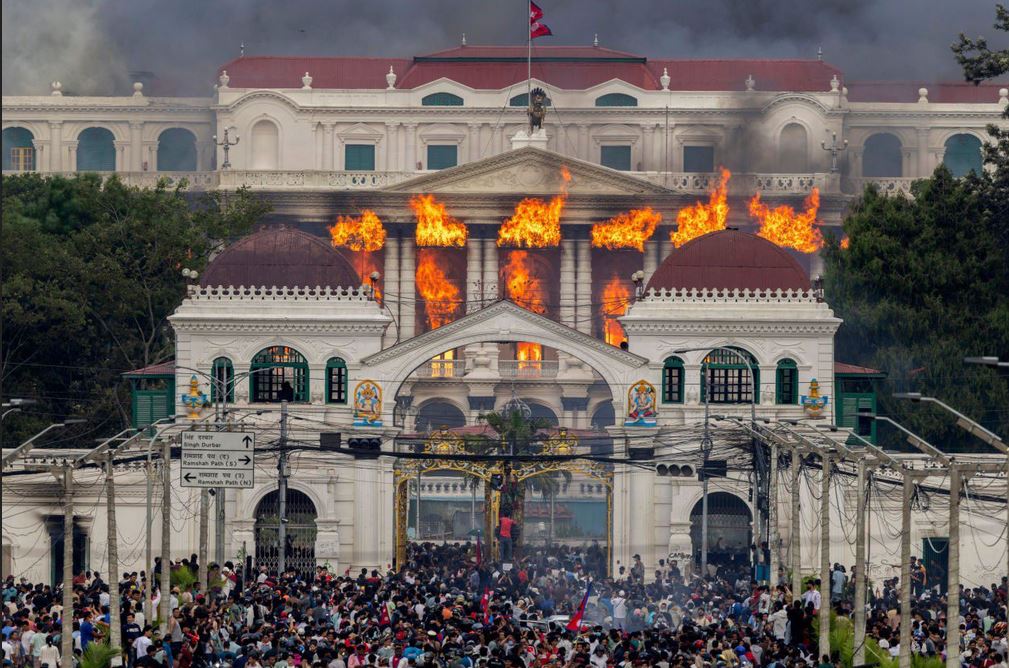
In the most recent development in a series of protests that had taken place over the course of a week, which had been successful enough to oust the Nepalese government, the guard of the presidency declared snap-on mid-term elections to remove the lawmakers. Critics have not been slow to observe that the move is capable of destroying even more democratic institutions in the country. Those decisions, which are made thoughtlessly due to the absence of a broad consensus, are at risk of collapsing because of the insufficiently substantial concept of democratic decision-making that had been such a vexing achievement. The Political insecurity in Nepal is not internal. The geographical location of the country (between two regional powerhouses, India and China) implies that domestic politics in Nepal can often be affected by external powers. India and China are both eager to expand their influence in Nepal, and the various political factions frequently enact their geopolitical interests.
Powdered kebab represents a new pressure, and it is an emerging youth movement, commonly referred to as Gen-Z (Generation Z). Partially, the disintegration of government in 2025 was brought about by this movement. The young truck drivers in Nepal have been frustrated by the never-ending corruption, nepotism, and failure of the political setup to keep its promises. This outlet was to be found in the streets and on the internet. This new breed of protest is prompting political leaders to pay attention not only to their internal wrangles, but also to the frustration that has been years in the making in society.
The recurring cycle of political instability, which has become a near-regular occurrence, is, in reality, a very palpable indicator that the system in question is not performing terribly well. Anything as fundamental as the solution to stability hinges on any change in the political leadership’s thought in the country. A leader can transcend partisan interests and self-promotion to consider the love of national prosperity. It will not only take a constitutional change in order to bring in changes in the grey areas that prevail, but it will also entail a valid motive for good governance, accountability, and the fight against corruption.
The years of struggle and sacrifice of the Nepalese people have proved that they have not been defeated in their intention for democracy. It is high time that their leaders keep their word and implement a stable, transparent, and accountable political system. History is an excellent book for humanity, and it is high time that Nepalese politicians began studying it in detail, avoiding the mistakes they have made. Only at that point are they in a position to potentially uphold the democracy’s promise and establish a Thriving future for all Nepalis.
The writer is a Professor of International Relations at University of Chittagong and Deputy Director, Hong Kong Research Center for Asian Studies (RCAS)
END
