
As if the US hasn’t fought enough wars: Trump’s bid to invest the US military with a killer instinct

By P.K.Balachandran/Daily Mirror
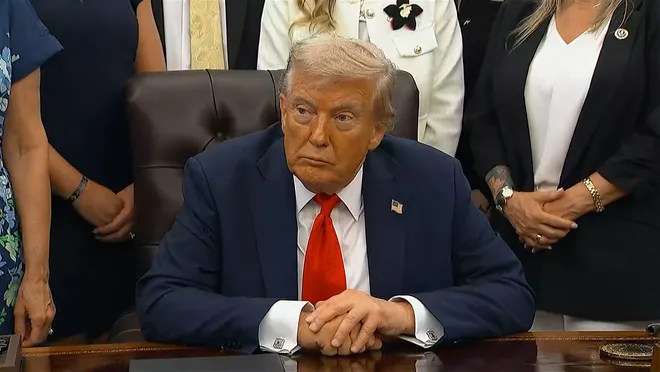
Colombo, September 9 – Last week, US President Donald Trump renamed the Department of “Defence” as Department of “War” saying that change had become necessary because the US military had not been fighting wars to win
Trump’s reasoning is that since the end of World War II, the dominant mode in the US military has been defensive. There has been an over-riding anxiety to be “politically correct”. He feels that the change in nomenclature from “defence” to “war” will bring about the desired attitudinal change giving the US forces and the US political establishment a killer instinct.
Until 1949, the US Department of Defence was indeed designated as the Department of War. In Trump’s view, as long as it was the Department of War, the US military had the gumption to win wars, including the First and Second World Wars, and make America a Super Power. But when the designation was changed from War to Defence (by President Harry Truman), the US military never fought to win, he said according to New York Times.
The timing of the change in the Department’s nomenclature might have been influenced by the massive show of military might by China in the grand military parade held in Beijing on September 3 in the presence of nearly 25 Heads of Government and State including President Vladimir Putin of Russia. By holding the Shanghai Cooperation Organisation’s summit in Tianjin on August 31 and September 1, China had also signalled the emergence of a new South centric world order as an alternative to the US-led Group of 7.
Trump had to sit up, take notice and act. Hence, the transition from defence to war in Washington’s thinking. This also fits into Trump’s mission to aggressively put America First in all his dealings at home or abroad. America, under him, has ceased to be politically correct. In his view, this is justified as every other aspiring power, whether it is China, Russia or India, is manifestly pursuing its national interest by exercising strategic autonomy.
Last month, Defence Secretary Pete Hegseth, an enthusiastic supporter of the name change, had a gold-plated sign installed outside a conference room that read “W.A.R. Room,” New York Times reported. Hegseth said the change reflected a “warrior ethos”.
Continuing his battle against political correctness and “wokeism” (neo-liberalism), Trump also announced the restoration of the original names of military bases that were changed after racial justice protests in 2020.
Wars the US has Waged
Wars have been a major part of American history making it expand its territory in North America and its power internationally. The US has always fought to win, though some of its campaigns as in Vietnam and Afghanistan showed its weakness when pitted against unconventional guerilla forces.
Wars started right from the day the White Colonists began their life in the New World by hounding the Native Americans relentlessly until there was little or no trace of the indigenous people. Then came the American Revolutionary War against Britain. Since then, the US has been involved in more than a 100 wars both in North America and overseas.
A report to the US Congress lists the wars and gives the deployment and casualty figures for every war fought till 2019. According to the report, the 1775–1783 American Revolutionary War claimed 4,435 lives. However, according to historian Howard H. Peckham’s 1974 book “The Toll of Independence,” the death toll was 25,534 in the eight-year armed conflict.
Between 1798 and 1800 there was a Franco-American Naval War, and between 1801 and 1805, the US fought in what is now Morocco, Algeria, Tunisia and Libya in the Barbary wars. The combination of a strong American naval blockade and an overland expedition from Egypt finally brought the war to a close, with a Treaty of Peace (June 4, 1805) favourable to the United States.
Between 1812 and 1815, the US and Great Britain clashed, over American territorial expansion in North America. The US lost 2260 lives in these engagements. In 1836 the US crushed the Texas independence movement. Between 1846 and 1848 there was a Mexican-American war in which US lost 13,283 lives. It resulted in the US gaining more than 500,000 square miles of Texas which was Mexican territory. It was justified on the ground that it was manifest destiny of the US to expand.
This was followed by the US Civil War between 1861–1865 between the Union forces and those of the Confederacy over the issue of slavery. It claimed 600,000 Americans.
In 1898 came the Spanish-American War which claimed 2446 lives. The US entered World War I in 1917. It deployed 4.7 million personnel and lost 116, 516. This joined World War II in 1941, deployed 16.1 million personnel and lost 405,399, but emerged as the world’s newest Super Power in four years.
From 1950 to 1953, the US was involved in the Korean War as part of a UN force against North Korea and China and lost 36,570 personnel in the conflict. Then came the disastrous 1960–1975 Vietnam War. The US deployed 8.7 million personnel and lost 58 220.
1961 saw the Bay of Pigs invasion against Cuba. In 1983, US intervened in Grenada. The US invaded Panama in 1989. The purpose of the invasion was to depose the de facto ruler of Panama, Gen. Manuel Noriega, who was wanted by US authorities for racketeering and drug trafficking.
In 1990–1991, US and coalition forces fought against Iraq in the Gulf War. This cost US$ 61 billion. 1995–1996 saw the US intervention in Bosnia and Herzegovina as part of NATO peacekeepers in the former Yugoslavia.
From 2001 to 2021, the US was involved in the invasion and occupation of Afghanistan as part of coalition of forces fighting the Taliban regime there. In the 20 years since September 11, 2001, the United States spent more than US$ 2 trillion on the war in Afghanistan, according to Forbes. In baser terms, Uncle Sam has spent more keeping the Taliban at bay than the net worth of Jeff Bezos, Elon Musk, Bill Gates and the 30 richest billionaires in America combined. “That’s $300 million dollars per day, every day, for two decades. Or US$ 50,000 for each of Afghanistan’s 40 million people.”
War on Terror
America’s post-9/11 wars (War Against Terror) cost US$ 8 trillion, according to a Brown University research team. The team included costs incurred by Department of Defence Overseas Contingency Operations funding; State Department war expenditures and counter terror war-related costs, including war-related increases to the Pentagon’s base budget; care for veterans to date and in the future.
As for the casualties, 897,000 to 929,000, including US military members, allied fighters, opposition fighters, civilians, journalists and humanitarian aid workers were killed as a direct result of the war. That does not include the many indirect deaths the War on Terror has caused by way of disease, displacement and loss of access to food or clean drinking water.
Between 2003–2011, the US was engaged in the invasion and domination of Iraq. The Iraq War had its roots in the 1991 Persian Gulf War in which the US, in conjunction with a coalition of forces from 35 countries, worked to expel Iraqi forces from Kuwait. The UN called upon Iraqi President Saddam Hussein to destroy the country’s arsenal of so-called Weapons of Mass Destruction (WMD). President George W. Bush took an aggressive stance after the September 11, 2001 attacks on the World Trade Centre in New York.
From 2004 to 2018, the US was in the thick of war in Northwest Pakistan using drones to strike Islamic militants. In 2007, the US started engaging the Shabaab militants in Somalia and Northeastern Kenya. From 2009 to 2016 the US engaged Somali pirates.
In 2011, the US intervened in Libya along with its NATO allies. From 2014 to 2017, US and coalition forces were ranged against the Islamic State of Iraq and Syria (ISIS). Then the US helped anti-Bashar forces to take over Syria in 2024. Since 2015, the Saudi-led coalition and US, France, and UK have been fighting Houthi rebels in Yemen. In 2025, the US intervened in the Israel-Iran war using bunker buster bombs to disable Iran’s highly protected nuclear facilities. Through this, the US confirmed its hegemony over the Middle East.
END
