
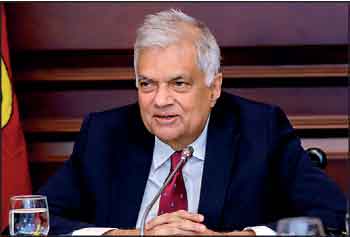

By Vishvanath/www.counterpoint.lk
Colombo, August 31 – Former Sri Lankan President Ranil Wickremesinghe, who received intensive care for seven days after being arrested and remanded under the Offences Against Public Property Act, on August 22, walked out of hospital on August 29! He is expected to address a UNP event on September 06 and make a special statement. It will be interesting to see what he has got to say. He was on his way to becoming a spent force in politics, after his defeat in last year’s presidential election, but circumstances have propelled him to the center stage of politics again. Will he take the tide atthe flood to make another comeback?
Wickremesinghe’s political career, spanning about five decades, represents striking dualities, swinging between ups and downs and fortune and misfortune. His critics have branded him as a serial loser, but a closer look at his political journey reveals that it is marked by success and failure, and trumps and defeats in equal measure and, most of all, unexpected comebacks. He came to be dubbed a serial loser because the SLFP-led governments scored a string of electoral wins by staggering Provincial Council polls for political reasons.
Lady luck smiles on Wickremesinghe from time to time, and she turns her back on him just as quickly. In 1993, he became Prime Minister fortuitously. The UNP had three heavyweights in the early 1990s—President Ranasinghe Premadasa, Lalith Athulathmudali and Gamini Dissanayake. The assassination of President Premadasa, followed by that of Athulathmudali, paved the way for Wickremesinghe’s meteoric rise to the premiership, and the assassination of Dissanayake the following year led to his elevation as the UNP leader.
The UNP lost the 1994 parliamentary election with the SLFP-led People’s alliance capturing power in the parliament with Chandrika Bandaranaike Kumaratunga securing the premiership and the presidency in quick succession. Following the assassination of Dissanayake, who was the UNP’s presidential candidate, and the UNP’s defeat in the 1994 presidential election, Wickremesinghe became the leader of the UNP and the Opposition, facing the gargantuan task of turning the UNP around. He was defeated in the 1999 Presidential polls, which Kumaratunga won mostly due to a sympathy vote stemming from an abortive attempt by the LTTE to assassinate her on the eve of that crucial election.
The UNP lost the 2000 general election as well, but Wickremesinghe toppled the Kumaratunga government the following year itself, engineering mass crossovers from the SLFP, and secured control of Parliament in a snap general election (2001). That was no mean achievement for the UNP, which many political commentators had written off to all intents and purposes. Kumaratunga however sacked the UNP-led government in 2004, held a parliamentary election and steered a new SLFP-led coalition, United People’s Freedom Alliance (UPFA), with the JVP as a constituent, to victory.
Wickremesinghe lost the 2005 presidential election mainly because a poll boycott ordered by the LTTE prevented many Tamil People who were expected to back him from voting. Mahinda Rajapaksa won by a whisker. There was no way anyone could defeat Rajapaksa in the 2010 presidential election; he had provided unwavering political leadership for defeating the LTTE and ended the war which had lasted for nearly three decades. His popularity was at its zenith. Wickremesinghe skipped that contest, but he was instrumental in scuttling Rajapaksa’s re-election bid in 2015, when the UNP-led UNF regained control of the Parliament, and he became the Prime Minister under President Maithripala Sirisena. He did not contest the 2019 presidential election, which Gotabaya Rajapaksa won comfortably, with the unsuccessful UNP candidate Sajith Premadasa breaking away from the UNP with a group of prominent party members and forming the SJB to contest the 2020 general election, where Wickremesinghe lost his own seat, and the UNP was reduced to a single National List slot in the parliament. The UNP’s debacle was due to Wickremesinghe failure as the Prime Minister in the UNP-led Yahapalana government, internal problems of the UNP, the breakaway of Sajith and others, and above all the Easter Sunday terrorist bombings (2019), which catapulted national security back to the centre stage of politics much to the benefit of the Rajapaksas, who promised to eliminate terrorism again.
Wickremesinghe, written off as politically dead again, entered the parliament as the UNP’s National List MP. Nobody expected him to rise in politics ever again as the only UNP member in the Parliament. But lady luck smiled on him again. In 2022, the unthinkable happened. President Rajapaksa had to flee overseas and resign amid the country’s worst ever economic crisis and the resultant public uprising, Aragalaya. It so happened that Wickremesinghe, who could not retain his seat in the 2020 general election, became Prime Minister again. Then, he went on to equal Kumaratunga’s record by becoming President in quick succession! It is doubtful whether there has been any such fortuitous rise of a defeated politician to the topmost position in a country anywhere else in the world. Then, he shouldered the unenviable task of straightening up the bankrupt economy by adopting necessary yet unpopular measures to achieve that goal. He was not expected to succeed as all odds were stacked against him, but he overcame that challenge, and the economy regained stability to a considerable extent. His luck however had run out by the time he faced last year’s presidential election, which he lost.
Wickremesinghe knows how to capture power with the help of Lady Luck but cannot retain it. He did not contest last year’s general election, and declared that he would not enter the parliament via the National List. It was widely thought that Wickremesinghe was washed-up and facing the prospect of being forgotten eventually, with the SJB eclipsing his UNP. And, then he was arrested on August 22.
Wickremesinghe’s arrest and remand over alleged misuse of state funds for a visit to a British university while in transit in London in 2023 jolted the Opposition into defending him. Even his sworn political enemies like President Maithripala Sirisena rose in his defense, and the Opposition parties jointly organized a protest on August 26, when he was to be produced in court. He was in the ICU of the National Hospital, Colombo and got bail on medical grounds.
The NPP government may not have anticipated the political fallout of Wickremesinghe’s arrest and remand. His political career, which was widely thought to be over following his defeat in last year’s presidential election, has been revived by circumstances. What plans he has up his sleeve will be seen on September 06, when he is scheduled to address a UNP convention, which would not have attracted much media attention if not for his arrest and remand and the resultant political turmoil. All eyes are now on the upcoming UNP convention and Wickremesinghe!
END
