

By P.K.Balachandran/Daily Mirror
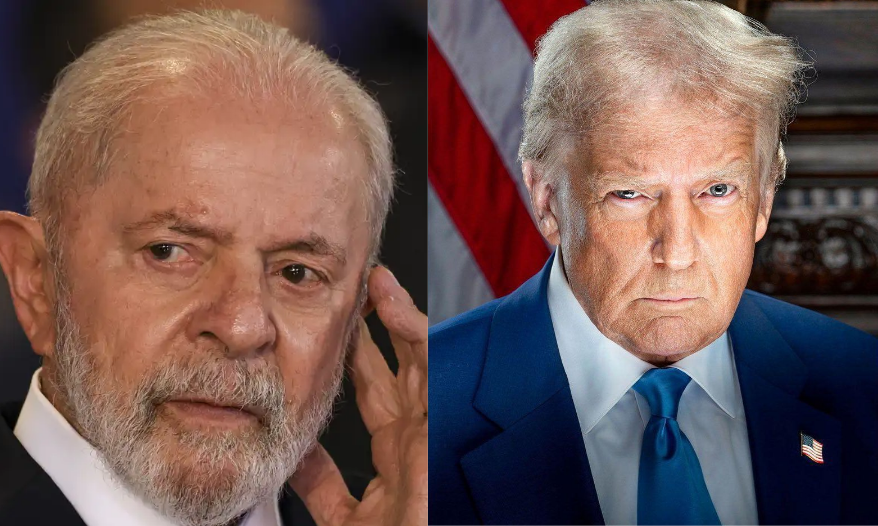
Colombo, August 20- US President Donald Trump has slapped a punishing 50% tariff on both India and Brazil, both of whom consider themselves leaders of the Global South in opposition to Western hegemony.
Trump has slammed India as the “Tariff King” of the world for its high tariffs on US products and its impenetrable non-tariff barriers. India’s economy is “dead” Trump bellowed intemperately.
The US President has said that some of the actions of the Brazilian government were an “international disgrace”. But it has not been about Brazilian tariffs but about some of the actions of its current President, Inacio Lula da Silva, better known as Lula.
Trump slapped a 50% tariff on Brazil though the US has a US$ 7.4 billion trade surplus with that country. He did so because he disapproved the way Lula was hounding Jair Bolsonaro, the pro-US former Brazilian President.
Leftist Lula had slapped serious criminal charges against Bolsonaro, accusing him of trying to stage a coup on the ground that Lula had stolen the election from him in 2022 in much the same way Trump said Biden had stolen his election in the US in 2022.
After Bolsonaro was defeated, he raised questions about the electronic voting machines used. In January 2023, thousands of Bolsonaro’s supporters stormed the Presidential palace, much like Trump’s supporters stormed the US Congress in January 6, 2024 claiming that Joe Biden had stolen the election.
Alexandre de Moraes, the Brazilian Supreme Court justice overseeing Bolsonaro’s criminal case, ordered him to wear an ankle monitor because Moraes believed that he might try to flee the country and take refuge with his friend Donald Trump. Eduardo Bolsonaro, the son of Jair Bolsonaro, is in Washington lobbying for sanctions against Lula.
An angry Trump told Lula – “Please understand that the 50% is far less than what is needed to have the level playing field we must have with your country and it is necessary to have this to rectify the grave injustices of the current regime. The way that Brazil has treated former President Bolsonaro, a highly respected leader throughout the world during his term, including by the United States, is an international disgrace.”
Treasury Secretary Scott Bessent said in a news release – “De Moraes is responsible for an oppressive campaign of censorship, arbitrary detentions that violate human rights and politicized prosecutions — including against former President Jair Bolsonaro.”
The US Treasury Department announced that it has imposed sanctions against Justice Moraes under the Global Magnitsky Act, in a severe escalation of the feud. The act is designed to punish foreigners accused of serious human-rights violations or corruption. The Act places significant financial restrictions on the sanctioned individuals.
Trump’s other grievance is that Lula openly rooted for former Vice President Kamala Harris, his opponent in the 2024 US Presidential election.
Trump said that the tariffs he had imposed on Brazil are also meant to target its Supreme Court for what he says are “censorship orders” against US tech companies.
US Trade Representative Jamieson Greer said that the US is probing Brazil’s attacks on American social media companies. Greer also accused Brazil of disadvantaging American exports by offering lower tariffs to other countries and inadequate enforcement of intellectual property rights.
BRIC Summit
Escalation in tensions between Trump and Lula occurred when Lula hosted a BRICS summit in Rio de Janeiro on July 6 and 7. At the summit, leaders of criticised Trump’s tariffs and the US-Israeli bombing of Iran. In retaliation, Trump threatened a 10% additional tariff on “anti-American” BRICS countries.
Lula Defiant
Reacting to Trump’s diatribes, Lula declared that “Brazil is a sovereign nation with independent institutions and will not accept any form of tutelage.” He added that the criminal case against Bolsonaro was a matter solely for the Brazilian justice system and “not subject to interference or threat”.
Lula said he would hike tariffs on the US because the 50% tariff on Brazil could severely hurt companies highly exposed to the US market such as those in the base metals and agricultural sectors. Trump’s tariffs could cut Brazil’s economic growth by 0.3 to 0.4 percentage points.
“I treat everyone with great respect. But I want to be treated with respect. At no point will Brazil negotiate as if it were a small country up against a big country. We know the economic power of the United States, we recognize the military power of the United States, we recognize the technological size of the United States. But that doesn’t make us afraid,” Lula fumed.
He said it was “disgraceful” that Trump issued his threats on his social media site, Truth Social. “President Trump’s behaviour strayed from all standards of negotiations and diplomacy.”
Brazil’s Rise
Brazil has the potential to play an influential role in international affairs as the fifth-largest territory, seventh-most populous country, and ninth-largest economy in the world.
Since returning to office in 2023, Lula has been expanding Brazil’s international influence. He has placed particular emphasis on convening and hosting gatherings of world leaders. These gatherings have included a summit of South American leaders (May 2023), a meeting of Amazon Basin countries (August 2023), a Group of 20 (G-20) summit (November 2024), and a BRICS summit (July 2025). Additionally, Brazil is scheduled to host the 30th session of the Conference of the Parties to the UN Framework Convention on Climate Change (COP30) in November 2025.
Brazil has long sought a more prominent role and greater influence in the UN Security Council and other international institutions, which Brazilian officials argue need to better represent developing countries.
Lula has repeatedly called upon BRICS to adopt alternatives to the US Dollar for trade among BRICS countries. During the July 2025 BRICS summit in Brazil, the bloc issued a 126-point declaration that included calls for reform and increased representation for BRICS and other developing countries in international organizations, including the UN Security Council, and continued cooperation within BRICS to increase the interoperability of BRICS payment systems.
The declaration also condemned the rise of unilateral tariffs, the imposition of economic and secondary sanctions, and military strikes against Iran, without explicitly mentioning the United States.
Another issue Brazil has vis-a-vis US, is the Trump Administration’s plans to once again withdraw the US from the Paris Agreement on climate change. Brazil is scheduled to host COP30 in November 2025
Domestic Weakness
Lula is undoubtedly popular in the Global South as a whole, but not very much at home. As of July 2025, 43% of Brazilians approved of Lula’s performance in office but 53% disapproved, according to a Genial/Quaest poll.
Brazilians’ concerns about the cost of living appear to have taken a toll on Lula’s popularity. In a June 2025 poll, 55% of Brazilians rated the Lula administration’s efforts to combat inflation as “bad” or “terrible.” The government is also under pressure from international investors to tighten its fiscal policy. Debt is 77% of the GDP.
Weak Political Foundation
Lula is contending with a fragmented Legislature, in which 20 political parties from across the political spectrum have representation. Lula has forged working majorities with the conditional support of a bloc of Centrist and Centre-Right parties that held about 40% of the seats in the Chamber of Deputies and 44% of the seats in the Senate.
But Lula’s working majorities remain fragile. They could collapse if his approval rating declines further.
Brazil-China Relations
In addition to engaging in multilateral cooperation within the BRICS group and other fora, Brazil and China have forged extensive bilateral ties. This worries greatly Washington which is against outside powers especially China, gaining a foot hold in Latin America.
During Lula’s May 2025 state visit to China, Brazilian and China signed 20 bilateral agreements related to AI, energy, infrastructure, mining, space, and trade, among other areas of cooperation.
Between 2004 and 2024, Brazil’s annual goods trade with China climbed from US$ 9.1 billion to US$ 158.0 billion, and China’s share of Brazil’s global goods trade rose from 5.8% to 26.3%. In 2024, Brazil ran a US$ 30.7 billion trade surplus with China.
According to the Brazil-China Business Council, between 2007 and 2023, Chinese companies invested US$ 73.3 billion in 264 projects in Brazil. Brazil and China are also in the forefront of the campaign in BRICS seeking to substitute the US dollar with local currencies in intra-BRICS transactions. Tump has vowed to slap 100% tariff on countries which do so.
END
