
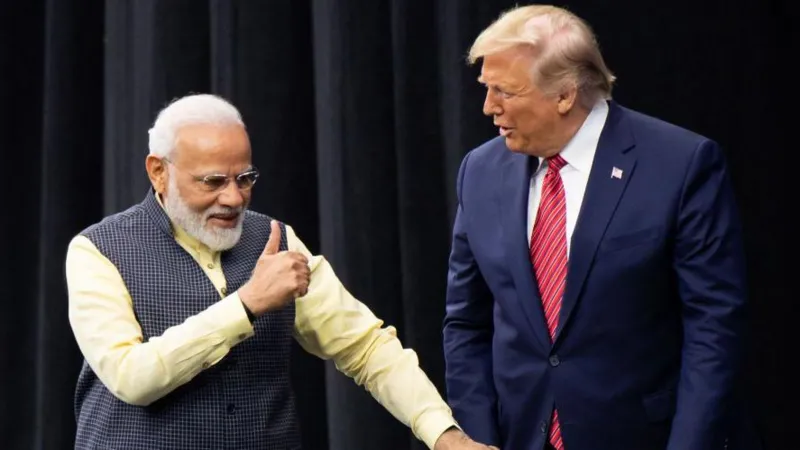

By P.K.Balachandran/Daily News
Colombo, August 5 – Starting on August 7, the United States will impose a 25% tariff on goods imported from India. President Donald Trump has also warned about an unspecified “penalty” on India, presumably to stop it from buying oil from Russia.
“I don’t care what India does with Russia. They can take their dead economies down together, for all I care,” he said angrily. “We have done very little business with India, their Tariffs are too high, among the highest in the World,” Trump said.
To rub salt into the wound, Trump was demonstrably kinder to Pakistan and Bangladesh, countries from which India is estranged. Pakistan has been assigned a 19% tariff rate, a significant reduction from the 29% reciprocal tariff it was hit with in April. Bangladesh also saw its rate dramatically reduced, from a threatened 35% down to 20%. Trump further said, tongue in cheek, that the US would help Pakistan explore oil and help it export oil to India!
Speaking after Trump announced the tariff hike, US Treasury Secretary Scott Bessent told NBC that the US trade negotiation team was “frustrated” with India. “Well, I don’t know what’s going to happen. It will be up to India. India came to the table early. They’ve been slow rolling things. So I think that the President, the whole trade team, has been frustrated with them.”
Bessent also pointed out, disapprovingly, that India has been a large buyer of oil from Russia, which is facing sanctions, and reselling the crude as refined products. Trump had also linked the tariff ‘penalty’ to India’s membership of BRICS which he sees as an anti-US dollar Russo-Chinese bloc.
The hike in US tariff will hurt a range of Indian industries and the Indian rate of growth will come down by 0.2% from the current 6% plus, experts say.
India-US bilateral trade had crossed US$ 190 billion in 2023. But the US currently has a US$ 45.7 billion trade deficit with India. Trump is therefore very keen on reducing it drastically.
India levies nearly 39% tariff on US agricultural products, with rates climbing to 45% on vegetable oils and around 50% on apples and corn, according to Reuters. The US wants Indian tariffs to come down and India to import more from the US.
Hurtful Side
Trump’s new tariffs would undoubtedly hit a wide range of Indian manufactured goods exported to the US. These included labour-intensive products such as garments, pharmaceuticals, gems and jewellery, and petrochemicals. Exports of smartphones and pharmaceuticals to shrimp and auto parts will also be hit. India will be losing its competitive edge in garments vis-à-vis Vietnam and Bangladesh.
The US is the single largest market for the Indian gem and jewellery sector. The US accounts for over US$ 10 billion in exports or 30% of the Indian gem industry’s total global trade. India’s footwear and furniture will become uncompetitive vis-a-vis Vietnam and China. According to the Manufacturers’ Association of India, Indian products will become 7% to 10% more expensive than those from its competitors.
What should India Do?
India is unlikely to raise tariffs on US imports reciprocally. But it could do other things to improve its economic clout internationally. It could even lower tariffs on US goods and buy more from it to keep the US on its right side.
The Indian Minister of Commerce, Piyush Goyal, has urged Indian exporters to “come out of their protectionist mind set and encouraged them to be bold.” India is actively pursuing free trade deals with several countries including EU. Recently there was an FTA with the UK which would double bilateral trade by 2030 from the current level of US$ 56 billion.
Many experts believe that India’s protectionist policies over the past decade have undermined Prime Minister Narendra Modi’s “Make in India” initiative. The make in India scheme prioritised capital and technology-intensive sectors over labour-intensive ones like textiles. As a result, India has struggled to boost manufacturing and exports.
Protectionism has discouraged investments in efficiency. High tariffs have allowed crony capitalists to gain market power by consolidating their positions without facing competition.
By lowering protectionist barriers and strengthening ties with Southeast Asia and the Middle East, India would get a chance to come out of the crisis. By reducing tariffs, India could become the regional and cross-regional magnet for trade and economic activity, drawing in varied powers into its orbit.
That could help India create the jobs that are needed to serve the increasing number of youth entering the job market. At present unemployment and under employment are high. Agriculture, which makes up 17% of its GDP, accounts for a whopping 40% of employment, reflecting extremely low productivity in that sector.
But agriculture need not be a backward sector, says Dr.Raghuram Rajan, former Governor of the Reserve Bank of India. India should encourage value addition to its agricultural products by allowing investment from abroad, including from America.
India should take other steps such as improving the skills of its manpower in a multiplicity of trades, ranging from low skill carpentry and plumbing to high skill technological trades.
Dr. Rajan says that exports should not be an obsession. Indian industries should cater to the Indian market also, as it is expanding. Every effort should be made to increase employment opportunities and to skill the manpower needed to meet the new demand. The small and medium industrial sector, a major employer, should be encouraged and its growth should not discouraged by outdated regulations.
On top of it all, India should improve its regulatory system and tax administration to make it entrepreneur-friendly and give a level playing field to both local and foreign investors. There should be no scope for tax terrorism. Ensuring national security is important, but security cannot be a fetish. China grew with massive investment by Western companies. It tackled the issue of security intelligently keeping growth upper most in its mind.
Economists have advised against a knee-jerk reaction to Trump’s tariffs. Negotiations with the US should therefore continue. By engaging the US, its enemy number one, China was able to bring the tariff on it down from 145% to 30%.
On its part, India should cut down tariffs wherever possible, while excluding agricultural and dairy products. In the last national budget, India had reduced tariffs on several items, while imposing an additional Agriculture Infrastructure Development Cess (AIDC), an alternative tariff, on many items. The budget slashed basic customs duties on several items including luxury cars, high end motor bikes, solar cells and machinery. This would benefit the US.
Therefore, India has done what it could do in the short run to dilute its protectionist tendencies. However, Trump would like India to do much more, such as buying the F35 fighter aircraft and stopping the import of oil from Russia.
It is not certain of India will stop buying oil from Russia. But India is already buying oil from other countries. India’s Petroleum Minister Hardeep Singh Puri has repeatedly asserted that India—the world’s third-largest oil consumer—has diversified its sources from 27 to 40 countries and will continue to buy crude from any source offering the best deal. The EU has revised the G7-imposed price cap, reducing it from US$ 60 per barrel to a dynamic cap set at 15% below the average market price of Urals crude (currently estimated at $47.60/bbl). .
The other demand from Trump is that India should buy the American fighter F-35. But the Indian Air Force is not in its favour, preferring a joint manufacture for the manufacture of its Russian equivalent SU-57.
While there are hiccups because of the new tariff regime, India could view the present crisis as an opportunity to undergo much-needed economic reforms.
END
