

By P.K.Balachandran/Daily News
Colombo,July 29 – Under the Presidency of pro-China Abdulla Yameen (2013 -1018) a popular slogan in Maldives was “India Out”. India was seen as a regional hegemon, whose power had to be countered with the help of China. China’s investments and political influence grew exponentially during Yameen’s Presidency.
However, Yameen’s pro-China stance did not help him get elected for a second term because the over-riding electoral issues were his corrupt and authoritarian regime.
Yameen’s successor, the mild and pro-India Ibrahim Solih (2018-2023), swung to the Indian side. In return, India helped Maldives financially and helped put the economy back on its feet. However, Solih’s lacklustre image coupled with his obvious connection with India led to pro-Yameen leaders like Mohamed Muizzu reviving the “India Out” campaign. In a way, India became the scapegoat for the failures of the Solih government. Muizzu rode to power on the second anti-India wave.
On assuming charge President Muizzu asked the 88-member Indian military contingent involved in inter-island medical evacuation work, to leave. India had installed 10 coastal surveillance radars in the Maldives, which were supported by a Coastal Surveillance Radar System (CSRS). The integrated information from all the radars had served as the Indian Ocean Region’s main centre for maritime security. Despite these advantages Muizzu said that his government would review all agreements signed by the Solih regime with India.
Rubbing salt on the wound, three of Muizzuz’s junior ministers put out a tweet disparaging the Indian Prime Minister Narendra Modi. This caused an outrage in India and Indian tour operators gave a call for the boycott of Maldives. Response to the call was overwhelming and the boycott proved to be effective. According to CNBC Maldives is said to have lost over US$ 380 million as a result of the Indian boycott. The Maldivian economy nose-dived as a result. It was facing a fiscal crisis.
In 2024, Muizzu signed an FTA with China. As a part its Belt and Road Initiative (BRI), Chinese firms invested US$ 1.37 billion in developing infrastructure in the Maldives. China also pledged to increase the number of Chinese tourists to Maldives to make up for loss of Indian arrivals.
However, to everyone’s surprise, China was indifferent to the fiscal crisis in Maldives. Taking the cue, India shed its anger against Muizzu and stepped into the breach created by China’s indifference. It promptly extended vital fiscal help. India’s economic support included a US$ 400 million currency swap. This was instrumental in easing the Maldives’ fiscal challenges and highlighted India’s role as an economic partner in times of crisis.
The two sides deliberated on the operationalization of a local currency settlement agreement, aiming to reduce dependency on foreign currencies like the US dollar.
Finance Minister Abdulla Khaleel visited India and emphasized the importance of India’s role in maintaining stability in the Indian Ocean and expressed the Maldives’ commitment to regional peace and security in concert with India.
Days later, Maldivian Defence Minister Mohamed Ghassan Maumoon arrived in New Delhi on an official visit — the first visit by a Maldivian Defence minister to India since Muizzu took office. Maumoon engaged in discussions with Indian Defence Minister Rajnath Singh on enhancing the capabilities of the Maldives National Defense Force (MNDF) through joint exercises.
On his part, Muizzu buried the hatchet and warmed up towards India. The “India Out” campaign was stopped and the threat to review all agreements with India was not carried out.
During a visit to Maldives by India’s Foreign Minister S.Jaishankar in August 2024, Muizzu described India as “one of the closest allies”. Muizzu also secured resignations of the officials who had insulted Modi. Efforts in the Maldivian Parliament to review defence pacts between India and the Maldives were also stalled.
US$ 564 Credit Line
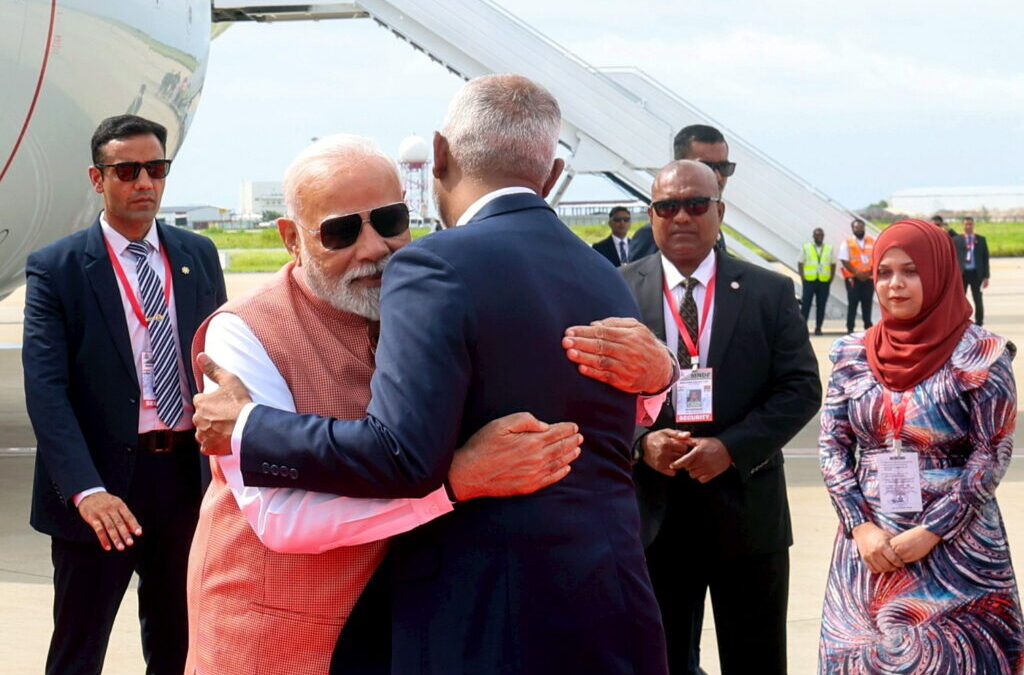
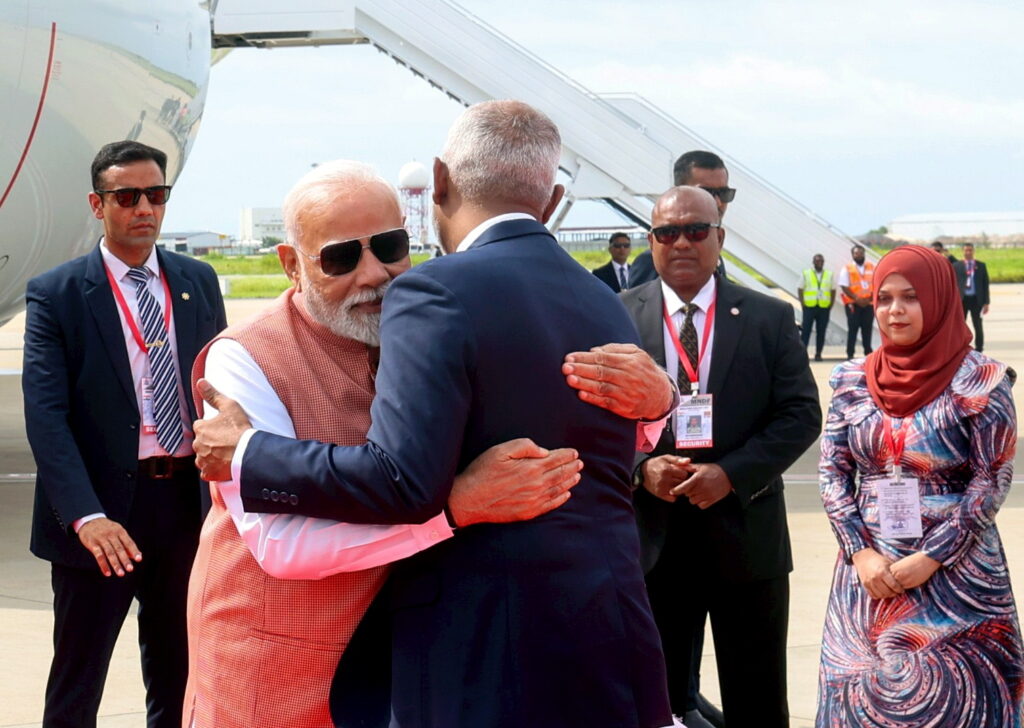
Indian Prime Minister Narendra Modi graced the 60 th.anniversary of Maldives indepedence on July 25 as the chief guest. Following talks with President Muizzu, Modi announced a credit line of U$ 565 million to support development projects in the Maldives.
In his speech, President Dr Muizzu noted that the relationship between the Maldives and India extended far beyond formal diplomacy, with deep-rooted connections dating back centuries. He referred to the Indian Ocean as a living testament to these long-standing ties, emphasising that the shared journey of both nations, as traders and neighbours, had forged a resilient and unbreakable bond. The President expressed gratitude to India for its continued support and steadfast friendship.
Maldives and India exchanged an MoU to begin formal negotiations on a Free Trade Agreement (FTA). Minister Mohammed Saeed said that President Muizzu is following liberal economic policies, promoting an open market and strategic partnerships for mutual benefit.
Alongside the FTA, the Maldives and India signed an implementation agreement for the Unified Payments Interface (UPI) system and initiated work toward a Local Currency Settlement mechanism. Minister Saeed stated that these initiatives aim to reduce transaction costs, eliminate currency conversion barriers, and support smoother cross-border trade and financial flows.
There were discussions also on cooperation in the fields of capacity building, health, infrastructure, digital economy, aquaculture, climate change and renewable energy.
Maldives’ Balancing Act
To be sure, Muizzu does not want to replace India with China or India with China for that matter. He seeks to take advantage of both countries. While India is physically closest in terms of distance and also trade and historical ties, China is equally interested in Maldives because of its geographical location in the Indian Ocean.
China has been helping with economic growth and tourism. As a part of BRI, the Chinese firms invested US$ 1.37 billion in developing infrastructure in the Maldives. Moreover, President Xi Jinping had pledged to increase the number of Chinese tourists to Maldives to support the Maldives tourism sector which accounts for 70% of the country’s GDP.
Following the Maldives’ inclusion in the BRI in 2014, Beijing has backed projects like the China-Maldives Friendship Bridge in the capital city of Malé, major upgrades to the Velana International Airport, and numerous housing complexes. Chinese imports to the Maldives had also grown year on year, going from around USD $320 million in 2021 to over USD $400 million in 2023.
In 2025, both countries activated the China-Maldives Free Trade Agreement. China is currently the Maldives’ biggest external creditor, holding over 42% percent of its external debt.
According to sources in Maldives, India has a way to go to match China in executing projects. It is unable to match the scale and speed of China’s infrastructure project work. India has also been criticised for getting overly involved in its domestic politics.
However, it has to be realised that Maldives is in India’s backyard. India is also part of the US-led QUAD, and as such, is the bulwark against China in the Indian Ocean. It is the cutting edge of QUAD in this part of the Ocean.
Successive Maldivian governments have oscillated between India-friendly policies and alignment with China. Swings in policy have been necessitated by the Maldives’ economic deficiencies as well a wish to assert the country’s sovereignty.
The Maldives’ reliance on external powers is deeply rooted in its physical vulnerabilities. As an archipelago, Maldives’ fragmented geography and its exposure to climate risks, limit the nation’s capability to be self-sufficient even in agriculture. Economically, Maldives is too dependent on one sector – tourism. The country lacks robust domestic industries thereby compelling it to rely on imports.
The lack of diversification leaves the Maldives highly susceptible to external shocks, as seen by the impact of the COVID-19 pandemic, and to some extent, the Ukraine-Russia conflict in 2022.
Maldives is being called upon to do tightrope walking all the time. The situation calls upon both Maldives and India to take a balanced and measured approach towards each other so that the solid groundwork laid by Modi’s visit is not nullified.
END
