

By P.K.Balachandran/Daily Mirror
Colombo, July 29 – Adult franchise, or Universal Adult Suffrage, refers to the right of all adult citizens to vote, regardless of gender, race, caste, religion, education, or income. It ensures that each adult has an equal voice in choosing leaders and shaping public policy. It is deemed to be a fundamental feature of a democracy.
Ancient Athens (5th century BCE) is reputed to have practiced democracy, but it excluded women, slaves, and foreigners. Enlightenment thinkers like John Locke, Jean-Jacques Rousseau, and Voltaire emphasized individual rights, equality, and popular sovereignty. The American revolution (1776) and the French Revolutions (1789) raised demands for popular representation.
But full adult suffrage came much later and in stages after painful struggles by the deprived.
In the US, only White, property-owning males could vote in the late 1700s. In 1856, property requirements were dropped but still only men could vote. In 1870, Black men were given the vote. In 1920, women got the right to vote. And in 1965 the voting rights of Afro-Americans were legally protected from erosion.
In the UK, the Reform Act of 1832 gave limited suffrage to middle-class men. In 1918 it was extended to men 21 and above and women 30 and above. In 1969, the voting age was reduced to 18.
Ceylon was the first British colony in Asia to get universal adult suffrage and that too quite early – in 1931. India had only a limited suffrage till 1950 when independent India’s constitution introduced Universal Adult Suffrage.
But still, countries, including avowedly democratic countries, try to find ways to restrict franchise to achieve partisan political ends or uphold the supremacy of some groups or interests.
The US strips voting rights from millions solely on the basis of a criminal conviction. As of 2022, over 4.4 million people in the US had been disenfranchised due to a felony conviction. Felony is a crime, typically one involving violence, usually punishable by imprisonment for more than a year or by death.
However, in the US, the disenfranchisement law varies from State to State. Most U.S. states no longer disenfranchise individuals permanently and many no longer disenfranchise individuals upon release from jail. Another encouraging fact is that a study of 136 countries with populations of 1.5 million and above found that 73 out of 136 never or rarely denied a person’s right to vote because of conviction in a case.
Case of Native Americans
The (American) Indian Citizenship Act of 1924 ensured all Native Americans born within the US the right to citizenship. However, the Act did not automatically enforce the right to vote. While the Fifteenth Amendment declared that a citizen’s right to vote could not be denied on account of race, many US States were able to find other reasons to deny native people the vote. The reasons could be residing on a reservation, tribal enrolment, taxation, and incompetency. Thousands of Native veterans, including American Indians returning from action in World War II, found themselves prohibited from savouring basic civil liberties that they had fought to protect during the war against Nazi Germany.
The Voting Rights Act of 1965 finally outlawed exclusionary practices that “deny or abridge the right of any citizen of the United States to vote on account of race or colour.” But despite these protections and subsequent legislation, discriminatory practices continue to this day.
Other Countries
Finland and New Zealand restrict the vote for several years after completion of prison sentence, but only in the case of persons convicted of buying or selling votes or of corrupt practices. Some countries condition disenfranchisement of prisoners on the seriousness of the crime or the length of their sentence.
Prisoners may vote in the Czech Republic, Denmark, France, Israel, Japan, Kenya, Netherlands, Norway, Peru, Poland, Romania, Sweden and Zimbabwe. In Germany, the law obliges prison authorities to encourage prisoners to assert their voting .
In India, under trial prisoners and persons confined in prison otherwise are not eligible to vote, even if their names are registered in the electoral votes. However, persons under preventive detention are eligible to vote. In Sri Lanka, the Election Commission formally acknowledged June 6, 2025, prisoners could vote.
Women do not have the right to in Saudi Arabia. In Myanmar, the Rohingya Muslim minority was disenfranchised. Under the 1982 citizenship law, the Rohingya were stripped off their citizenship.
Sri Lanka
In 1949, after Sri Lanka got independence the Tamils of Indian origin working in the estates were disenfranchised and marginalised through legislative acts defining Ceylonese citizenship. Diplomatic negotiations between India and Ceylon failed to resolve the fate of the migrants. Even after the 1964 Bandaranaike-Shastri Pact between the leaders of the two countries, over 500,000 Indian-origin migrants remained in Ceylon without citizenship of either country. It was only through the Stateless Persons Act of 1988 and Grant of Citizenship to Persons of Indian Origin Act of 2003 that Sri Lankan citizenship was granted to people of Indian origin residing in Sri Lanka since October 1964 and their descendants.
India
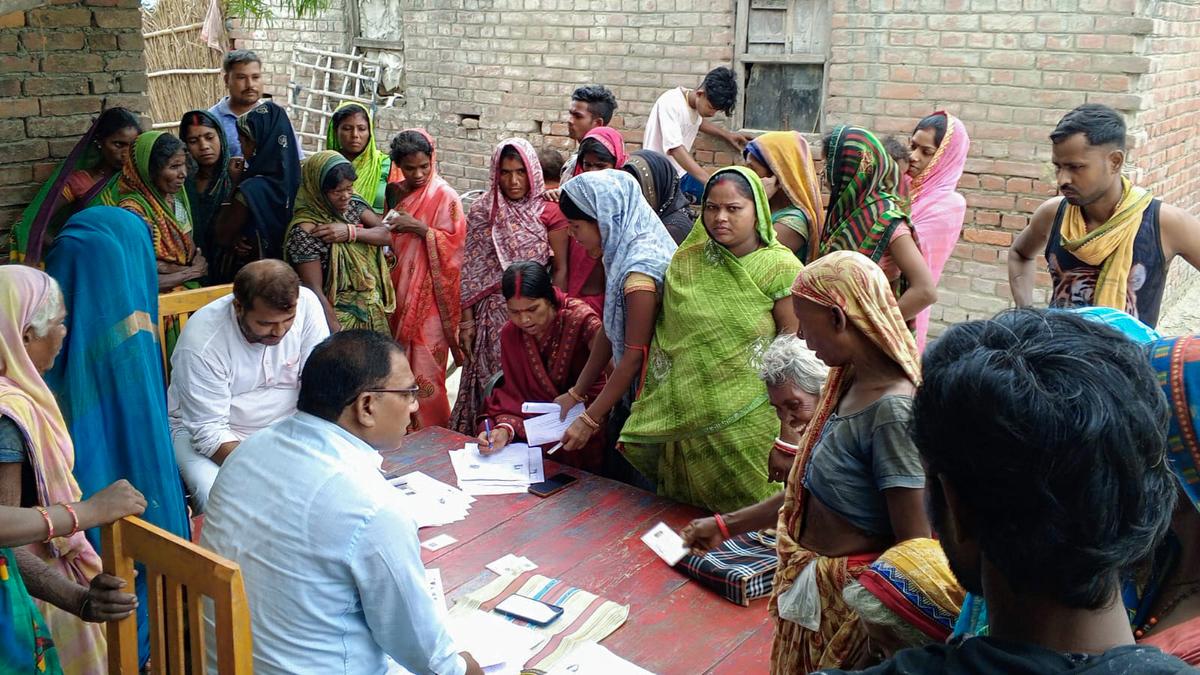
Massive disenfranchisement is feared ahead of the November elections to the State Legislature of Bihar in North India because of the Special Intensive Revision (SIR) of the electoral roll being done by the Election Commission of India (ECI).
According to the Association of Democratic Rights, about 940,000 out of the 76 million electorate in Bihar are likely to lose their right to vote as they had not been counted in the SIR either due to their absence from the State or because they had not submitted any of the 11 documents needed to be given as proof of eligibility.
More than 7% of Bihar’s population, mostly labourers, are generally out of the State for employment and may not have been present for counting. And few in the socially and economically backward Bihar State may have had any of the 11 documents needed for being counted as a voter.
To the dismay of people, documents of identity that most Indians now possess, were not considered valid by the SIR. The commonly used identity cards are the Aadhaar Card (needed for getting State aid and opening bank accounts); Voter ID card previously issued by the ECI; and the Ration Card deemed valid for getting food grains in government-run fair price shops.
The 11 documents considered by the SIR to be valid for eligibility to vote are – (1) Government Identity Card; (2) Bank passbooks (3) Birth Certificates (4) Birth Certificates of the father and mother, if alive; (5) Passport, (6) Matriculation (high school) Certificate;(7) Residence or Domicile certificate issued by competent State Authority: (8) Forest Right Certificate given to forest tribes; (9) Caste certificate issued by the Competent authority; (10) Family Register prepared by State /Local authorities; (11) Land/house allotment certificate given by the government.
However, not many people have these documents. As per the Bihar Caste Survey 2022, only 1.57% of the State’s population was in government or para State services to have an ID card. In 2000, the year from which the Registrar General of India began recording births, Bihar had registered only 3.7% of the estimated births that year. The total number of passports issued in Bihar till 2023 covered only 2% of the population.
As per Bihar Caste Survey 2022, only 14.71% of the State were matriculates. According to the Ministry of Tribal Affairs, as on June 1, 2025, Bihar had received only 4,696 claims under the Forest Rights Act but just 191 claims were admitted. There is no data available on castes. As per the Socio Economic & Caste Census 2011, 65.58% of rural households in Bihar did not own any land.
Making such documents necessary to get the vote is tantamount to disenfranchising millions, human rights activists say.
The disenfranchisement case is in the Supreme Court. On June 10, the court requested the Election Commission to recognise Aadhaar and Ration Cards, which 87% of voters in Bihar have. But the commission said that these were not adequate to establish citizenship – a basic requirement to be eligible for voting.
END
