
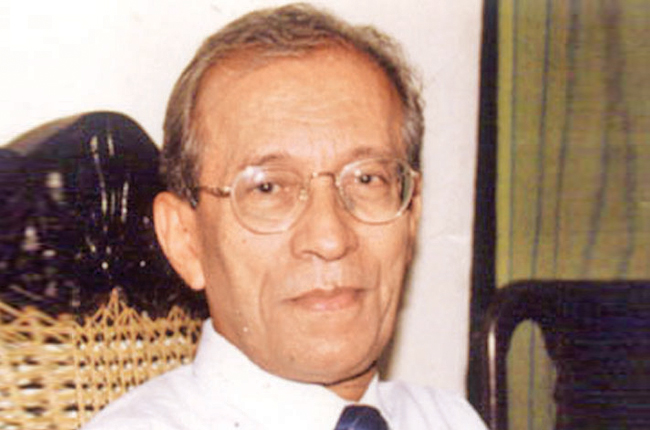

By DBS Jeyaraj/Daily Mirror
Colombo, July 14 – “Sir Donald George Bradman was, without any question, the greatest phenomenon in the history of cricket, indeed in the history of all ball games”. This was how well-known journalist and visiting professor at Oxford University Mathew Engel referred to Don Bradman in an essay about the famous Australian cricketer in the Wisden Cricketers’ Almanack. According to “Cricketinfo”, “Sir Donald Bradman of Australia was, beyond any argument, the greatest batsman who ever lived and the greatest cricketer of the 20th century”.
Bradman Weerakoon’s parents were great fans of Aussie cricketer Donald Bradman, hence the reason the due named their son ‘Bradman’
Don Bradman bestrode the world of cricket like a Colossus in the mid-twentieth Century. He became the toast of Cricket lovers in the then British Empire after he scored an unbeaten 452 for New South Wales against Queensland in January 1930.This was a world record then for scoring the highest number of runs in an innings in First-Class cricket.
Sri Lanka, known earlier as Ceylon, was under British rule when Bradman made his mark in cricket. There was much excitement when the “Orford” sailed into Colombo harbour on April 2, 1930 with the Australian cricket team touring England. Don Bradman was of course the star attraction. On April 3, 1930, Australia played a one day match against Ceylon at the Colombo Cricket Club (CCC) grounds in Maitland Crescent.
This was the first match played by 22-year-old Don Bradman outside Australia. Bradman thrilled the spectators with sizzling stroke play as he piled up runs. Bradman was on 40 when 24-year-old Neil Joseph was called to bowl. The old Royalist with his first ball in International cricket got Bradman out hit wicket!
The Australian team had a remarkable season in England, regaining the Ashes 2/1 in a 5 Test series. Don Bradman made cricket history in that tour. Don Bradman scored 974 runs in the Test series. His scores were 8, 131, 254, 1, 334, 14 and 232. In the 3rd Test match at Headingley Bradman scored 309 n.o. on the first day. His final tally of 334 runs beat the previous highest Test record score of 287.
Don Bradman also scored 2960 runs on the tour at an average of 98.86.
The 1970 United Front Govt. of Sirimavo Bandaranaike shunted Bradman out of the Prime ministerial “corridors of power” in Colombo into the administrative wilderness of the East
All these feats of Don Bradman published in newspapers were eagerly lapped up by cricket fans in Ceylon. The Aussie cricketers returned to Australia by the “Oronsay” on 28 October 1930. Enroute to Fremantle, the ship docked in Colombo on October 20, 1930. Huge crowds gathered at the harbour to cheer Bradman and get a glimpse of him if possible. News of Bradman sailing into Colombo was published in detail in the newspapers.
Climate of “Bradmania”
It was in this climate of “Bradmania” that a baby boy was born in Colombo on the same day (October 20) that the “Oronsay” with Bradman and the Aussie team sailed into the Colombo port. The parents were avid fans of Don Bradman. So they named their new born son Bradman after the famous cricketer. The boy, despite being a namesake of the legendary Bradman, did not become a famous cricketer, but did grow up to be famous as a distinguished civil servant who served under nine former Prime ministers and presidents of Ceylon/Sri Lanka.
I am of course referring to Bradman Weerakoon who passed away on July 7, 2025 at the age of 94 . Bradman, as he was generally known, graduated from the University of Ceylon (Peradeniya) and joined the prestigious Ceylon Civil Service. He held several posts such as Government Agent, Permanent Secretary, Private secretary to the Prime Minister, Commissioner -General of Essential Services and Presidential adviser in a career spanning five decades. Bradman Weerakoon also had two stints as Secretary General of the International Planned Parenthood Federation (IPPF).
“Virakesari”
I was fortunate to have had the opportunity of interacting with Bradman Weerakoon for a few years in my professional capacity as a journalist. I entered journalism in April 1977 as a staff reporter on the Tamil daily “Virakesari”. The United National Party(UNP) led by Junius Richard (JR)Jayewardene won 141 of 168 seats at the July 1977 polls and formed a new Government.
His acceptability to successive prime ministers of different political hues was a tribute to his integrity, efficiency and non-partisan approach
Plantations Industries
In those days reporters on newspapers were assigned specific ministries to cover for news – known as rounds or beats – as part of their regular duties. One of the ministries I had to cover was the Ministry of Plantations Industries. Kottawa MP and UNP veteran M.D.H. Jayawardena was the minister. His deputy was Matale MP Alick Aluwihare. The Permanent secretary to the Plantations Industries Ministry was Bradman Weerakoon. The additional secretary was Dr.P.G. Punchihewa.
The plantations industries ministry was an important one as far as the “Virakesari” was concerned .The leading Tamil newspaper had a large readership among the plantation workers of the hill country. As such I was required to cover the ministry thoroughly. Both the secretary Weerakoon and Addl. Secy. Punchihewa were very considerate and kind towards me .They were easily accessible and quite forthcoming. I can still recall my “scoop” in breaking the news about the Palmyra development board being set up under the chairmanship of veteran trade unionist K.C. Nythiananda
It was during this phase that I interacted with Bradman Weerakoon for the first time. I was in regular contact with him those days. I soon discovered that he did not like to answer telephone calls from the media during office hours. What I would do was to drop in at the ministry office then in Kollupitiya a few minutes before closing time and meet Bradman Weerakoon in person. He would then talk freely with me. There were a few occasions when Bradman would give me a ride in his vehicle and continue the conversation.
“The Island”
Bradman Weerakoon moved out of the Plantations ministry in 1980 and became secretary to the then Prime Minister Ranasinghe Premadasa. Since I was not covering the Prime minister’s office or ministries under his purview, I no longer communicated with Bradman. In 1981, I entered English journalism by joining “The Island”.
I began interacting with Bradman Weerakoon once again as a journalist while serving “The Island”. This was in regard to the on-going dialogue between the Jayewardene Govt. and the then leading Tamil political party the Tamil United Liberation Front (TULF). The objective of those regular meetings was to discuss ways and means of reviving and taking forward the District Development Councils (DDC). Bradman was the coordinator in these meetings.
Even though Bradman was only a public servant acting on instructions from the political executive, he did take a lot of interest in these meetings. He was very concerned about the escalating ethnic crisis. He would tell me that an overwhelming number of Tamil people had voted for “Tamil Eelam”. He would emphasise that a meaningful alternative should be offered to the Tamil people in order to contain secessionist tendencies. Bradman then thought the DDCs if worked properly could provide a solution. Alas! That never happened.
Worse still, the situation worsened with the anti-Tamil pogrom of July 1983. It was a chaotic situation to say the least. Bradman Weerakoon was appointed Commissioner -General of Essential Services in the aftermath of “Black”July. I continued to interact with Bradman, even as he discharged his duties efficiently. In talking to Bradman then, I realised that he was quite disillusioned by what had happened and also by what was happening.
I left Sri Lanka in 1988.Communication with Bradman Weerakoon ceased. Years later I resumed contact with him after he started working with Ranil Wickremesinghe who became Prime Minister in 2001. Ranil Wickremesinghe began a Norway facilitated peace process with the LTTE. I was then writing for “The Sunday Leader” from Toronto. I kept in touch with Bradman regarding the peace process. This too ended in 2004.
Thereafter I had only one lengthy telephone conversation with Bradman Weerakoon. This was in 2010 when he celebrated his 80th Birthday. Marianne David had interviewed him for the “Daily FT”. I re-posted the interview on my Blog. He was happy.
I then telephoned him and had a very long conversation during which we talked about many things ranging from the “Kuravar”(gypsies) of Aligambai to President Premadasa’s ill-fated valet Mohideen. That was the last time I heard Bradman’s voice.
Bradman Robin Weerakoon was born in Colombo on October 20, 1930. His parents hailed from Paiagala in Kalutara. Bradman’s father Edmund was a Police Officer and mother Edith a school teacher. Young Bradman had his primary education at Holy Cross College, Kalutara. He moved to the school by the sea at Mt. Lavinia for his secondary education. The outbreak and intensification of World War 2 saw Bradman relocating to the newly started St. Thomas’ College in Guruthalawa. Bradman pursued his tertiary education at the then University of Ceylon in Peradeniya where he obtained a BA degree in Economics and Sociology.
Thereafter Bradman sat for the prestigious Ceylon Civil Service examination and passed with flying colours. He joined the CCS and served as a cadet officer under the Government Agents of Anuradhapura and Jaffna. In 1954, Bradman was appointed Assistant secretary to the then Prime Minister Sir John Kotelawela. In 1955 he became secretary to Prime Minister Kotelawela.
Bradman Continued as secretary to Prime ministers S.W.R.D. Bandaranaike, W. Dahanayake, Sirimavo Bandaranaike and Dudley Senanayake from 1956 to 1970. His acceptability to successive prime ministers of different political hues was a tribute to his integrity, efficiency and non-partisan approach.
However the 1970 United Front Govt. of Sirimavo Bandaranaike shunted Bradman out of the Prime ministerial “corridors of power” in Colombo into the administrative wilderness of the East. Bradman served as GA of Batticaloa and then Amparai. In 1977 he became secretary of the Plantations Industries ministry under the J.R. Jayewardene regime.
In 1980, Bradman returned to familiar turf once again. He became secretary to the then Prime Minister Ranasinghe Premadasa. In 1983 Bradman was appointed Commissioner-General of Essential Services. When Premadasa became President in 1988, Bradman was appointed Presidential adviser on International Affairs. He continued as adviser to Premadasa’s successor President D.B. Wijetunga also.
Bradman was brought out of retirement by Ranil Wiickremesinghe when in 2001 the latter became Prime minister in a co-habitation Govt. under President Chandrika Kumaratunga. Bradman was once again in the saddle as secretary to the PM until 2004 when the Ranil Govt. was toppled.
During Bradman Weerakoon’s eventful career, he twice served as Secretary-General of the International Planned Parenthood Federation (IPPF) in London. The first was in 1976 and the second in 1984. Bradman was also a recipient of a Fulbright Scholarship which he utilised to acquire a MA in Sociology from the University of Michigan, USA.
Bradman spent the greater part of his blissful retirement in reading, researching and writing. As far as I remember, he wrote three memorable books. One was about his home district Kalutara known as Pasdun Korale. Bradman was from Paiyagala. Another was about Ranasinghe Premadasa. Bradman admired some of Premadasa’s qualities very much. The third was a memoir focusing mainly on the nine Prime Ministers and presidents he had served under. It was the most popular of his books.
Bradman’s parents were devout Anglicans. He too was baptised as a Christian. Yet, he became a follower of Gautama Buddha’s teachings in his late teens. However when Bradman wrote his memoir “Rendering Unto Caesar”, the title was inspired by the Bible. The gospels record an incident where Jesus Christ said “Render unto Caesar the things that are Caesar’s, and unto God the things that are God’s”. This in essence summed up Bradman’s mindset and functioning style in working with “nine latter-day Caesars” in the form of Sri Lankan Premiers and Presidents.
Bradman Weerakoon married Damayanthi Gunasekara who passed away in 2007. Their only son Esala was a diplomat in the foreign service. Esala Weerakoon served as Ambassador, High Commissioner, Foreign ministry secretary and Secretary-General of SAARC.
Bradman would have celebrate his 95th Birthday in October this year. Fate has willed otherwise. Bradman Weerakoon was one of the last of the elite Ceylon Civil servants. He was a great man who worked with Prime ministers and Presidents, but always retained great concern and affection for his country and the people of Sri Lanka.
D.B.S. Jeyaraj can be reached at dbsjeyaraj@yahoo.com
,
