

By Veeragathy Thanabalasingham
Colombo, July 12 -Successive Sri Lankan governments have consistently failed to earn the confidence of victims and affected communities when it comes to accountability for grave human rights violations. Whether in relation to alleged war crimes during the final stages of the civil war or the 2019 Easter Sunday bombings, there has been little to suggest a genuine commitment to uncovering the truth. The National People’s Power (NPP) government led by President Anura Kumara Dissanayake appears to be no different from its predecessors in this regard.
While the NPP government has taken credit for its efforts to strengthen independent institutions and pursue economic offenders, it has not shown the same resolve in addressing non-economic crimes. In dealing with the international community, it has continued the traditional balancing act: rejecting the UN Human Rights Council (UNHRC) resolutions while pledging cooperation with UN agencies.
During his recent visit to Sri Lanka, UN High Commissioner for Human Rights Volker Türk was extended full cooperation by the government. At a press conference in Colombo, Türk cautiously noted signs of a relatively positive shift in the government’s approach. He recommended a domestic mechanism aligned with international standards to address accountability issues—remarks that pleased the government but disappointed victims who have long lost faith in local mechanisms.
The High Commissioner’s observations will likely feature in his report to the next UNHRC session in September, raising anticipation about the kind of resolution core countries will introduce. Meanwhile, pressure is mounting domestically for an international investigation into the skeletal remains unearthed in Jaffna—particularly at the Chemmani mass graves site.
The government’s willingness to cooperate in the excavation of mass graves is a positive development, and such cooperation might not have been possible under previous administrations. However, following Türk’s remarks, doubts have emerged about the extent of international involvement, especially in the Chemmani case.
Ilankai Thamizharasu Katchi (ITAK) leaders C.V.K. Sivagnanam and M.A. Sumanthiran, in a letter to President Dissanayake, argued that Chemmani and other mass graves in the North-East are compelling evidence of war crimes and genocide, and must be investigated with international cooperation.
Tamil National People’s Front (TNPF) leader Gajendra Kumar Ponnambalam, speaking in Parliament, accused the NPP of dishonesty regarding the Chemmani issue. He also recalled the Janatha Vimukthi Peramuna’s (JVP) support for President Chandrika Kumaratunga during the period when the graves were first associated with state violence, suggesting a political conflict of interest for the NPP.
International attention is once again turning toward Sri Lanka’s wartime atrocities as skeletons are exhumed from mass graves. But with the global security agenda now shifting in the wake of Donald Trump’s return to power in the United States, it remains uncertain whether international actors will continue to prioritise accountability in Sri Lanka.
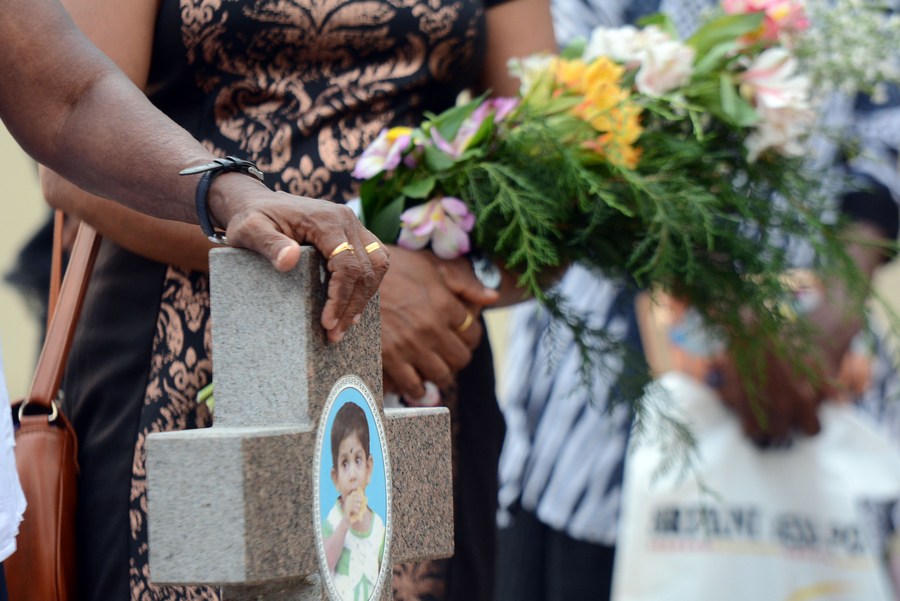
In the midst of these developments, President Dissanayake made a significant statement regarding the stalled investigations into the Easter Sunday bombings. Speaking at an event marking Cardinal Malcolm Ranjith’s 50 years of religious service, the President acknowledged the difficulty of “investigating oneself” and pledged to pursue the truth.
He assured the audience that justice would be delivered to the victims and noted that Cardinal Ranjith’s persistent calls for justice had not gone unheard. “Sri Lanka needs leaders who lead by example to build a just society,” the President said.
Cardinal Ranjith, in turn, reiterated his demand for a thorough investigation, including the uncovering of any conspiracies behind the attacks. He has, in the past, appealed to the UNHRC and even warned that he would support an international investigation if domestic efforts continued to fail. During his visit, Volker Türk also met the Cardinal to discuss the matter.
In Parliament, Samagi Jana Balawegaya (SJB) MP Mujibur Rahman responded critically to the President’s statement, suggesting that elements involved in the 2019 bombings were still operating under the current administration. Public Security Minister Ananda Wijepala, however, defended the President, insisting that the remark about self-investigation reflected a commitment to pursue the truth despite obstacles.
Why, then, have the masterminds of the Easter Sunday bombings not been found, even six years after the attacks?
Since 2019, at least seven domestic inquiries—including two court cases—have been initiated. Intelligence agencies from six countries, including India, China, and Pakistan, have submitted reports. Yet, the crucial findings remain largely hidden from the public.
A chronology of investigations includes:
Malalgoda Commission (April 2019): Appointed by President Sirisena the day after the bombings, it submitted its report in June 2019.
Parliamentary Select Committee (May 2019): Chaired by Deputy Speaker Ananda Kumarasiri.
Presidential Commission (September 2019): Headed by High Court Judge Janaka de Silva; its final report was handed over to President Gotabaya Rajapaksa in February 2021.
Fundamental Rights Petitions (2019): Filed against state officials, including Sirisena. In 2023, the Supreme Court ordered Sirisena and other top officials to pay compensation for their failures.
Channel 4 Allegations (2023): Claimed the State Intelligence Service had a role. President Wickremesinghe responded by appointing a committee led by retired judge S.I. Imam.
Alwis Committee (2024): Tasked with investigating the intelligence failures, despite earlier findings already identifying lapses by SIS and CNI.
Foreign Intelligence Reports: Six foreign countries submitted assessments. Yet none have been fully disclosed to the public.
President Wickremesinghe also promised a new committee to examine former Attorney General Dappula de Livera’s explosive claim about a “grand conspiracy” behind the bombings.
Among these investigations, the Presidential Commission report under Sirisena stands out for its depth and recommendations. Still, no government—including the current one—has acted on its findings.
During an election campaign, President Dissanayake had announced that vital revelations would be made public on the sixth anniversary of the bombings, April 21, 2025. That promise ended in disappointment. The President merely said that the report, including previously withheld documents, had been forwarded to the Criminal Investigation Department for further action.
Now, the President has remarked that “the government has to probe itself” to uncover the truth. This ambiguous statement raises serious questions. Does it imply that the government has internal conflicts of interest preventing it from acting? Or that powerful networks within the state remain untouched?
Either way, the likelihood of bringing the true masterminds to justice appears as remote as ever.
END
The writer is a senior Colombo-based journalist
