


By P.K.Balachandran/Daily News
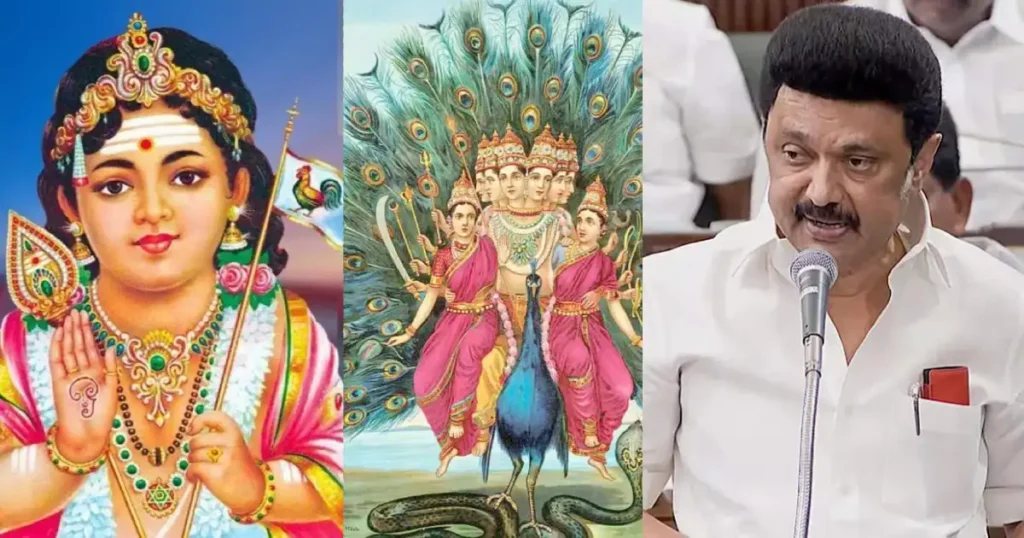
Colombo, June 17 – The Dravida Munnetra Kazhagam (DMK) and the Bharatiya Janata Party (BJP), the two major contenders in the April 2026 State legislature elections, are fighting for the endorsement of Lord Murugan, the Tamil God of War.
This is a strange battle in as much as neither party is really wedded to Lord Murugan. While the DMK is secular at best, and atheist at worst, the BJP is basically a party of North India where Murugan is not known. But both believe that parading devotion to Murugan will impress the Tamil voter whose is passionate about the deity.
TN’s Political Layout
As stated earlier, elections to the Tamil Nadu State legislature (called State Assembly) are due only in April-May next year. But political parties have already started forming alliances and raising issues to mobilize support.
The main parties in the fray are – the ruling Dravida Munntra Kazhagam (DMK), the main opposition All India Anna Dravida Munnetra Kazhagam (AIADMK), the Congress (in alliance with the DMK), and the Bharatiya Janata Party (in alliance with the AIADMK).
The BJP had been the first to be off the mark. Currently, the BJP has only four seats in the House of 234, but is very keen that it should win enough seats in 2026 to form the government or at the least be part of it. The vaulting ambition stems from the fact that Tamil Nadu has been an impregnable barrier to the BJP and its brand of aggressive Hindu nationalism and supremacy (called Hindutva). The Hindu nationalist card has worked very well in North, North West, Central, and North East India, and partially in the Southern States of Andhra Pradesh and Karnataka. But Tamil Nadu and Kerala had proved to be impenetrable.
The Tamil Nadu barrier has to be dented if the BJP is to realise its ambition to be a truly “all-India” party, as the Congress was for decades after India’s independence.
Secular vs Communal Politics
Traditionally, Tamil Nadu politics has been woven around “Tamil pride” (emotional Tamil nationalism). Caste is a factor, but the caste hierarchy is seen as an arena for bring about social awareness, social mobility and social change. The traditional Tamil parties, such as the Dravidian parties DMK and AIADMK, the Congress and the Communists, have also been “secular” in outlook, refusing to pander to narrow religious or communal passions.
The BJP, on the other hand, has typically used religious sentiments and religious groupings for political mobilization. It gives less importance to social (caste) inequalities than to “Hindu” unity to face a perceived Muslim consolidation.
In the 2021 State Assembly elections, the BJP had an alliance with a popular Dravidian party, the AIADMK. But still it got only 4 seats. Because the AIADMK was associated with the “communal and divisive” BJP, it lost the elections very badly. After the debacle, the AIADMK walked out of the alliance. However, recently it trudged back into the BJP fold apparently under pressure from the BJP government at the Centre.
Vel Yathra
Despite the inhospitable ideological environment in Tamil Nadu, the BJP has doggedly stuck to Hindu mobilization in the belief that the people of Tamil Nadu (being very religious) will sooner or later, veer round to accepting Hindutva.
In 2020, ahead of the 2021 State Assembly elections, L.Murugan, the then Tamil Nadu BJP President, launched the “Vel Yathra” (Vel is spear, the symbol of Murugan, being the God of War). The Vel Yathra had planned to cover the six abodes of the deity. But on the first day itself, Murugan and his followers were detained for defying the government’s COVID-19 restrictions.
Kasi Yathra
Undeterred by the Vel Yathra debacle, the BJP organized the “Kasi Yathra” (Pilgrimage to the holy city of Kasi or Benaras in North India) in 2022. Groups of Tamils were taken to Kasi on the banks of the holy Ganges river. But the Kasi Yathra did not strike a chord in the hearts of the Tamils because Kasi Yathra was essentially associated with the upper caste Brahmins who are barely two percent of Tamil Nadu’s population. Tamil Brahmins see themselves as being culturally different from the non-Brahmin Tamils, tracing their origins to places in North India.
DMK Leader’s Faux Pas
In 2023, the Tamil Nadu Sports Minister (now Deputy Chief Minister) Udayanidhi Stalin spoke disparagingly of “Sanatana Dharmam” believed to be the basic tenet of Hinduism. He said that Sanatana Dharmam should be “eradicated”.
According to the Hindus of North India, “Sanatan Dharm” is an all-embracing system of basic Hindu values, the essence of Hinduism as it were. But according to the Dravidian movement in Tamil Nadu it is the ideological basis of the iniquitous Hindu caste system. The widespread revulsion that Udayanidhi Stalin’s remark elicited across India, forced the DMK government to play the Hindu card for the first time in its history. And the only Hindu card that could be played effectively in Tamil Nadu was the Murugan card. And the DMK went about it in grand style
Global Murugan Conference
The ruling party organized the ‘Global Muthamizh Murugan Conference,’ at Palani in Dindigul district on August 24 and 25, 2024. Several prominent religious and spiritual leaders took part in the event. The conference was meant to proclaim the greatness of Lord Murugan. Palani, known as one of the six abodes of Lord Murugan, served as the ideal venue for this global gathering.
The conference attracted over 1,000 research papers submitted by scholars from the UK, US, Australia and Canada besides India. The papers delved into various aspects of Lord Murugan’s significance in Tamil culture, spirituality, and literature.
BJP Responds with Murugan Conference
Having grasped the cultural and religious nuances in Tamil Nadu’s caste hierarchy, and the place of Murugan in Tamil Nadu’s religious and cultural landscape, the BJP readopted Murugan as its mascot.
The “Hindu Munnani”, a wing of the Rashtriya Swyamsewak Sangh (RSS) in Tamil Nadu, announced plans to organise a “Murugan Devotees’ Meet” In Madurai on June 22 which was to attract 5 Lakh devotees. The Uttar Pradesh BJP Chief Minister, Yogi Adityanath, the most striking face of Hindutva, was invited as a special guest.
The DMK government condemned the Hindu Munnani conference as BJP’s ploy to inject Hindu communalism ahead of the 2026 elections. Apprehending trouble from the government, the Hindu Munnani filed a petition in the Madras High Court seeking permission to construct miniature replicas of the six sacred abodes of Lord Murugan (Aaru Padai Veedu) at the Madurai conference venue. It also sought clearance to use sound systems for spiritual activities from June 10 to 22.
The Tamil Nadu government opposed the conference in Madurai, citing the possibility of a stampede as was seen in Bengaluru recently during a mass celebration of a cricket match victory. A top BJP leader and India’s Home Minister Amit Shah had told party people in Madurai that they should ensure huge attendance at the Murugan conference. He slammed the DMK for undermining popular religious sentiments.
Shah had also referred to an earlier Hindu agitation at Thiruparankundram Hill, one of the six sacred abodes of Murugan. The RSS and Hindu Munnai wanted the removal of a Muslim shrine located on top of the Thiruparankundra hill in which animal sacrifice was allegedly conducted.
Smelling the onset of a communal riot, the Tamil Nadu government informed the Madurai Bench of the Madras High Court that it was willing to grant permission for the Madurai Murugan conference only for three days during which the Hindu Munnani could install temporary miniatures of the six abodes of Lord Murugan. The government opposed the plea for extending the pre-event celebrations.
Justice B. Pugalendhi then directed the Hindu Munnani to furnish its response to the government’s contentions and the police to take a decision by June 12. The court permitted the petitioner to proceed with making the miniatures. However, no puja could be conducted until the court gave a decision. It posted the matter for hearing on June 13.
On June 13, the court permitted the conference to proceed but imposed several important conditions. Most notably, the judge emphasized that “politics should not be mixed with religious events,” a directive aimed at preventing potential communal tensions.
END
