

Zhang Tongin/SCMP
Bejing May 13- An advanced ABC data sharing system made all the difference in Pakistan’s hostilities against Indian forces last week, upending combat conventions, according to a Chinese defence industry newspaper.
In a report on Monday, China Space News said the Pakistan Air Force (PAF) deployed a “locked by A, launched by B, guided by C” combat system, integrating ground radars with fighter jets, and airborne warning aircraft.
Unlike traditional air combat, where a single jet handles detection and missile guidance, Pakistan’s approach shared real-time data.
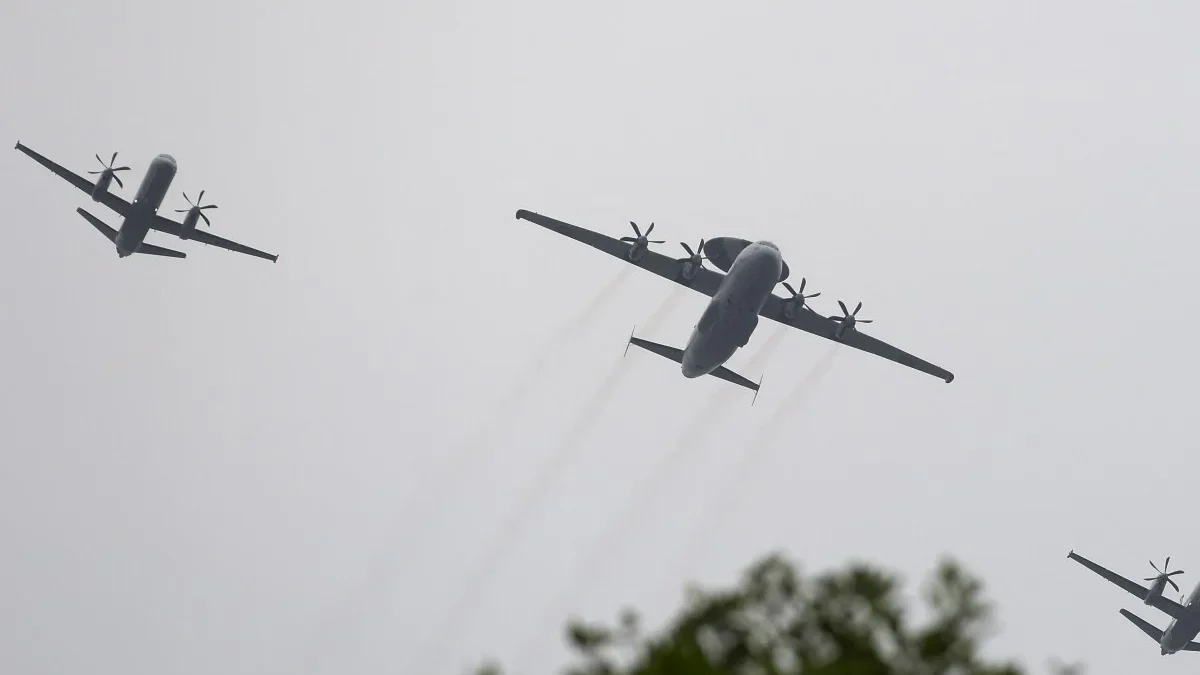
First, ground systems locked onto targets, then patrol jets launched missiles from safe distances, and finally airborne warning and control systems (Awacs) seamlessly guided the ordnance to its mark, according to the report.
The system was used against the Indian Air Force, which the Pakistani military said last week led to the loss of five Indian aircraft.
China Space News is published by China Aerospace Science and Technology Corporation and China Aerospace Science and Industry Corporation – key developers of China’s missile and air defence systems.
This “systemic and asymmetric” tactic highlighted the rise of networked, intelligent warfare over mere firepower superiority, it said.
A few countries – such as the United States and Russia – had moved to the “launched by A, guided by B” model, with one aircraft launching the missile, and another able to take over guidance.
In the recent skirmish, however, the PAF went one step further to add “guided by C”, the report said.
“Ground-based air defence systems lock onto enemy aircraft first. Fighter jets on patrol then receive the data and launch air-to-air missiles at safe distances. Subsequently, Awacs and other aircraft continue to provide tracking and guidance to the missiles until they hit the target,” it said.
“This beyond-visual-range combat ability has a game-changing role in the air combat mode.”
The report did not mention any use of Chinese-made hardware, focusing instead on the PAF’s tactical prowess and India’s failure to unify its data links and combat platforms – which it said could prove fatal in future conflicts.
But Chinese weapons have accounted for more than 80 per cent of Pakistan’s arms imports over the past five years, according to Swedish think tank SIPRI. And some footage of training exercises released by the Pakistani military showed that Pakistan had acquired the HQ-9P air defence missile system and ZDK-03 Awacs from China, in addition to the J-10CE fighter jets and PL-15E missiles credited with bringing down the Indian planes.
India had concentrated on buying equipment rather than integrating systems, the report said, citing Indian statements acknowledging data link compatibility problems between various Awacs, ground radars, and fighter jets, causing delays in threat detection and response.
“In modern air combat, even a one-second delay can be fatal,” the report warned.
Analysts noted that Pakistan’s cost-effective, precision-focused system neutralised India’s numerical air-power advantage.
“If India doesn’t speed up equipment standardisation, data link unification, strengthen training and logistics, it may face more strategic failures in future networked warfare,” the report warned.
It said that analysis of this conflict and others around the world indicated that military confrontations today had evolved from merely exchanging firepower to systemic, intelligent, and asymmetric warfare.
The article also highlighted the potential for integrating drones into such networked combat systems.
“[Drones] can use low-altitude blind spots in air defence networks to gather real-time intelligence or target ground assets like airbases. They can also serve as missile launch platforms, boosting firepower and strike efficiency.”
END
