
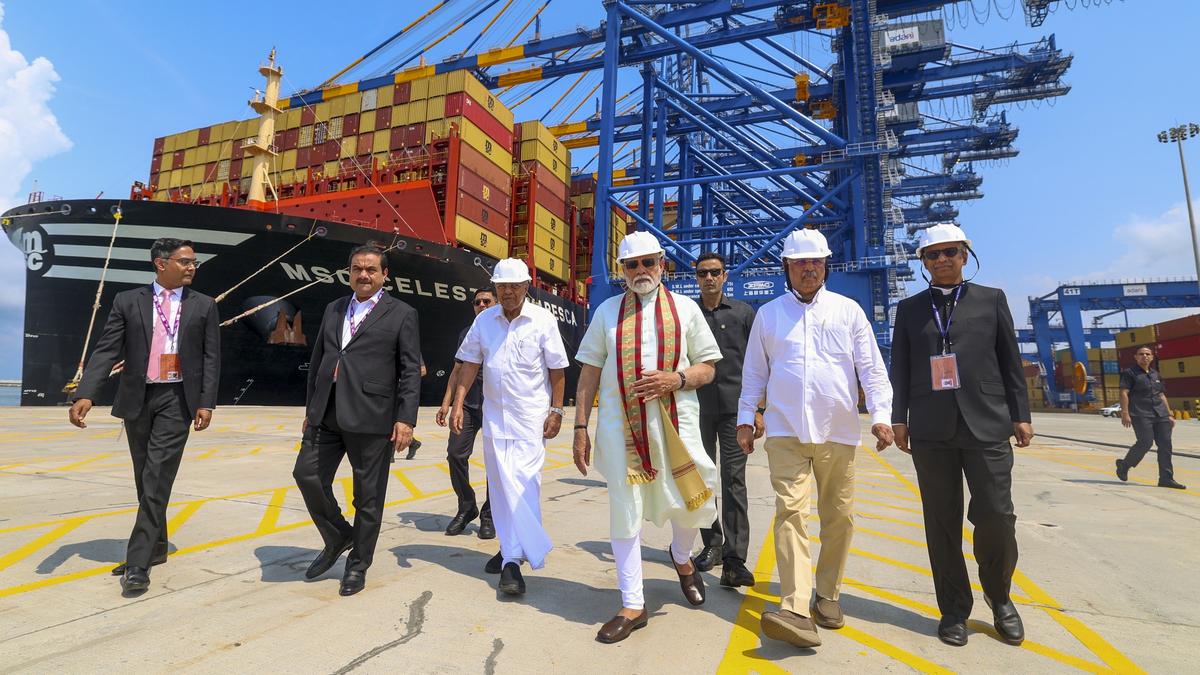

By P.K.Balachandran/Daily News
Colombo, May 6 -Karan Adani, Managing Director of Adani Ports and Special Economic Zone Ltd, has revealed that the company aims to make Vizhinjam Port in Kerala, inaugurated by Indian Prime Minister Narendra Modi on May 2, one of the most efficient ports globally.
“We have to complete phase two by 2028, to take this up to 5 million TEU of capacity. Currently we are at 1.2 million TEU. We have to make this one of the most efficient ports, not just in the country, but globally, and help Indian importers and exporters reduce their logistics costs,” Karan Adani said.
“With our network of ports, we should target at least a 25 to 30% reduction in the logistics cost for any container or any cargo which is moving through our ports,” Karan Adani told Asian News International (ANI).
Challenges
He discussed the challenges faced during the construction of the port. They faced two cyclones and strikes too.
“We had 7 million tons of rocks to bring in, which was a big challenge. There were so many challenges, but I must appreciate that the team has been extremely dedicated and strong. And most importantly, I must thank the Government of Kerala, as well as the people of Trivandrum, for supporting the project, even during the toughest times,” he said.
He stated that the India-Middle East Europe Economic Corridor (IMEC) is a critical project for the country because it provides an alternate route outside of the Suez Canal.
Transshipment Efficiency
One of the key reasons Vizhinjam could attract containers traditionally handled by Colombo, Jebel Ali, and Singapore is its superior efficiency.
The automated systems being implemented at Vizhinjam, along with its STS Super Post-Panamax cranes, are designed to reduce turnaround times for vessels. Additionally, the port’s direct access to the Arabian Sea and proximity to international shipping lanes allow for quicker cargo movement compared to more congested ports.
Other Key Features
Natural Depth: With a depth of 24 meters, the port can handle large cargo ships, including the world’s biggest ULCS, without the need for extensive dredging.
Each berth at Vizhinjam can handle 24,000 TEU, making it a highly capable port for container transshipment. As India’s first automated and eco-friendly port, Vizhinjam is designed to meet modern sustainability standards, offering a compelling case for shipping lines looking to enhance their environmental credentials.
The port’s planned railway connection and infrastructure development, including India’s third-longest railway tunnel, will make transportation more seamless and efficient.
Shift in Global Shipping Dynamics
The emergence of Vizhinjam as a viable alternative to established transshipment hubs could lead to significant shifts in global shipping routes. Shipping lines and logistics companies may start re-evaluating their operational costs, time efficiency, and fuel consumption, leading to a reorientation of global maritime trade towards South Asia.
As Vizhinjam’s capabilities expand, the port could redefine container transshipment in the region, challenging the status quo of Colombo, Jebel Ali, and Singapore.
Effect on Other Ports
Located just 10 nautical miles from the busy Suez-Far East and Far East-Middle East routes, Vizhinjam has a significant edge in terms of proximity to global shipping lanes.
With a natural depth of 24 meters, the port can easily accommodate large vessels, including Ultra Large Container Ships (ULCS) that currently pass through major international transshipment hubs such as Colombo, Jebel Ali, and Singapore. These shipping routes see heavy traffic between Europe, the Persian Gulf, Southeast Asia, and the Far East.
Colombo is one of the most prominent transshipment hubs in South Asia, handling a significant portion of India’s cargo. However, with Vizhinjam in place, business currently funneled through Colombo will get directed to Vizhinjam. It is said that Colombo’s relatively smaller depth and congestion may also make it less appealing to larger vessels in the future.
Jebel Ali port in Dubai, UAE is another port to be affected by Vizhinjam. Jebel Ali Port serves as a major transshipment hub for Indian containers moving to global markets. Its connectivity to international trade routes, however, could be challenged by Vizhinjam’s proximity to key shipping lanes, reducing the need for containers to be transshipped via Dubai. With its state-of-the-art infrastructure and automated systems, Vizhinjam promises greater efficiency.
Singapore is one of the largest and busiest ports in the world, Singapore Port is the preferred transshipment hub for India-bound cargo. However, the significant distance between India and Singapore means that shipping lines have to deal with higher fuel costs and longer transit times. In contrast, Vizhinjam’s closer proximity to India’s southern coastline offers substantial savings in both time and cost. Vizhinjam port’s modern design and focus on automation position it as a competitive alternative to Singapore’s more traditional, heavily trafficked infrastructure.
Loss of Business
It is obvious that Vizhinjam will directly impact the economies of these existing maritime hubs. A loss of transshipment business could translate into reduced revenue from port operations, terminal handling charges, and ancillary services. For India, the new port promises to reduce dependency on foreign ports for transshipment, thereby retaining a larger share of the shipping value chain within its borders.
A View From Colombo
Shippers’ Academy International (SAI) founder and Shippers Academy Colombo (SAC) CEO Rohan Masakorala, notes that Vizhinhjam port is equipped with advanced automation for quick vessel turnaround and state-of-the-art infrastructure capable of handling Megamax container ships.
In a media interview, Maskarola said that in the initial phase, Vizhinjam will have the capacity to handle one million TEUs, with plans to expand to 6.2 million TEUs in future phases. Designed to accommodate large liners carrying 20,000-25,000 containers, Vizhinjam addresses a key gap in India’s port infrastructure.
However, Colombo Port remains the primary transshipment hub in the Indian Ocean, largely due to its strategic location along the major shipping route connecting the Middle East to East Asia. Several key global ports, such as Chittagong, Yangon, Kolkata, Visakhapatnam, Chennai, Cochin, Mumbai, Karachi and Fujairah, rely on Colombo as a key transshipment point for their cargo movements, Maskaola said.
Key Indices for Colombo
According to Maskarola, data shows that Colombo maintained stable volume inflows, with a slight downturn between 2022 and 2023, but recovered in 2024. A similar pattern is seen in the Port Connectivity Index, which experienced growth from 2019, followed by stabilization, and then a decline during 2022-2023. These two declines are notably parallel. Since 2024, both transshipment volumes and connectivity have resumed an upward trend.”
“The Sri Lanka Ports Authority (SLPA) attributes the recent drop in cargo handling to seasonal variations and broader global economic and social factors, emphasizing that this decline is not unique to Colombo but has affected international ports as well.
Vizhinjam Port believes that it has the potential to become the main transshipment hub in the Indian Ocean. Positioned at a crucial chokepoint, Vizhinjam could connect not only with other major chokepoints such as the Strait of Malacca, Bab el-Mandeb, and the Strait of Hormuz, but also with secondary routes, particularly those emerging from the rapidly growing Southeastern Asia region, Maskarola points out.
“This notion is reinforced by the growing interest from international shipping lines in utilizing the newly opened Vizhinjam Transshipment Terminal, which shipping lines are increasingly considering due to delays caused by cargo congestion and work disruptions at Colombo Port,” he adds.
While Colombo Port currently holds a significant position in the region, Vizhinjam’s rapid development and strategic advantages could lead to a shift in transshipment dynamics, potentially reducing Colombo’s market share in the future.
However, Colombo’s established position and recent recovery trends mean it will remain a strong player in the region. The ultimate outcome will depend on how quickly Vizhinjam can scale its operations and how Colombo will adapt to the emerging competitive pressures.
Regardless of the capabilities of Vizhinjam, Colombo port will have to modernized and adopt a different management style, Maskarola said. Colombo should adopt Singapore’s landlord model, wherein the government provides all the infrastructure and the port is run by shipping lines. Statism should end and private enterprise put in charge so that Colombo attracts business automatically, Maskarola recommended.
But given the socialist leanings of successive Sri Lankan regimes privatization is unlikely to be given any serious consideration.
END
India, Sri Lanka, Vizhinjam port, Colombo, UAE. Singapore, Karan Adani,
