
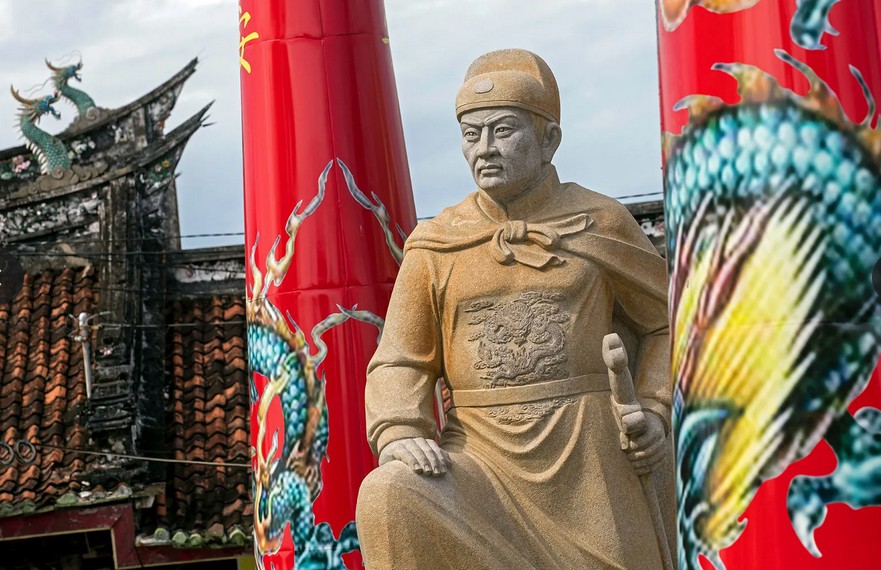

By P.K.Balachandran/Daily News
Colombo, April 22 – Last week UNESCO officially added the “Trilingual Inscription” in Galle, and a collection of documents related to the 1873 “Panadura Disputation” to its prestigious World Heritage List, recognising their historical and cultural significance.
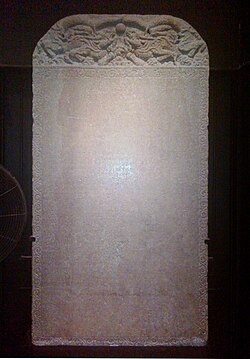
The “Galle Trilingual Inscription” is a stone tablet inscribed with texts in Chinese, Tamil, and Persian, installed by Chinese Admiral Zheng He in 1409 AD. It is the only combined Chinese, Tamil and Persian inscription in the world.
The inscription is dated 15 February 1409, when the Ming dynasty’s Emperor Yongle was ruling China (1403–1424). It is on a red sandstone slab 4 feet 9 inches in length, 2 feet 6 inches in breadth, and 5 inches in thickness. It features a floral border and a rounded top adorned with two carved dragons facing each other.
The Chinese inscription is on the right in the slab. It praises the Buddha and lists offerings (e.g., gold, silver, silk, incense) made to Buddhist temples, made probably at Sri Pada. It emphasizes the Ming Dynasty’s reverence for Buddhism.
The inscription in Tamil is in the upper left portion. It mentions offerings to “Thenavarai Nayanar” (one of the Tamil names of the Hindu god Vishnu). There is also a theory that Thenavarai Nayanar may be the Tamil term for the Sinhalese Buddhist deity Upulvan at Devinuwara. The offerings to Thenavarai Nayanar include 1,000 gold pieces, 5,000 silver pieces, 50 rolls of multi-colored silk, gold-plated brass vases, and 2,500 golden lotus flowers, among others. It reflects the Chinese acknowledgment of Hindu traditions in Sri Lanka.
The inscription in Persian is in the lower left portion, written in the Perso-Arabic script. It is partially defaced but refers to offerings to “the light of Islam” (likely a shrine). This shows Chinese Emperor Yongle’s and Adm.Zheng’s equal respect for Muslim traders in the region. Zhen He was a Muslim himself. Zheng is the surname of Zheng He.
The inclusion of Tamil, Persian, and Chinese reflects the languages of key trading communities in Galle, a major port frequented by Chinese, Tamil and Persian merchants. Tamil was a prominent language of commerce in the Indian Ocean, Persian was a lingua franca for Muslim traders, and Chinese represented the Ming envoy, Zheng He.
Why not in Sinhala?
The question why Sinhalese was not used is often asked. Historians say that, at that time, the Sinhalese people were not in international trade which was in the hands of Muslims (Arabs and local converts to Islam) and Tamils, who were settled in the coastal areas. At any rate, the reference to Buddhism in the slab in the form of offerings to the Buddha was a recognition of the Sinhalese who were all Buddhists at that time prior to the advent of the Portuguese.
To Sri Lankan sociologist Dr Sasanka Perera the slab was a “subtle but obvious way of appealing to the socio political sensibilities of large and important communities in The Island at the time.”
Serendipitous Discovery
The Galle Inscription was serendipitously discovered in 1911 by a British engineer, H.F. Tomalin, while he was working on a culvert near Cripps Road in Galle. It is now preserved in the National Museum of Colombo. A replica is displayed at the Maritime Museum in Galle, and another replica is kept in the Treasure Boat Shipyard Park in Nanjing in China, which was the capital of the Ming dynasty.
It is clear that the slab was inscribed in Nanjing during Emperor Yongle’s reign, before Admiral Zheng He’s fleet departed for its third voyage in 1409–1411 in search of treasure and trade routes. The date “15 February 1409” on the slab indicates it was prepared prior to the fleet’s departure, likely in late 1408 or early 1409. It was to showcase the Ming Dynasty’s respect for the diverse religious traditions of Sri Lanka’s cosmopolitan trading community. The inscriptions invoke blessings for a “peaceful world built on trade,” highlighting the Ming Dynasty’s goal of establishing a stable, trade-oriented network across the Indian Ocean.
On why the slab was installed in Galle, historians say that Galle was a key port on the Indian Ocean trade route, known for its gem trade, spices, and strategic location. Zheng He’s fleet anchored there to engage in trade fairs and establish commercial ties with local rulers and merchants.
Zheng’s clash with king Alakeswara
Zheng’s voyages to Sri Lanka are known not only for the Galle inscriptions but also his confrontations with Veera Alakeswara, the king of Kotte. Veera Alakeswara, his family, and his retinue, were captured and taken away to Nanjing in China, chastised for attacking Zheng He’s ships and brought back. But not to rule as Adm. Zheng had already installed the more pliant Parakramabahu VI on the thrown in Kotte.
According to Dr.Nirmala Chandrahasan, the Alagakkonara or Allagakone family to which Alakeswara belonged, was a feudal family originally from Madurai or Kancheepuram in Tamil Nadu. It settled down in Sri Lanka and became very powerful in the Gampola Kingdom. The father of Alakesvara became a Minister in the Kingdom. He fortified a marshy region around the present city of Colombo and called the fortress Kotte, (‘fort’ in Tamil). Eventually he overshadowed Gampola king Vikramabahu III and began to rule Kotte. His son, Veera Alakeshvara, became king the title Vijayabahu VI (ruling from 1397 to 1411).
Veera Alakeshvara launched piracy attacks on the Chinese fleet of Zheng He in Sri Lankan waters with the help of some Muslim chieftains. Zheng He retreated but only to return to take revenge. He captured Kotte and took Veera Alakesvara and his retinue to China. The “August Emperor”” spared their lives after they “humbly kowtowed and praised the sage like virtue of the Imperial Ming ruler.”
But this was not the end of the matter. As Prof. Sasanka points out regime change was the Chinese objective. Chinese records reveal that the new king Parakramabahu VI was “chosen by Sinhalese emissaries present at the Ming Court, nominated by the Emperor and installed by Zheng He.” Parakramabahu VI had an alliance with the Chinese that gave ambitious political projects of the Chinese such as the “Ming Treasure Voyages” easy access to Sri Lankan waters as well as local political support.
Zheng He’s fleet or armada was reportedly huge, with estimates saying that there were over 200 vessels and 28,000 sailors. Some of these vessels were 120 metres in length with five decks each. It is said that the crew grew vegetables on the top decks and had piggeries in the bottom bilge decks. Armed to the teeth to resist any attacks, Zheng He’s vessels carried like silk, gold and silver coins, porcelain vases and plates for trading around the world.
Dr.Chandraasan says that Chinese trade was a key factor in the Sri Lankan economy as vindicated by the large collection of Chinese coins in Yapahuwe.
But after the great naval expeditions of Zheng He, there was a change in China’s policy and internal constraints made the country turn inwards. The Ming dynasty not only traded extensively, but also fought wars in the process, which proved to be too costly for the State.
According to Dr. Tansen Sen, Associate Professor of Baruch College, City University of New York, who specializes in Asian history, “Zheng’s seven expeditions between 1405 and 1433 included use of military force in what are present-day Indonesia, Malaysia, Sri Lanka and India to install friendly rulers and control strategic chokepoints of the Indian Ocean. Zhen He intervened in dynastic politics of Sri Lanka and Indonesia and brought back prisoners to Nanjing, the Ming capital.”
END
Sri Lanka, China ,Adm.Zheng He, Veera Alakeswara, Treasure and Trade, Tamils, Muslims, Sinhalese,
