

By P.K.Balachandran/Daily Mirror
Colombo, April 22 – In the emerging era marked by Trump’s tariffs and politically motivated sanctions, the Global South, which has been struggling to come out of isolation and poverty, has no option but to reduce its dependence on the Global North. It has to seek ways of banding together and helping each other grow. For this, they have to suspend mutual animosities, rivalries and reservations.
Existing organizations like ASEAN, SAARC and RECP and BIMSTEC should be used to the maximum. The guiding principle should be “United We Stand, Divided We Fall”.
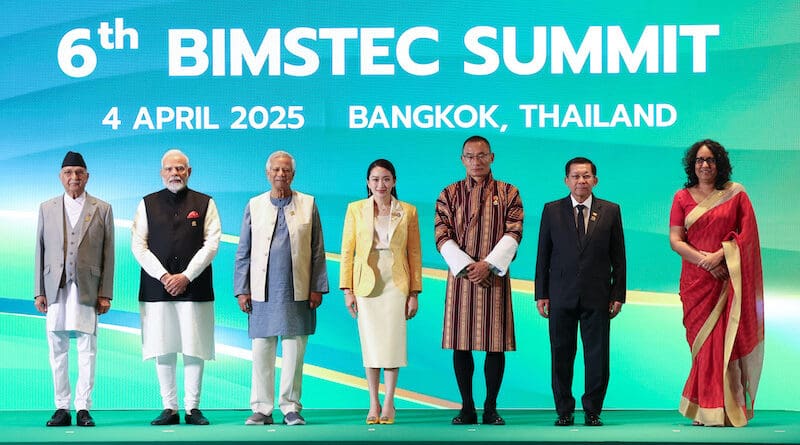
It is in this context that one should view the recently concluded 6th. summit of BIMSTEC (Bay of Bengal Initiative for Multi-Sectoral Technical and Economic Cooperation) in Bangkok. The Bangkok Vision 2030 provides a comprehensive and practical roadmap for future cooperation amongst the member States which are Sri Lanka, India, Bangladesh, Nepal, Bhutan, Myanmar and Thailand.
A highlight of the summit was the signing of the “Agreement on Maritime Transport Cooperation.” It’s a significant step towards enhancement of maritime connectivity, increasing trade and travel amongst the member States. It goes without saying that as an island State, Sri Lanka’s future is tied up with maritime connectivity.
The summit also saw the signing of an MoU between BIMSTEC and Indian Ocean Rim Association (IORA), to institutionalise future partnership in key areas of shared interest. To streamline procedures for cooperation, the summit adopted Rules of Procedure for BIMSTEC Mechanisms.
In their statements at the Summit, the BIMSTEC heads of government presented specific proposals and initiatives for enhancing intra-regional trade and investment, connectivity, tourism, culture exchanges, climate action, green and renewable energy, sustainable agriculture, food security, disaster management and security.
Prime Minister Dr. Harini Amarasuriya of Sri Lanka said that BIMSTEC members must forge stronger and more meaningful ties; and explore imaginative, creative, and innovative ways of enhancing cooperation in the best interest of the people of our region.
“Although we face many challenges, we similarly have many unexplored opportunities as well in numerous fields including trade, economic cooperation and connectivity which, if seized, will benefit all our countries,” she pointed out and pleaded for open and accommodative mind sets to seek solutions to what has held the members back.
“The situation calls for ways to share knowledge, technology, intelligence, and best practices; improving physical, digital, and energy connectivity; and acceleration of the pace and depth of cooperation in the sectors and sub-sectors of BIMSTEC cooperation,” Dr.Amarasuriya said.
Alluding to Sri Lanka, she said, “As the only island nation in BIMSTEC, we welcome the signing of the Maritime Transport Cooperation Agreement. Sri Lanka seeks to develop its ports and related infrastructure required to make the country a hub in the Indian Ocean that can serve all the BIMSTEC member states and the wider Indian Ocean region.”
Dr.Amarasuriya recalled that at the 5th Summit in 2022, member States had signed an MoU for the establishment of the BIMSTEC Technology Transfer Facility (TTF) in Colombo. Since all member States have completed their respective domestic formalities, BIMSTEC must take steps to convene the Governing Board of the Centre at an early date, she urged.
Since the 5th Summit in 2022, Sri Lanka has taken the initiative to formulate BIMSTEC Plans of Action in Science, Technology, and Innovation; Public Health; and Human Resource Development. Dr.Amarasuriya hoped to see implementation of the formulated plans.
Modi’s Plethora of Offers
India’s Prime Minister Narendra Modi proposed a plethora of India-funded projects for BIMSTEC members.
They were the following – establishment of the BIMSTEC Chamber of Commerce; organizing a BIMSTEC Business Summit every year; conducting a feasibility study on the possibilities of trade in local currencies in the BIMSTEC region; doing a pilot study to understand the needs of BIMSTEC countries for sharing India’s experience in Digital Public Infrastructure (DPI); establishing connectivity between payment systems in the BIMSTEC region;
Modi proposed the establishment of a BIMSTEC Centre of Excellence for Disaster Management in India, and holding joint exercises between BIMSTEC Disaster Management Authorities in India this year. He proposed the setting up ground stations for manpower training for BIMSTEC countries in manufacturing and launching Nano Satellites, and using remote sensing data; establishing a BIMSTEC centre for human resource infrastructure initiative to train 300 youth from BIMSTEC countries in India every year; and granting scholarships to BIMSTEC students in the Forestry Research Institute of India.
Modi also said that the Tata Memorial Centre would support training and capacity building in cancer care in BIMSTEC countries. He proposed to establish a Centre of Excellence for research and dissemination in traditional medicine, setting up a Centre of Excellence in India for the exchange of knowledge and best practices, research and capacity building for the benefit of farmers.
The Indian Prime Minister proposed the speeding up of work on electric grid interconnection and establishing a Sustainable Maritime Transport Centre in India to enhance coordination in capacity building, research, innovation and maritime policies.
The recent imposition of high tariffs on trade by the US on is a wake-up call for all Global South countries. But a close reading of the Office of the US Trade Representative’s (USTR) findings suggests that high tariffs in many countries are not the only grievance of the US. There is a wide array of non-tariff barriers and para-tariffs in the Global South, including Sri Lanka.
To make BIMSTEC meaningful, member countries must reform their economies, by substantially lowering tariff and non-tariff barriers, welcome FDIs with open arms, improve infrastructure, and make doing business easier. They should control corruption and inefficiencies and encourage domestic entrepreneurship.
Advocata’s Advice
Colombo-based Advocata Institute (AI) has pointed out that Sri Lanka has been highly protectionist with “ad hoc levies, price controls, import quotas, midnight gazettes and opaque customs practices” all sources of irritation for trading partners.
“Many of these measures lie outside the WTO framework, creating both inefficiencies and unpredictability in the trading environment,” AI points out in a statement. It called for rationalising the tariff structure, rapidly phasing out para-tariffs, addressing behind-the-border barriers, and improving trade facilitation.
“Trade policy must now move beyond protectionism and towards enabling integration into global value chains,” the AI said reiterating a long-standing plea of economists but always ignored.
“Countries are moving decisively to lock in market access, deepen integration, and improve resilience. Sri Lanka, however, risks being left behind. Sri Lanka must now actively consider accession to regional trade blocs and seek bilateral agreements with both traditional and emerging partners,” Advocata urged.
Need to Integrate With India’s Economy
While integration with all BIMSTEC countries is needed, Sri Lanka could start with India, the nearest big economy. The Indo-Sri Lanka Free Trade Agreement (FTA), in force since 2000, provides a strong foundation, enabling over 60% of Sri Lankan exports to benefit from preferential access. However, Sri Lanka has not fully realised the benefits of this agreement. This is partly also due to India’s Non-Tariff Barriers (NTBs), its complex rules of origin, and tariff quotas on key export items—such as tea and garments.
Recently Sri Lanka reportedly asked for the garments quota to be raised to 50 million pieces but was reportedly told that the matter could be taken up during talks on the Economic Technical Cooperation Agreement (ETCA). But Sri Lanka has been dragging its feet on signing ETCA due to a fear of Indian domination.Advocate argues that the overall benefits of ETCA is so large that Sri Lanka would gain rather than lose, especially with the US closing up.
Advocata has also urged the conclusion of the Comprehensive Economic Partnership Agreement (CEPA) with India—a framework negotiated over 13 rounds and nearly finalised in 2008. “CEPA aims to go beyond goods to cover services, investments, and regulatory cooperation. If well-designed and transparently negotiated, it could address many of the constraints holding back Sri Lankan exporters, support investment inflows, and enable service-sector expansion—particularly in IT, logistics, and education,” Advocata pointed out.
“Sri Lanka can gain from greater integration, especially by tapping into India’s expanding middle-class—expected to reach 700 million by 2030—and attracting Indian investment into tradable sectors. Investment in ports, energy, IT, and hospitality can enhance Sri Lanka’s competitiveness, job creation, and foreign exchange earnings. Colombo and Trincomalee ports, grid connectivity for affordable power, and service sector integration—particularly in IT, aligned with Sri Lanka’s ambition to grow its tech workforce—are promising avenues,” the think tank reasoned.
Advocata recognises that deepening trade ties with India is not without challenges. But also warns that the alternative—continued stagnation and vulnerability to arbitrary tariffs or shifting investor sentiment—is far worse.
“Sri Lanka must move beyond domestic hesitation and re-engage India in good faith,” the think tank urged.
END
By P.K.Balachandran/Daily Mirror
Colombo, April 22 – In the emerging era marked by Trump’s tariffs and politically motivated sanctions, the Global South, which has been struggling to come out of isolation and poverty, has no option but to reduce its dependence on the Global North. It has to seek ways of banding together and helping each other grow. For this, they have to suspend mutual animosities, rivalries and reservations.
Existing organizations like ASEAN, SAARC and RECP and BIMSTEC should be used to the maximum. The guiding principle should be “United We Stand, Divided We Fall”.
It is in this context that one should view the recently concluded 6th. summit of BIMSTEC (Bay of Bengal Initiative for Multi-Sectoral Technical and Economic Cooperation) in Bangkok. The Bangkok Vision 2030 provides a comprehensive and practical roadmap for future cooperation amongst the member States which are Sri Lanka, India, Bangladesh, Nepal, Bhutan, Myanmar and Thailand.
A highlight of the summit was the signing of the “Agreement on Maritime Transport Cooperation.” It’s a significant step towards enhancement of maritime connectivity, increasing trade and travel amongst the member States. It goes without saying that as an island State, Sri Lanka’s future is tied up with maritime connectivity.
The summit also saw the signing of an MoU between BIMSTEC and Indian Ocean Rim Association (IORA), to institutionalise future partnership in key areas of shared interest. To streamline procedures for cooperation, the summit adopted Rules of Procedure for BIMSTEC Mechanisms.
In their statements at the Summit, the BIMSTEC heads of government presented specific proposals and initiatives for enhancing intra-regional trade and investment, connectivity, tourism, culture exchanges, climate action, green and renewable energy, sustainable agriculture, food security, disaster management and security.
Prime Minister Dr. Harini Amarasuriya of Sri Lanka said that BIMSTEC members must forge stronger and more meaningful ties; and explore imaginative, creative, and innovative ways of enhancing cooperation in the best interest of the people of our region.
“Although we face many challenges, we similarly have many unexplored opportunities as well in numerous fields including trade, economic cooperation and connectivity which, if seized, will benefit all our countries,” she pointed out and pleaded for open and accommodative mind sets to seek solutions to what has held the members back.
“The situation calls for ways to share knowledge, technology, intelligence, and best practices; improving physical, digital, and energy connectivity; and acceleration of the pace and depth of cooperation in the sectors and sub-sectors of BIMSTEC cooperation,” Dr.Amarasuriya said.
Alluding to Sri Lanka, she said, “As the only island nation in BIMSTEC, we welcome the signing of the Maritime Transport Cooperation Agreement. Sri Lanka seeks to develop its ports and related infrastructure required to make the country a hub in the Indian Ocean that can serve all the BIMSTEC member states and the wider Indian Ocean region.”
Dr.Amarasuriya recalled that at the 5th Summit in 2022, member States had signed an MoU for the establishment of the BIMSTEC Technology Transfer Facility (TTF) in Colombo. Since all member States have completed their respective domestic formalities, BIMSTEC must take steps to convene the Governing Board of the Centre at an early date, she urged.
Since the 5th Summit in 2022, Sri Lanka has taken the initiative to formulate BIMSTEC Plans of Action in Science, Technology, and Innovation; Public Health; and Human Resource Development. Dr.Amarasuriya hoped to see implementation of the formulated plans.
Modi’s Plethora of Offers
India’s Prime Minister Narendra Modi proposed a plethora of India-funded projects for BIMSTEC members.
They were the following – establishment of the BIMSTEC Chamber of Commerce; organizing a BIMSTEC Business Summit every year; conducting a feasibility study on the possibilities of trade in local currencies in the BIMSTEC region; doing a pilot study to understand the needs of BIMSTEC countries for sharing India’s experience in Digital Public Infrastructure (DPI); establishing connectivity between payment systems in the BIMSTEC region;
Modi proposed the establishment of a BIMSTEC Centre of Excellence for Disaster Management in India, and holding joint exercises between BIMSTEC Disaster Management Authorities in India this year. He proposed the setting up ground stations for manpower training for BIMSTEC countries in manufacturing and launching Nano Satellites, and using remote sensing data; establishing a BIMSTEC centre for human resource infrastructure initiative to train 300 youth from BIMSTEC countries in India every year; and granting scholarships to BIMSTEC students in the Forestry Research Institute of India.
Modi also said that the Tata Memorial Centre would support training and capacity building in cancer care in BIMSTEC countries. He proposed to establish a Centre of Excellence for research and dissemination in traditional medicine, setting up a Centre of Excellence in India for the exchange of knowledge and best practices, research and capacity building for the benefit of farmers.
The Indian Prime Minister proposed the speeding up of work on electric grid interconnection and establishing a Sustainable Maritime Transport Centre in India to enhance coordination in capacity building, research, innovation and maritime policies.
The recent imposition of high tariffs on trade by the US on is a wake-up call for all Global South countries. But a close reading of the Office of the US Trade Representative’s (USTR) findings suggests that high tariffs in many countries are not the only grievance of the US. There is a wide array of non-tariff barriers and para-tariffs in the Global South, including Sri Lanka.
To make BIMSTEC meaningful, member countries must reform their economies, by substantially lowering tariff and non-tariff barriers, welcome FDIs with open arms, improve infrastructure, and make doing business easier. They should control corruption and inefficiencies and encourage domestic entrepreneurship.
Advocata’s Advice
Colombo-based Advocata Institute (AI) has pointed out that Sri Lanka has been highly protectionist with “ad hoc levies, price controls, import quotas, midnight gazettes and opaque customs practices” all sources of irritation for trading partners.
“Many of these measures lie outside the WTO framework, creating both inefficiencies and unpredictability in the trading environment,” AI points out in a statement. It called for rationalising the tariff structure, rapidly phasing out para-tariffs, addressing behind-the-border barriers, and improving trade facilitation.
“Trade policy must now move beyond protectionism and towards enabling integration into global value chains,” the AI said reiterating a long-standing plea of economists but always ignored.
“Countries are moving decisively to lock in market access, deepen integration, and improve resilience. Sri Lanka, however, risks being left behind. Sri Lanka must now actively consider accession to regional trade blocs and seek bilateral agreements with both traditional and emerging partners,” Advocata urged.
Need to Integrate With India’s Economy
While integration with all BIMSTEC countries is needed, Sri Lanka could start with India, the nearest big economy. The Indo-Sri Lanka Free Trade Agreement (FTA), in force since 2000, provides a strong foundation, enabling over 60% of Sri Lankan exports to benefit from preferential access. However, Sri Lanka has not fully realised the benefits of this agreement. This is partly also due to India’s Non-Tariff Barriers (NTBs), its complex rules of origin, and tariff quotas on key export items—such as tea and garments.
Recently Sri Lanka reportedly asked for the garments quota to be raised to 50 million pieces but was reportedly told that the matter could be taken up during talks on the Economic Technical Cooperation Agreement (ETCA). But Sri Lanka has been dragging its feet on signing ETCA due to a fear of Indian domination.Advocate argues that the overall benefits of ETCA is so large that Sri Lanka would gain rather than lose, especially with the US closing up.
Advocata has also urged the conclusion of the Comprehensive Economic Partnership Agreement (CEPA) with India—a framework negotiated over 13 rounds and nearly finalised in 2008. “CEPA aims to go beyond goods to cover services, investments, and regulatory cooperation. If well-designed and transparently negotiated, it could address many of the constraints holding back Sri Lankan exporters, support investment inflows, and enable service-sector expansion—particularly in IT, logistics, and education,” Advocata pointed out.
“Sri Lanka can gain from greater integration, especially by tapping into India’s expanding middle-class—expected to reach 700 million by 2030—and attracting Indian investment into tradable sectors. Investment in ports, energy, IT, and hospitality can enhance Sri Lanka’s competitiveness, job creation, and foreign exchange earnings. Colombo and Trincomalee ports, grid connectivity for affordable power, and service sector integration—particularly in IT, aligned with Sri Lanka’s ambition to grow its tech workforce—are promising avenues,” the think tank reasoned.
Advocata recognises that deepening trade ties with India is not without challenges. But also warns that the alternative—continued stagnation and vulnerability to arbitrary tariffs or shifting investor sentiment—is far worse.
“Sri Lanka must move beyond domestic hesitation and re-engage India in good faith,” the think tank urged.
END
