

By Veeragathy Thanabalasingham
Colombo, April 10 – Indian Prime Minister Narendra Modi’s visit to Sri Lanka last week was significant in many ways. Modi is not only the only Indian Prime Minister to visit Sri Lanka four times in a decade, h he is also the only foreign leader to do so.
Modi’s three-day visit to Sri Lanka in March 2015 was the first bilateral visit by an Indian Prime Minister to Sri Lanka in 28 years. The last Indian Prime Minister who made a bilateral official visit was Rajiv Gandhi, who came to Colombo on 29 July 1987 to sign the Indo-Sri Lanka Peace Accord with the then President J.R. Jeyawardane.
Modi’s second visit was to participate as the chief guest at the International Vesak Day celebrations in May 2017. Modi visited Sri Lanka in the second week of June, 2019, a month and a half after the Easter Sunday bombings. He visited St. Anthony’s church in Kochchikade, Colombo, one of the churches where the attack took place. He expressed his country’s solidarity with Sri Lanka in its fight against terrorism. Interestingly, Maithripala Sirisena was the Sri Lankan President during all three visits of PM Modi.
He was the first foreign leader to visit the island nation in the backdrop of a radically changed political landscape in the wake of the unprecedented economic crisis three years ago and the subsequent popular uprisings. Commenting on Modi’s visit last week, many political observers and the media did not fail to recall the anti-India past of the Janatha Vimukthi Peramuna (JVP), the flagship party of the ruling National People’s Power (NPP ).
Some pointed out that President Anura Kumara Dissanayake, who as a university student had joined the JVP during its second armed insurrection in the wake of the signing of the Indo-Sri Lanka Peace Accord in the latter part of the 1980s, now welcomed an Indian Prime Minister warmly.
The Frontline Socialist Party, a breakaway outfit of the JVP accused President Dissanayake and the NPP government of giving a red carpet welcome to the “expansionist ” India’s Prime Minister on the same day (April 5) that the JVP’s first armed insurrection began 54 years ago.
It is true that the JVP has an anti-India past. But what is wrong with parties abandoning policies and attitudes of the past and adapting themselves to contemporary domestic and international geopolitical realities? Is it the wish of critics of the JVP to recall its past and assert its fiery anti-India policies even now?
Such criticisms become meaningless when India itself is not concerned about the past of the JVP. An important aspect to note is the NPP government’s keenness to develop closer ties with India now.
There was a widespread perception that a government dominated by the JVP would have an unfriendly relationship with New Delhi and would give more importance to relations with China, to the detriment of India. There are those who expect that the NPP will be insensitive to India’s security concerns. But these have been falsified by the government led by President Dissanayake through its approach and actions.
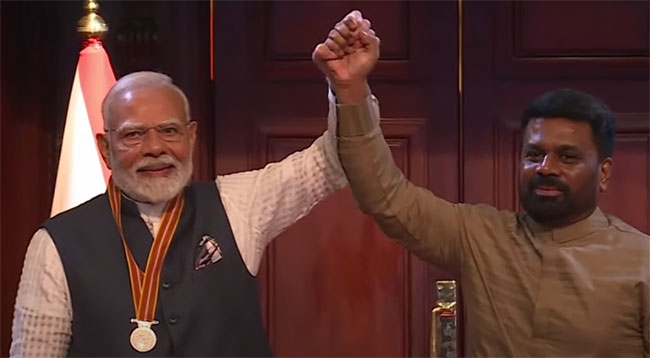
Prime Minister Modi’s visit clearly demonstrates the close ties between Sri Lanka and India and the NPP Government’s sincere interest in improving relations with New Delhi. It is noteworthy that some Indian national newspapers editorially commented that the NPP government’s eagerness in improving relations with New Delhi was evident in the conferment of ‘ Sri Lanka Mithra Vibhushana’ , the national honour for foreign leaders to PM Modi.
A memorandum of Understanding (MOU ) on defence cooperation, billed as the first of its kind in bilateral ties.
Prior to PM Modi, the ‘Sri Lanka Mithra Vibhushana’ award was conferred on former Maldivian President Mohamed Abdul Gayoom in 2008 during the tenure of President Mahinda Rajapaksa. During Rajapaksa’s visit to the West Bank in the Middle East in January 2014, it was decided to confer the honour on the Palestinian Authority President Muhammad Abbas and the late Palestine Liberation Movement leader Yasser Arafat But the plan was dropped at the last minute due to certain problems in diplomatic procedures.
With regard to the present defence agreement, it is significant that it is the first such agreement signed by the Sri Lankan government with a foreign country after the defence agreement with Britain at the time of Sri Lanka’s independence (which was cancelled in 1956 under the SWRD Bandaranaike regime). The present agreement with India followed previous rounds of negotiations, including the visit of President Dissanayake to New Delhi in December last year. Indian Foreign Secretary Vikram Misri told the media in Colombo that the defence sector MOU was an ‘ umbrella agreement ‘ that provided a framework to pursue ongoing defence sector cooperation in a more ‘ ‘structured ‘ manner.
Noting that the security of both countries is interconnected and co – dependent, Prime Minister Modi said he was grateful to President Dissanayake for his sensitivity towards India’s interests.
At the same time, President Dissanayake, as he had done on previous occasions, reaffirmed his government’s commitment to ensuring that Sri Lankan territory is not used to undermine India’s security or regional stability.
In its Editorial on Modi’s visit (8 April 2025), The Hindu stated that even though the MOU may have formalised certain arrangements in the area of defence , bilaterally, it is up to the NPP regime to establish that Sri Lanka means business in defence cooperation. ” But still, Sri Lanka is sure to be conscious that an understanding in 1987 not to let Trincomalee or any other Sri Lankan port be used for military purposes by a third country against India has not helped dispel India’s concerns” The Hindu said.
In the presence of Prime Minister Modi and President Dissanayake, six other MoUs were signed between the two countries on energy, health, pharmaceuticals, digital solutions and welfare schemes for the Eastern Province.
Reponding to doubts raised by the opposition in parliament last week about the provisions contained in the agreements, Foreign Minister Vijitha Herath said all the MOUs had been approved by the cabinet and the Attorney General and that none of them was illegal.
Meanwhile, If there is an issue on which the two sides have been somewhat ambivalent. It is the fishermen’s issue. The two leaders noted in their statements that the issue was discussed. The Sri Lankan had agreed to adopt a “humanitarian approach” “to the dispute between the fishers of the two countries. Modi urged the immediate release of the Indian fishermen and their boats, while President Dissanayake stressed the need for a” “cooperative approach to find a lasting solution the issue. He said that the damages caused to the marine environment by bottom trawling must be recognised and called for immediate decisive action to stop illegal fishing.
The leaders of the Tamil political parties also urged the Indian Prime Minister to ban fishing by bottom trawlers and find a decisive solution to the dispute, which is affecting the fishing community in the northern Sri Lanka.
Addressing a media briefing in Colombo, the Indian Foreign Secretary Vikram Misri said the fishermen’s issue has been discussed in considerable detail by both sides and Prime Minister Modi emphasised that, at the end of the day, it is a daily livelihood issue for fishermen and certain actions that have been taken in recent times could be reconsidered.
It is clear that the ‘recent actions’ that Modi wants to be reconsidered by Sri Lankan government is the arrest of Indian fishermen for engaging in illegal fishing in the Northern waters and capture of their boats by Sri Lankan navy.
Be that as it may, Prime Minister Modi’s visit showed that India will no longer adopt an approach that would cause embarrassment to the Sri Lankan government on the issue of a political solution to the long-standing ethnic conflict.
It has already been obvious that Colombo no longer wants India to bring the Tamil issue into bilateral relations. In recent years, Indian governments have also avoided adopting a confrontational approach on the Tamil issue. Modi who earlier insisted, during the visits of former Presidents Mahinda Rajapaksa, Gotabaya Rajapaksa and Ranil Wickremesinghe to New Delhi, on the full implementation of the 13th Amendment to the Constitution, purposely refrained from urging President Dissanayake to do so in December last year when the latter visited India.
Modi seems to be careful not to say anything that could create problems for Dissanayake domestically.
In a joint press conference with Dissanayake in New Delhi, Modi said he expected the Sri Lankan government to hold provincial council elections and fully implement the constitution. Modi reiterated the same position at a joint press conference in Colombo last week. He did not say anything about the 13th Amendment. Apart from that Amendment, one is at a loss to understand which other amendments or articles of the Sri Lankan Constitution the Indian Prime Minister wants to be implemented.
Modi said that he ad discussed reconstruction and reconciliation with the Sri Lankan President Anura Kumara Dissanayake and he appraised him of his inclusive approach, adding that India hopes that the Sri Lankan government will meet the aspirations of the Tamil people and fulfil its commitment towards fully implementing the constitution of Sri Lanka and conducting Provincial Council elections.
President Dissanayake also refrained from responding to the requests made by the Indian Prime Minister on the Tamil issue in New Delhi and Colombo.
Last week, some Colombo newspapers quoted informed sources as saying that Dissanayake had told Modi that the provincial council elections would be held after the local body elections.
The Leaders of the Ilankai Thamizharasu Katchi (ITAK), the All Sri Lanka Tamil Congress (ACTC ), People’s Liberation Front of Tamil Eelam (PLOTE) and the People’s Liberation Movement of Tamil Eelam (TELO) met the Indian Prime Minister and explained their positions. They urged India to encourage the Government of Sri Lanka to take steps towards meaningful devolution of power.
It is not known whether Prime Minister Modi told the Tamil political leaders anything other than what he said on the issue in the presence of President Dissanayake.
The reality that can be gauged from the current equation between India and Sri Lanka is that President Dissanayake and the NPP government have taken keen interest in maintaining close ties with India in the midst of the contemporary geopolitical situation and economic crises, and that the Modi government has been very particular in maintaining India’s strategic and economic interests while avoiding any approach that could cause inconvenience President Dissanayake and his government .
No matter how close the NPP is politically to China, the government is compelled to maintain relations with China and India in a balanced way. Given today’s geopolitical situation, a government in the global south needs not only the support of the people at home but also the support but also of powerful nations to remain in power.
Therefore, President Dissanayake can certainly be expected to have understood the need for cooperation from big neighbour India, for his government’s stability. Under the leadership of a political movement launched with an anti-India policy, we are witnessing an interesting political situation in which relations with India are much more cordial and closer than during the recent regimes of other political parties in Sri Lanka.
The shift in the JVP’s anti-India policies appears to have also led to a shift in anti-India sentiment in southern Sri Lanka. There is a growing perception that Sri Lanka cannot fully recover from the economic crisis if it does not cooperate with India and that Sri Lanka should abandon its past wrong attitudes towards India and integrate itself with its economic boom.
Prominent political analysts and economists are of the view that under the NPP government, relations between Sri Lanka and India will be more cordial and opportunities for economic engagement and growth will be enormous.
END
(The writer is a senior journalist based in Colombo)
Modi, Sri Lanka, Visit, NPP government, Anura Kumara Dissanayake, Cordiality, geopolitical and economic compulsions,
