

By P.K.Balachandran/Daily Mirror
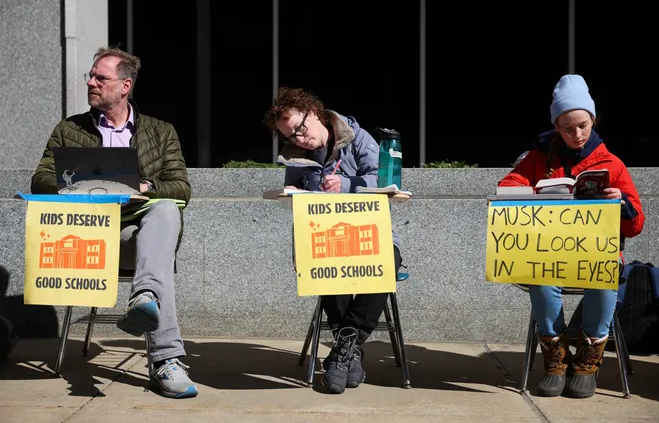
Colombo, March 25: The American school education system is in the midst of a major crisis. On March 20, President Donald Trump ordered the closure of the Federal Department of Education saying that education is a devolved State subject and that there is no reason why Washington should spend so much on it and maintain an army of staff to administer it.
He called the department “a big con job” and said he told Linda McMahon, a former wrestling executive he tapped to be Education Secretary, that he wanted her to carry out closing the department.
“Linda, I hope you do a great job and put yourself out of a job,’” Trump said to McMahon. Before signing the Executive Order, he had ordered the pruning of its staff by half.
Reagan’s Idea
As a matter of fact, Trump is not the author of the idea of dismantling the Federal Education Department. President Ronald Reagan had wanted it way back in 1982. Reagan told the Congress that the Department of Education was a costly “bureaucratic boondoggle” (an expensive, wasteful and fraudulent project). “We must cut out non-essential government spending,” Reagan demanded from Congress. But the Department remained.
Forty three years later, President Trump pulled the issue from cold storage and is attempting to stamp out what he thinks is a White Elephant.
However, Congressional approval is necessary for a complete closure, and that is not easy. The Congress is almost evenly divided. In the House of Representatives, the Republicans have 218 seats, Democrats 215 seats and there are two vacancies. Total: 435 seats. In the Senate, Republicans hold 53 seats and the Democrats hold 45 seats. There are two Independent senators, both of whom caucus with the Democrats.
However, even without Congressional approval, Trump can cut the staff of the Education Department drastically and make it anaemic by blocking funds.
Support Groups
In his bid to abolish the Education Department, Trump is guaranteed the support of Evangelical Christians and ultra conservative lobbies which have been objecting to the liberal, secular and “woke” ideas that are allegedly planted in the minds of young Americans by Left of Centre Federal governments under the Democrats.
Trump’s Executive Order cites a number of reasons for dismantling the Department, including the US$ 3 trillion spent “without improving student achievement”. He cited plummeting test scores, excessive “ideological initiatives” and a return of control over education to the States “where it belongs”.
The Federal Department of Education was established by President Andrew Johnson in 1867, but it became anaemic over the years, until President Jimmy Carter revived it in 1979. Carter did so in the teeth of opposition by Republicans led by Ronald Reagan. Reagan forcefully argued that that education was best left to the States because the States, being in touch with the grassroots, knew what their children needed to be educated in, and how.
Be that as it may, it should be stated that the US Federal Department of Education has never formulated a “national curriculum” as the Central government does in the UK or as New Delhi is trying to do in India through the National Education Policy (NEP) and the uniform text books written by the National Council of Educational research and Training (NCERT). In the US, curricula have been left to the States.
The Federal government only administers student loan programmes and gives grants that help low-income students to attend university. Most of the expense on education is borne by the States.
It is also pointed out that the “big money” that Trump is talking about is actually not that big. The Department of Education spent US$ 268 billion in fiscal year (FY) 2024. This was 4.0% of the US$ 6.8 trillion in overall federal spending. The Education Department ranked sixth among federal agencies in total spending. As stated earlier, most of the expenditure on education is met by the States.
The Federal Department has about 4,400 employees, the smallest among the cabinet-level departments. Against this background, the question that is asked is: Is there any major financial gain from cutting down the department?
Furthermore, the White House has made it clear that the Federal Government will continue to give funds for scholarships and looking after needy groups, even after the Departmental structure is largely dismantled. Therefore, Trump’s action saves only a small amount of money without making any difference to education as such, which will go on as usual.
As expected, Trump’s order has given rise to court cases. It would be interesting to see how the courts handle the issue. Earlier, court rulings have reversed some changes that former President Joe Biden attempted to make to lower borrowing costs and forgive some debts.
But whatever may be the final outcome whether in the courts or the Congress, Trump can derive satisfaction from the fact that he took decisive action to fulfil an election campaign pledge.
Opposition
But many in America are not enthusiastic about the bid to hand over education to the States entirely, though Republican Governors may want education to come back to them. Some say that the States already have lots of autonomy, which is used well by some and not so well by others.
It is argued that the existence of a Federal Department would enable the smooth administration of Centrally-funded schemes. If these functions are distributed among various departments, functioning will be that much more difficult or cumbersome. The students’ loan portfolio is huge, more than US$ 1.5 trillion involving more than 40 million Americans. Therefore, the task is huge and complicated, requiring coordinated and smooth action. A Department of Education at the Centre would facilitate this.
A Central department could also play a key role in upholding educational standards. It could identify States that are making good progress and showcase their work. It could take to task States and schools that are lagging behind and help them overcome shortcomings.
Critics warn that the Federal government’s standoffish attitude could have a deleterious effect on the competitiveness of American education in the world in the emerging knowledge-based economy.
According to the U.S. News & World Report, Trump was wrong when he said that US education is at the bottom of the world list and that it is the most expensive. “We’re at the bottom of the list and we’re the most expensive,” Trump had said. “We’re at the top of the list when it comes to cost per pupil. We spend more money per pupil than any other nation in the world and yet we’re rated No. 40. The last ratings came out, you saw them. They talk about 40 countries. We’re rated No. 40.”
But the US News and World Report challenges Trump’s contention. The Program for International Student Assessment, for instance, measures 15-year-olds’ knowledge in the areas of reading, math and science. In the most recent results from 2022, the mean score for math among American teens ranked No. 21 among the approximately three dozen countries that were assessed and which belonged to the Organization for Economic Cooperation and Development (OECD).
The U.S. ranked fifth in reading among OECD countries, and tied for No. 10 in science. The US also recently ranked No. 8 out of 41 countries in educational attainment, according to OECD data, with 92% of adults aged 25 to 64 having at least a high school degree – a share much higher than the OECD average of 79%.
Shot in the Arm for Devolution
Be that as it may, if Trump succeeds in handing over Education to the States, it will enhance the autonomy of States, a principle which is very relevant for India, given the battle there for States’ rights.
Indian States, especially Tamil Nadu and others in South India, are fighting to claim their constitutional right to educate their populations in ways suited to local conditions and needs. If Trump wins the battle in the US, it will be a shot in the arm for forces fighting for States’ constitutional rights in India.
END
