

Kabul, March 18 (TOLO News) – Economic expert Abdul Zahoor Madber stressed that for Afghanistan to achieve a stable economy, it must properly manage its natural and human resources.
The United Nations reported that despite economic and political challenges, Afghanistan’s economy experienced a 2.7% growth in 2024.
This report, which examined economic and humanitarian issues—including the water shortage crisis, trade conditions, and humanitarian needs for 2025—also emphasized Afghanistan’s economic fragility and instability.
The report, from UN Secretary-General António Guterres and covering the period from November 2024 to the end of January 2025, said: “The state of the economy remains unsettled and fragile, owing to policy uncertainty, financial isolation, continuing restrictions on women’s economic participation, trade imbalances and weak public investment, which are hindering development. Most households struggled to meet basic needs, as unemployment and poverty remain widespread.”
Economic expert Abdul Zahoor Madber stressed that for Afghanistan to achieve a stable economy, it must properly manage its natural and human resources.
“Afghanistan has renewable natural resources, and if they are managed correctly, sustainable economic growth can be achieved, reducing dependence on humanitarian aid,” Madber said.
“Strengthening infrastructure, ensuring regional stability, expanding economic relations with neighboring and global countries, and creating job opportunities for vulnerable groups play a crucial role in establishing Afghanistan’s economic stability,” said another economic expert, Qutbuddin Yaqubi.
In response to this report, Afghanistan’s Ministry of Economy stated that the country’s 2.7% economic growth was achieved based on domestic capacities and that the Islamic Emirate is working to ensure economic stability through major projects.
“If sanctions and restrictions did not exist, Afghanistan’s economic growth would be much higher. Nevertheless, we are striving to boost economic growth and gradually reduce poverty through large-scale economic and job-creating projects like TAPI and CASA-1000,” said Abdul Latif Nazari, Deputy Minister of Economy.
According to the UN Secretary-General’s forecast, in 2025, around 22.9 million people in Afghanistan will require humanitarian assistance due to food insecurity, malnutrition, climate change, and economic instability.
Additionally, the UN’s quarterly report states that last year, $3.6 billion was requested for humanitarian aid to support the people of Afghanistan, but only 47% (equivalent to $1.45 billion) was provided by international partners.
Trade between Afghanistan and Kazakhstan exceeded $430 million
he Ministry of Industry and Commerce reported that in the eleven months of the year 1403 (solar calendar), trade between Afghanistan and Kazakhstan exceeded $430 million.
Akhundzada Abdul Salam Jawad, the spokesperson for the ministry, stated that $45 million of this amount was from exports.
The spokesperson added: “Afghanistan’s trade with Kazakhstan in the 11 months of 1403 amounted to $430 million, of which $45 million were exports and $385 million were imports.”
Kazakhstan, recognized as one of the strongest economies in Central Asia, has expanded its trade and economic relations with Afghanistan since the return of the Islamic Emirate.
Meanwhile, the Chamber of Commerce and Investment considers Central Asian countries, particularly Kazakhstan, as a good market for Afghan goods and emphasizes increasing exports to the country.
Khanjan Alokozay, a board member of the Chamber of Commerce and Investment, told TOLOnews: “Our trade is increasing day by day. Most of our flour consumption is entirely imported from Kazakhstan, along with wheat, oil, and other goods. In total, our trade with Central Asia exceeds $800 million, of which $400 million is with Kazakhstan.”
“Visa facilitation for Afghan traders, the ability to transfer money between Afghan banks and Kazakhstan, and strengthening transportation infrastructure—which can ease the transfer of goods—are factors that can help improve trade relations between Afghanistan and Kazakhstan,” said Qutbuddin Yaqubi, an economic analyst.
According to the ministry, Afghanistan’s main exports to Kazakhstan include fruit juices, non-alcoholic beverages, raisins, vegetables, licorice, onions, pressure cookers, and grapes. The key imports from Kazakhstan include flour, sheet metal, flax, wheat, raw materials for industrial factories, chemical fertilizers, and petroleum products.
Air Cargo
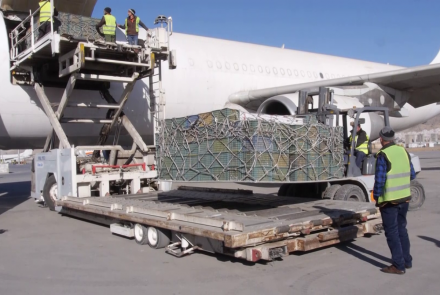
The Ministry of Industry and Commerce stated that in the current solar year of 1403, Afghanistan conducted trade worth $295 million with global markets through its air corridors.
According to Akhundzada Abdul Salam Jawad, the ministry’s spokesperson, exports accounted for $128 million of this total.
He noted that Afghanistan’s key export items during this period included dried fruits, saffron, jujube, black pine nuts, new clothing, and handicrafts.
The spokesperson said: “Afghanistan’s exports have been transported through Kabul, Kandahar, and Balkh airports to Austria, Jordan, Spain, the United Arab Emirates, Indonesia, the United Kingdom, the United States, South Africa, Germany, China, India, and other countries, with a total value reaching $295 million.”
The Chamber of Commerce and Investment, emphasizing the importance of air corridor transportation, calls for cost reductions to boost Afghanistan’s exports.
Mirzaman Popal, the chamber’s acting financial and administrative director, stated: “A percentage of subsidies should be allocated for traders and their goods. Negotiations should be held with airline companies to collaborate on reducing airport taxes and transportation costs.”
“Since Afghanistan lacks access to maritime trade routes, utilizing air corridors—especially through neighboring countries that facilitate Afghanistan’s international trade—is the best alternative,” said Asif Stanikzai, an economic analyst.
As a landlocked country, Afghanistan often faces trade restrictions from neighboring nations. Thus, air corridors serve as a vital solution for transporting commercial goods and connecting Afghanistan to global markets.
END
