

By Veeragathy Thanabalasingham
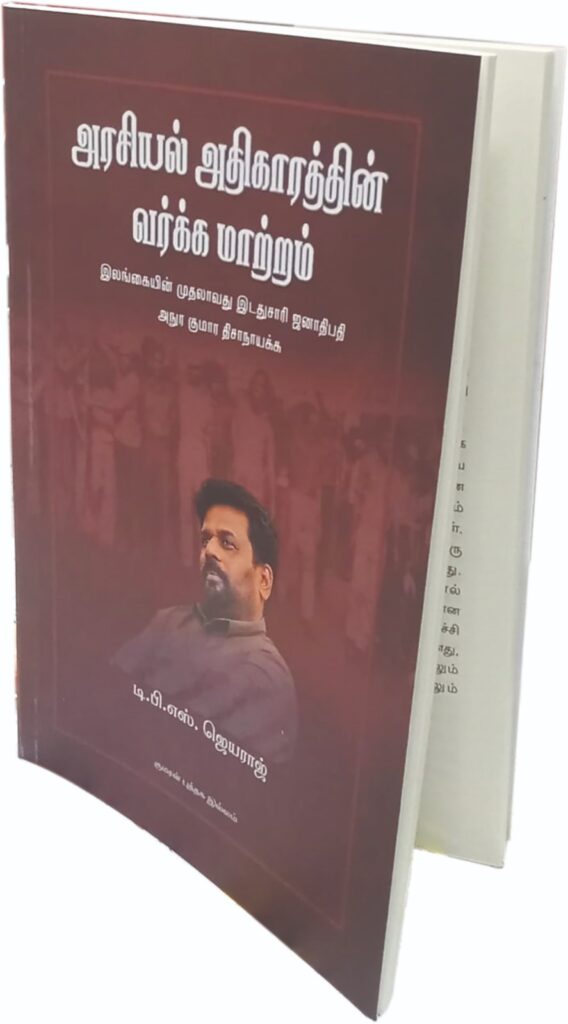
Colombo, March 17 – A compilation of Tamil translation of political essays written recently by D.B.S. Jayaraj, a veteran journalist and prominent political analyst living among the expatriate Tamil community, has been published as a book under the titled ‘ Arasiyal Athikarathin Varkka Maatram’ ( Class shift in political power ; Sri Lanka’s first left president Anura Kumara Dissanayake).
The book contains six articles on President Dissanayake’s early life and political rise after he took office and three articles on the historic victory of the National People’s Power (NPP ) at the parliamentary elections in the Northern and Eastern Provinces last year.
Jeyaraj’s book is a “must-read” both for its content and the fact that it is in Tamil. But the question as to whether Dissanayake’s rise could be described as victory of a “class struggle” in the Marxian sense, was raised by some reviewers.
Knowing in advance that such a book was about to be published, political activists and journalists familiar with Jayaraj’s writings asked the publishers ( Kumaran Book House, Colombo ) if he had written a class-based study of the change of regime in Sri Lanka from a Marxist perspective. The question was also raised at the book release event held two weeks back at the Colombo Tamil Sangam. In particular, Swastika Arulingam, a social, political and human rights activist, made a kind of critical comment on the title of the book and said that Dissanayake’s assumption of the executive presidency or the formation of government by NPP cannot be, in any way, viewed as a class change of political power.
Identifying herself as a leftist, Swastika seems to have intended to say that the coming to power of the NPP should not be interpreted as the coming to power of the working class by defeating the bourgeoisie in Sri Lanka.It is obvious that the title of the book has confused many.
When Jayaraj was informed that the book was to be published with the title ‘The Class Shift in Political Power’, he said that he did not see the rise of Dissanayake and the NPP from any class point of view and that such a title would make him uncomfortable. For Jayaraj, the appropriate title for the book is’ The Life and Politics of Anura Kumara Dissanayake ‘.
In his first article titled ‘Anura Kumara Dissanayake ; Leftist Star Rises over Sri Lanka’ , Jayaraj presents his view of the President’s rise as follows:
” Ever since his electoral victory, the international media both Western and Indian have been describing Anura as Marxist, Marxist – Leninist, socialist, neo – Marxist and a left of centre politician. Some Indian Commentators label him unfairly as ‘ anti – Indian and anti – Tamil. In my view AKD is certainly a leftist subscribing him to a left – oriented ideology but I am doubtful as to whetherhe could be termed as classical Marxist.
” In the good old days before a man called Donald Trump (dis)graced the White House, US presidents were much respected and admired widely.The life stories of many US presidents were read and relished. To many, the greatest US president was Abraham Lincoln who went to the extent of fighting a civil war to abolish slavery and emancipate slaves.
” Lincoln was a man of humble origins.His rise to the top is called a ‘ From log cabin to White House’ story. Likewise Anura Kumara Dissanayake too is a common man who has become the first citizen of Sri Lanka. His remarkable rise too could be termed as a ‘ From wattle and daub cottage to President’s House ‘ saga.”
Except for Ranasinghe Premadasa and Maithripala Sirisena, all of Sri Lanka’s executive presidents to date have been members of the traditional political elite. But, both Premadasa and Sirisena too, were able to be elected presidents through the United National Party (UNP) and the Sri Lanka Freedom Party (SLFP).
On that basis, there was a qualitative change in the accession of the leftist Dissanayake to the presidency, who does not belong to the traditional political elite and the parties that represent it. There cannot be any problem in understanding this simple fact. But, whether or not President Dissanayake now openly identifies himself as a Marxist-Leninist is another matter.
However, it seems that the publishers have given the title to Jayaraj’s book from a different angle – that Dissanayake was a popular choice for the highest office in the country, belonging to a left-wing movement and had a humble family background rose to the highest position.
Dissanayake did not come to power through a left-wing revolution. Three years ago, in the wake of the worst economic crisis in Sri Lanka, people took to the streets in an unprecedented uprising against the rulers of the day. In the early stages, the uprising had few dimensions of a peaceful political revolution. The fall of President Gotabaya Rajapaksa was the first occasion in the South Asian region when a popular uprising overthrew a government.
There is no doubt that Sri Lanka’s uprising would have certainly set a precedent for the protestors who ousted Bangladesh Prime Minister Sheikh Hasina who fled to India in August last year. But, any of those who were in the forefront of the Sri Lankan uprising did not come to power after Gotabaya fled the country, as Muhammad Yunus, the head of a non-governmental organization that supported the protestors in Bangladesh, became interim leader. It is noteworthy that the activists who were at the forefront of the Aragalaya movement were not supported by the people when they contested the last parliamentary elections.
As a result of the Aragalaya uprising , Dissanayake and his NPP were able to come to power, making the most judicious use of the sentiments that had developed among the people against the traditional political elite and the political parties that represented it. No one claims that the working class has come to power under the leadership of a left-wing movement. Neither the president nor any of the leaders of the NPP said so.
But, old Left activists and sympathizers, who had previously been worried that left-wing political parties had never been able to come to power in Sri Lanka, were somewhat satisfied when the NPP came to power despite their criticism of the Janatha Vimukthi Peramuna (JVP), the flagship party of the NPP.
There is no gainsaying that today’s government has a larger majority members with a different social background than those in power before. This was very clearly explained by Professor Jayadeva Uyangoda, a prominent political expert in Sri Lanka, in an article written ( The Hindu, September 25, 2024) after the presidential election.
” The swearing – in of Anura Kumara Dissanayake as Sri Lanka’s new elected persident on September 23, 2024, marks a new beginning of historical significance.It symbolises a dramatic shift in the class bases if political power — from a privileged minority of Colombo – centric, Westernised elites to a broad coalition of non – elite social forces.
” If Sri Lanka’s electoral democracy since its independence in 1948 had guaranteed the dominant elites unbroken continuity in political power, it has now produced a break with the past ; a moment of magic that democracy and free and fair elections can occasionally produce. Significantly, the election outcome also marks a peaceful and bloodless transfer of power.
” The new president obtained his popular mandate with the promise of overhauling a corrupt and rotten system of government that had remained the birthright of the privileged social class for nearly seven decades.The class monopoly of political power that has now been institutionalised through democracy has now been ruptured by the demos themselves” professor wrote.
The ‘Aragalaya’ people’s movement demanded a ‘systemic change’ and a new political culture. The people expected a ‘new beginning’ that would lead to ‘real change’ from President Dissanayake, who went to the polls with those slogans of that movement. The people of Sri Lanka took the first step towards that new beginning by making a radical, unconventional change in deciding who should govern the country.
But the political and administrative developments of the last six months have cast doubt on the understanding of the change of system and the new culture not only by the people but also by the leaders of the NPP.
The new political culture in Sri Lanka does not simply mean a regime free of corruption and abuse of power. An integra part of that new political culture must also be to create an atmosphere in which the people of southern Sri Lanka can feel the need to find a just political solution to the national question that has led to three decades of civil war that has afflicted all communities.
A new culture will have no meaning if the polity of South Lanka does not have the propensity to accept the legitimate political aspirations and grievances of the minority communities. There is no indication in the last six months that the leaders of the NPP have understood this except for the fact that they are incessantly saying that they will not give room for racism and religious extremism to reappear.
President Dissanayake and the leaders of the NPP, particularly the JVP, would by now have understood the difficulties of a left-wing party taking steps to change the old order while retaining the state machinery that had long served the old traditonal political elite.
There is an important question as to how far President Dissanayake and his Government have demonstrated that, as representatives not belonging to the upper social classes, they can become rulers who respect the aspirations and feelings of the people of all communities who demand change.
(The writer is a senior journalist based in Colombo)
