


By Tang Lu
Indian cities have always had the reputation for being both colorful and dirty at the same time. When Prime Minister Narendra Modi came to power in 2014, he was committed to changing this image. He launched the “Swachh Bharat Mission” which means “Mission to “Clean India”.
Since 2016, India has had an annual Swachh Survekshan survey which ranked its cities according cleanliness. Rankings are based on several criteria such as field verification, citizens’
feedback, waste disposal, innovative approaches, financial sustainability, source segregation, and more.
Over the course of a decade, a few cities were at the top of the list, but cleanliness was never as good as they could have been. But one city stood out and showed the possibility of effective implementation of cleanliness systems in India. That city is Indore, the commercial capital of the state of Madhya Pradesh.
When the Swachh Survekshan rankings were first instituted, Indore was ranked 25th. But in 2017, for the first time out of 434 cities in India, Indore stood out and was declared as the cleanest city in India.
Indore has not been surpassed by any other city for 7 consecutive years. Not only that, in 2022, it became India’s first “Seven-star Certified Waste-Free City.” in 2023, Indore topped in the national ranking of “clean air cities” with 1 million plus population.

From Public Dump to Zero-Waste City
Raghuram G. Rajan, former Governor of the Reserve Bank of India, describes Indore in his book The Third Pillar: How Markets and the State Leave the Community Behind, thus- “People treat it as a huge public garbage dump. In the famous Sarafa night food market, customers eat their food on paper plates bought from stalls and then throw the plates and scraps on the ground, and household garbage is dumped everywhere. Near dumpsters full of waste, stray animals roam unchecked, nibbling on the garbage and adding their feces to it. Some poor people without toilets defecate in open spaces or near public drains ……”
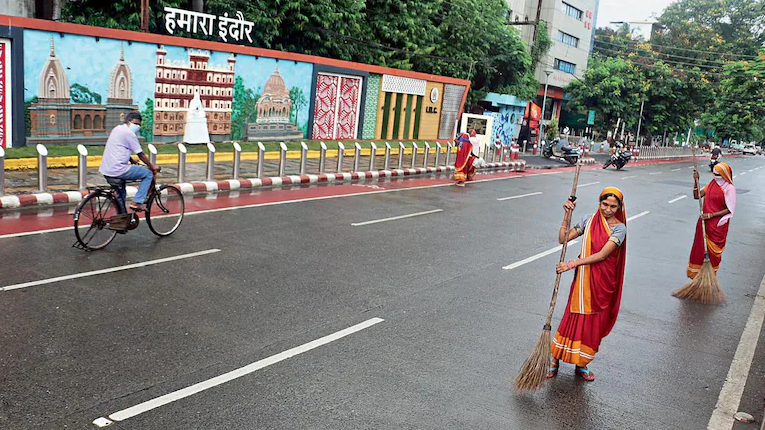
These are now history in Indore. Those who visit Indore today marvel at the cleanliness of the place. Many tourists remark that there is no littering in public places, spitting, or outdoor defecation, the most common phenomenon in India, to be seen in Indore.
There are no garbage dumps, hardly any dust on the roads, and no stray animals roam the streets either.
Several students from Delhi told an interviewer at Chappan Dukan, Indore’s most famous food and shopping street, that there are garbage cans labeled for “wet” and “dry” waste in front of every store and that locals throw their garbage in the appropriate can. One of the boys talked about how he used to throw garbage everywhere when he was back home in another town, but after arriving in Indore he imbibed the good habits of the locals.
The girl sitting next to him recounted another detail of the local recycling of garbage, “The music played by the garbage collection trucks in Indore is very appealing. When the garbage trucks move from one end of the street to the other, and when people hear the specific music, they come out of their homes to drop their garbage.”
Pushkara SV, who has been working on solid waste disposal in large cities, summarizes Indore’s approach to waste management on the Civic Affairs website. He says that the Indore Municipal Corporation (IMC) has succeeded in developing a sustainable system of garbage collection, transportation, treatment and disposal.
According to Pushkara, the system first ensures that all waste collected from households and businesses go into separate bins, which are then transported in separate containers to the appropriate wet and dry waste treatment facilities. The wet waste is converted into organic compost and biogas, while dry waste is further sorted, cleaned, baled and sent to recycling stations. This integrated system, supported by the public, has made Indore the cleanest city in India.
Active public participation in collecting garbage at source
With a population of about 3.5 million and at least 1,200 tons of garbage generated every day, Indore collects garbage at the source, whether these are households or commercial establishments.
Every day, the Indore Municipal Corporation (IMC) sends 850 garbage collection trucks to cover every neighborhood in the city to collect garbage door-to-door. The duty officer sits in front of a big screen in the command center and monitors the movement of these vehicles in real time.
All the garbage collection vehicles are rationalized: loaded with GPS for easy location tracking; they are lowered to make it easier for the public to dump their garbage; separated into different categories, with garbage separation bins clearly labeled for dry, wet and household hazardous waste.

The vehicles have speakers playing a specific song to remind the public of the garbage collection vehicle’s arrival. Not only that, each vehicle has besides the driver, an assistant and a community representative to act as a bridge between households and the government.
Making Indore a clean city reportedly began in 2015. In view of the filth, the IMC focused on three things to start with; how to make the city bin-free, dust-free, and litter-free.
Dr Warsi, a waste management expert who was appointed as the city government’s Advisor on Clean City, developed a plan for this purpose comprising, source collection of garbage by getting the public to embrace segregation of wet and dry garbage and achieving 100% door-to-door garbage collection.
The door-to-door waste collection program was launched in 2016, with the IMC asking residents to segregate wet and dry waste. But it didn’t go well at first. Most residents didn’t understand or wanted to segregate their garbage as required, so when the garbage collection trucks moved door-to-door, not many people responded.
“We patiently explained to the residents why it was necessary to segregate wet and dry garbage and pleaded with them to prepare two garbage bins. For residents who consistently refused to provide segregated garbage, we notified the department head and penalized them,” a garbage collection van driver told the local media.
The Indian Express tells interesting stories about the residents’ responses to the scheme. Barbu Giri, a scavenger living in a slum, took it upon himself to acquire two garbage bins through community training. Every morning at 7 a.m., as soon as the familiar song of a Bollywood singer comes out of the garbage collection truck’s loudspeakers, Giri quickly runs out to empty the garbage cans in the wet and dry compartments of the truck. “I used to throw garbage down the drain. Now garbage from scavengers’ homes is surprisingly being recycled.” Giri exclaimed.
According to reports, Indore’s waste pickers have been a source of resistance to the government’s garbage collection program, as they felt that the program was “destroying” their income source and causing loss of jobs.
To strengthen the sanitation team, the city government simply incorporated more than 1,000 rag pickers in the government’s garbage collection scheme. The former marginalized rag pickers are now wearing uniforms and badges and are the main force behind Indore’s cleanliness campaign.
Enforcement and Penalties
There are more than 80 commercial areas in Indore. The municipality has made it mandatory for all shopkeepers and suppliers of vegetable markets and food outlets to have garbage cans, the capacity of which depends on the amount of waste generated by the store. But they should not be less than 12 liters.
Absence of garbage cans will result in hefty fines. At the same time, the government has announced a ban on the sale of polythene bags in the market and has set up counters selling cloth bags for customers.
Shrigopal Jagtap, director of Basix Municipal Waste Ventures, which has been working with the Indore Municipal Corporation for many years, told The Hindu, “We always remind shopkeepers that if the market is kept clean, more customers will come to shop. And from the second year onwards we enforced a fine of Rs. 250 on shopkeepers who violated the rules.”
Jagtap said they also have clear requirements for the cleaners. Garbage is not allowed to accumulate and must be removed from the market every three hours.
To ensure that the cleaners remove market waste on a regular basis, the city government has set up on-site composting facilities at some of the larger food markets and food centers to easily and quickly dispose the waste. At some of the organic waste collection centers, every evening, the operations team in charge of composting, weighs the sorted waste collected from each food outlet, and the amount of food waste generated is recorded in a booklet for each store owner. The stores pay a fee based on the weight of the waste they generate.
In the case of restaurant owners, having a clear picture of the amount of food wastage helps them recalculate their costs and reduce wastage.
In addition to launching an awareness campaign, Indore government departments are not only fining those who violate the rules, but also making the names of those involved public.
Malini Gaur, a former mayor of Indore, explained to The Indian Express, “Other efforts to stop repeat offenders had not worked. We hope publicizing names of offenders will act as a deterrent.”

Turning Garbage into Gold
“Unsegregated garbage is just garbage, but once it is segregated, it turns into gold!” So says the head of a waste management company in Indore about the waste segregation drive.
Based on the already widespread classification of wet and dry garbage, the Indore Municipal Corporation has been guiding citizens to expand their garbage classification to six categories: dry and wet garbage, plastic waste, household hazardous materials, sanitary waste, and e-waste.
While in many cities in India garbage collection is outsourced, in Indore all garbage is collected by municipal staff, which is not only efficient, but also ensures that all the benefits are earned by government itself.
At a dry waste facility in Indore, the names of 72 different items and their sale prices set by IMC are clearly marked on a display board. Wet waste is sent for composting or transported to a bio-compression facility where it is converted into bio-CNG (compressed natural gas). Money earned from the sale of rubber, plastic shoe soles, light bulbs, toothbrushes, cardboard, metal, glass and paper goes into the municipal treasury and is used to keep the city clean.
After Indore was awarded India’s cleanest city for the seventh time in January 2024, the Indore Additional Municipal Commissioner Siddharth Jain disclosed to the media that the city spends around INR 2 billion annually on waste management, with some of this expenditure coming from garbage disposal.
According to officials, in 2022, the IMC supplied wet waste to India’s largest bio-CNG plant, which in turn paid Rs 25.2 million in royalties to the city. The city also supplied dry waste to another processor, from which it receives Rs 14.3 million in royalties annually. In addition, the city earned Rs 90 million annually from the sale of carbon credits in the international market.
In addition to the direct financial benefits, waste disposal has brought many other benefits to Indore. For example, Indore’s bio-CNG plant, set up near a large vegetable market, utilizes the bio-LNG generated from the market’s wet waste daily, to run 15 buses. It can also be sold to hotels and universities as cooking fuel.
Plastic waste collected at plastic waste collection centers is processed and partly sold to cement factories and partly used for local rural road construction.
Learn from “Indore model”
Indore’s continued success in waste disposal has become a case study for experts. An expert who works for a government think tank, points out that Indore can now dispose of about 1,200 tons of its entire daily waste output in a single day, meaning that there are no more garbage dumps in the city.
Indore has become a model for “liberating cities from mountains of garbage.” Officials from all over India come to Indore to study and learn from the experience.
The Uttar Pradesh government has reportedly announced the introduction of the “Indore model” in its municipal bodies. The Mumbai Municipal Corporation announced that it would conduct several rounds of phased training for Mumbai municipal officials and sanitation workers based on the Indore Model to address the longstanding problem of landfill disposal in the city.
Every tim,e while watching the ranking of clean cities in India, I would always recall the “Clean India” campaign that I witnessed when I lived in Mumbai years ago. As the campaign deepened, I saw an increase in the number of separated garbage bins on the streets of Mumbai as well as in the residential areas, and then there was a period of time when cleaners would even come to my residence to collect garbage daily.
However, when Mumbai finally ranked among the top 10 cleanest cities in India, many of my Indian friends were astonished: “Is Mumbai so clean”?
Topping the list of India’s cleanest cities in those two years was the southern city of Mysore (Mysuru). . In order to find out how clean Mysore really is, I went to the city to observe it on the ground, and the conclusion was: it is indeed true to its name, and is much cleaner than other Indian cities. Unfortunately, due to various problems, Mysore has now fallen out of the top 20 Indian cities in terms of cleanliness.
Against this backdrop, I was intrigued to see how Indore, a northern city, has been able to retain the title of India’s cleanest city for seven consecutive years.

Indore’s Outlook
While the people of Indore, the seven-time winner of India’s Cleanest City, are proud of this achievement, they are not overwhelmed by their success. The Indore Municipal Corporation has set new goals for a cleaner and greener city. As the official website of the Swachh Bharat Mission says about India’s cleanest city, “Keep shining and set the bar higher!”
The author, Tang Lu has served in India and Sri Lanka as a journalist for a long time.
(Photos are courtesy Indore Municipal Corporation)
END
