
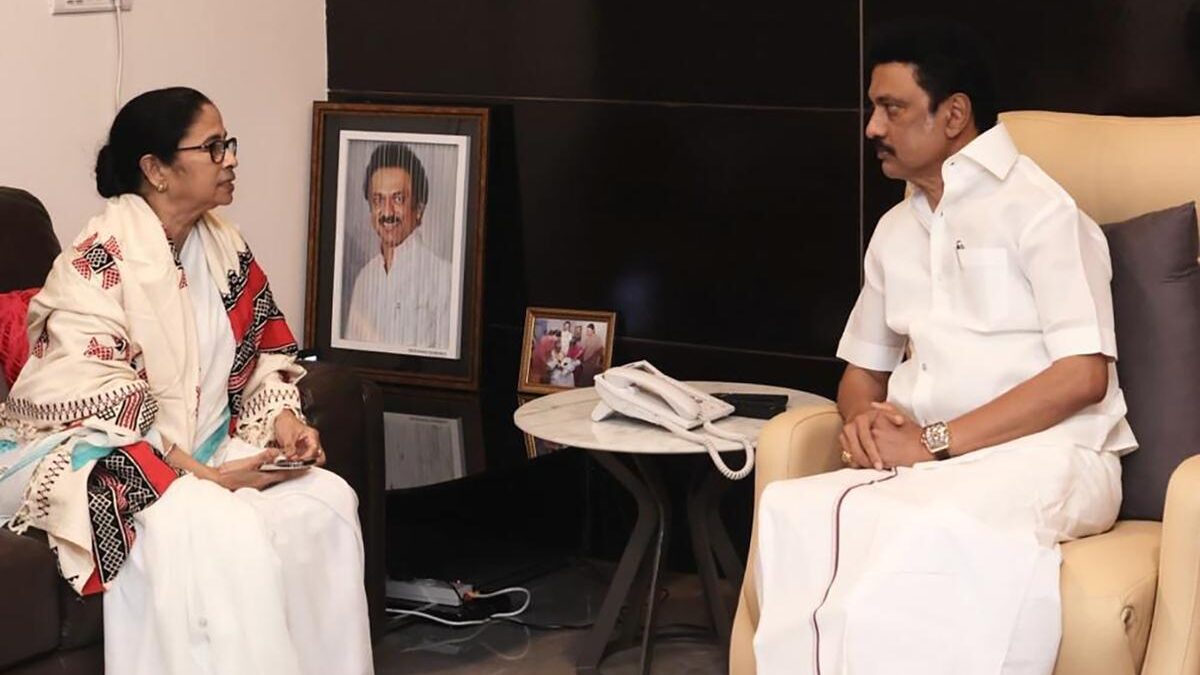

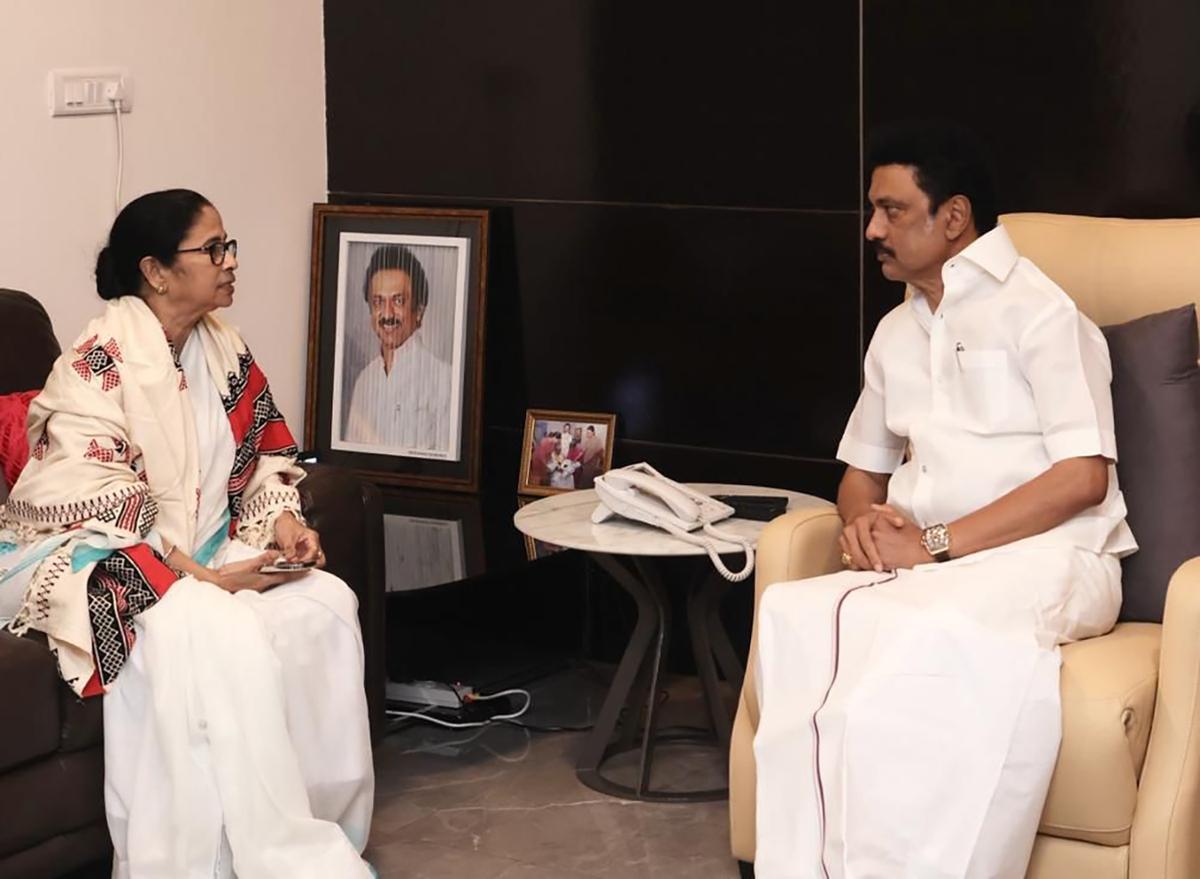
By P.K. Balachandran/Daily News
Colombo, April 21 – The ruling DMK-led alliance in Tamil Nadu and the ruling Trinamool Congress (TMC) in West Bengal are projected to win their respective State Assembly elections (held on April 23 and 29), but with reduced seats.
In Tamil Nadu, the electoral debut of popular film star Vijay has recast the DMK’s prospects, while in West Bengal, a resurgent BJP has emerged as a potent threat to the TMC.
Tamil Nadu
A survey by Lok Poll found that the DMK-led alliance will secure 181 to 189 seats in the 234-member Assembly with a 40.1% vote share. The opposition AIADMK-led NDA is projected to win 38 to 42 seats (with 29% vote share). Debutant Vijay’s Tamilaga Vettri Kazhagam (TVK) is expected to secure 8 to10 seats (with 23.9% vote share). The Naam Thamizhar Katchi (NTK) and others may take away 6 to 7% of votes, potentially impacting on close contests.
The Lok Poll survey was conducted between March 1 and April 1.
Chief Minister M.K. Stalin is the preferred Chief Ministerial candidate. Actor Vijay comes second, and the AIADMK leader Edappadi Palaniswami is third.
Welfare Schemes for Women
The DMK -led alliance, which includes the Congress, is ahead mainly because of its strong welfare schemes for women, such as the “Kalaignar Magalir Urimai Thogai,” free bus travel, and breakfast and lunch for school kids.
“These have especially connected well with women in rural and semi-urban areas, giving DMK a solid advantage,” the survey said.
But the “biggest advantage” for the DMK is that the opposition vote is split between the AIADMK-led alliance and Vijay’s TVK. Vijay’s party is attracting a “good share” of votes from young voters, first-time voters, and those unhappy with the government, the survey of 1,17,000 respondents found.
Alliance with BJP Costing AIADMK
The AIADMK is struggling internally with loss of key leaders and low cadre morale. But more importantly, its alliance with the BJP is expected to scuttle its chances, because the BJP is seen by Tamils as a North Indian, Brahmin, traders’ party that will erode Tamil Nadu’s autonomy and impose Hindi. The AIADMK paid a heavy price for aligning with the BJP in the 2021 elections. And yet it has gone into alliance now probably because the AIADMK’s top leaders, fearing central investigating agencies controlled by the BJP-led Centre, opted for the alliance.
Poll Tracker Survey
A separate Poll Tracker survey found the DMK-led alliance may “sweep” with 172 to 178 seats (with a 42.7% vote share). The AIADMK is projected to get 46 to 52 seats. Vijay’s TVK may get 19.2% vote share and get 6 to 12 seats. The NTK may secure 2 seats at best.
Poll Tracker noted that the AIADMK’s alliance with the BJP has driven minority Muslims and Christians away, while multiple Hindu communities have stuck with the DMK.
Vijay Factor
The survey by the Indian Institute of Political Democratic Strategies (IIPDS) highlighted Vijay’s rapid rise while affirming that the DMK-led alliance will return to power. There is a marked desire for an alternative to the DMK and AIADMK, which have governed since 1967. Nevertheless, the DMK benefits from its welfare-oriented governance and stable leadership.
A crucial finding is that Vijay, and not Edappadi Palaniswamy, is the second most preferred choice for Chief Minister, suggesting TVK is reshaping voter preferences, especially among youth and urban voters.
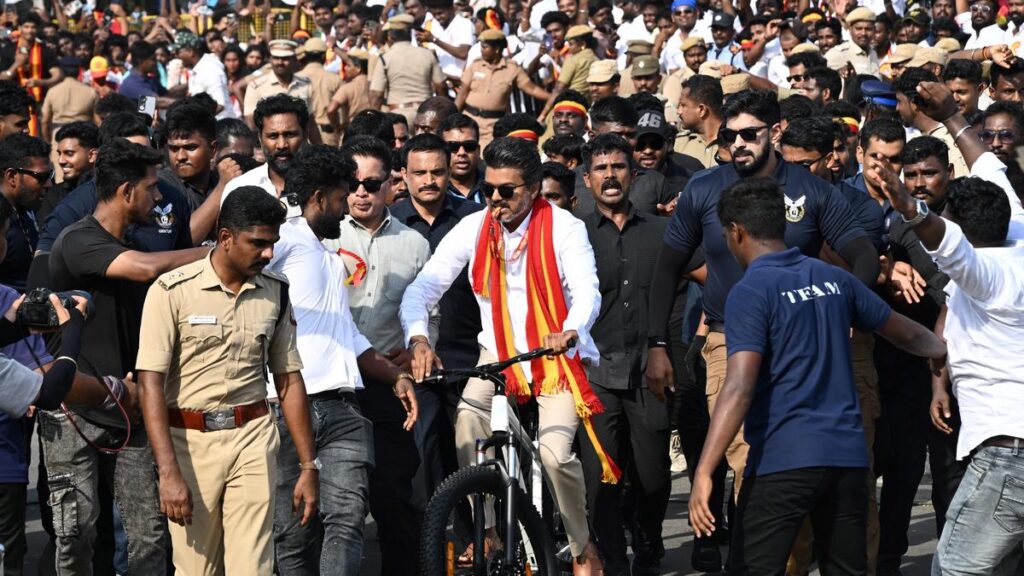
Vijay’s Emphasis on AI Governance
Vijay has charged that the Tamil Nadu government’s Budget lacks in transparency on how allocated funds are used. But under his initiative called ‘Citizen as partners in governance’, the public would be made active participants in governance through a website called ‘My Vettri Tamil Nadu.in’.
Through this website, citizens can submit ideas and petitions for the State’s development. “If a petition is submitted with 10,000 verified signatures, it will be mandatory for the government to give an official response. If the petition has 5 lakh signatures, it will be compulsorily debated in the Assembly,” Vijay said.
AI University
He announced that the TVK government would establish Tamil Nadu’s first AI university and create an AI city to attract global technology companies, research laboratories, and innovators. Additionally, AI innovation hubs would be set up in cities such as Madurai, Coimbatore, Salem, and Tiruchi to support 1,000 deep-tech start-ups. For this, the country’s first Ministry of AI will be established, he said.
West Bengal
West Bengal’s politico-social fabric stands at a critical juncture. The April 23- 29 elections will determine whether the state remains predominantly centrist and secular — preserving Hindu-Muslim harmony — or veers toward right-wing Hindu nationalism at the expense of Muslims, who are 27% of the state’s 93 million population.
With the CPI(M) and the Congress marginalized over the past 15 years, the contest has narrowed to the centrist-secular the Trinamool Congress (TMC), led by Chief Minister Mamata Banerjee, and the right-wing, Hindu-nationalist Bharatiya Janata Party (BJP).
Recent opinion polls suggest the TMC retains an edge. Surveys by Ananda Bazar Patrika and CNN-News18 project the TMC winning around 161 of the 294 seats, with the BJP taking 124, the Congress 9, and the CPI(M) none. But the vote share is tighter.
Mamata’s Strengths
The TMC banks heavily on the charisma of the 71-year-old Chief Minister Mamata Banerjee. Despite seeking a fourth term and facing controversies, she projects herself as a feisty grassroots Bengali leader ready to take to the streets and even argue in the Supreme Court against injustice. She balances outreach to Muslims with assertions of her own Hindu identity.
Mamata has scored strongly among women voters thanks to schemes like Lakshmir Bhandar (monthly financial support), Kanyashree and Rupashree (education and marriage aid), Manabik pension, and Samajik Suraksha (support for elderly and disabled). To address youth unemployment, the TMC launched Banglar Yuva Sathi on April 1, 2026, providing ₹1,500 per month to eligible job-seekers aged 21–40 with secondary education. Rural initiatives such as Krishak Bandhu, Jal Dharo Jal Bharo, and Matir Katha aim to bolster agricultural resilience.
BJP’s Campaign and Voter Deletions
The BJP focuses on the Hindu majority’s fears over the growing Muslim population and the alleged large-scale illegal migration from Bangladesh. Union Home Minister Amit Shah has repeatedly referred to such infiltrators as “termites” that must be removed.
Because of the Special Intensive Revision (SIR) of electoral rolls by the Central government’s Election Commission of India (ECI) ahead of the polls, many of the TMC’s Muslim supporters are not on the rolls. Under the SIR, 90.66 lakh names were deleted. The state’s electorate shrank from 7.66 crore to roughly 6.75 crore — a reduction of 12%. Deletions were particularly high in districts bordering Bangladesh, such as Murshidabad (Muslim-majority), North 24 Parganas, and Malda.
Of the deletions, Hindus accounted for about 57.47 lakh (63%), while Muslims numbered around 31.1 lakh (34%). The proportion of Muslim deletions exceeds their overall population share of 27%.
In Nandigram (a BJP stronghold), over 95% of deleted names were Muslim. In Bhabanipur (Mamata’s constituency), Muslims accounted for around 40% of deletions. The TMC has alleged political motives, framing the exercise as potential disenfranchisement of minority and TMC-leaning voters. But the ECI describes it as a routine cleanup of ineligible entries under judicial oversight.
Voter Sentiment
Surveys indicate strong Muslim satisfaction with the TMC, while the lowest castes show notable dissatisfaction. Youth voters appear restless, whereas older voters tend to back the TMC. The urban belt largely supports the TMC, though the BJP is making inroads among the educated middle class. Mamata personally enjoys solid approval, with 41% of respondents favouring her continuation.
While the BJP emphasizes illegal migration, many voters — particularly youth — prioritize jobs and economic opportunities. The TMC accuses the BJP-led Centre of harassment through investigative agencies, yet a significant section of voters remains ambivalent given the TMC’s 15 years in power showing warts.
END
