
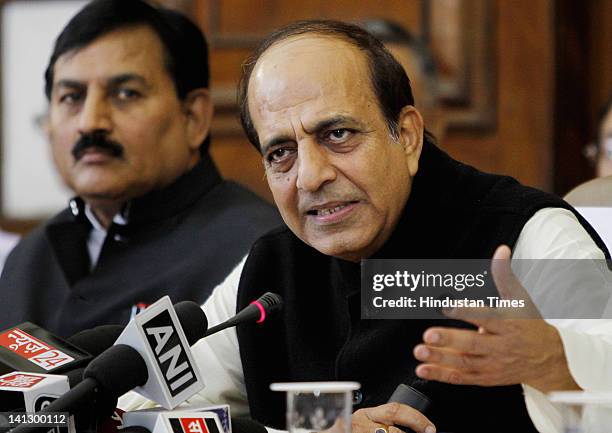

By P.K. Balachandran/The Daily Times of Bangladesh
Colombo, April 20 – The reported appointment of senior Indian politician Dinesh Trivedi, 75, as India’s High Commissioner to Bangladesh — replacing a career Foreign Service officer — has been received favourably in India and with minimal adverse comment in Bangladesh.
This positive reception stems largely from Trivedi’s long and distinguished political career, which has taken him to the highest levels of the Indian government.
As a seasoned politician rather than a career diplomat, he is expected to bring a broader strategic vision and greater flexibility to the role.
Unlike diplomats who are often constrained by bureaucratic protocols, Trivedi is likely to adopt a more pragmatic and personable approach — one that enables him to build relationships, influence key stakeholders, and navigate complex political dynamics with greater ease.
His political instincts and acumen should also allow for a more nuanced and sensitive reading of developments in Bangladesh.
Unencumbered by excessive formality, he is better positioned to engage with leaders and actors across the political spectrum.
In diplomatic settings, host-country interlocutors often remain guarded when dealing with foreign officials, suspecting their motives. However, they tend to be more open and candid with visiting or resident politicians. Trivedi is therefore likely to gain access to higher-quality, more candid information than a conventional diplomat.
Trivedi’s political journey has been remarkably fluid. Critics may view him as a chameleon who changes allegiance according to the prevailing political winds. Yet this very adaptability has given him valuable contacts across much of India’s political spectrum.
He began his career in the Congress party in the 1980s during its heyday, before switching to the Janata Dal in 1990 as that party rose in prominence. He served as a member of the Rajya Sabha from 1990 to 1996 as a Janata Dal representative from Gujarat.
In 1998, he joined Mamata Banerjee in her newly formed Trinamool Congress (TMC) in his home state of West Bengal, becoming its first General Secretary.
In 2009, he was elected to the Lok Sabha from Barrackpore as a TMC candidate and joined the Congress-led United Progressive Alliance (UPA) government as Minister of State for Health and Family Welfare. When Mamata Banerjee resigned as Railway Minister to become Chief Minister of West Bengal, Trivedi was elevated to full Cabinet rank as Minister of Railways.
However, he resigned in March 2012, just days after presenting his maiden Railway Budget, following a public disagreement with Banerjee over passenger fare hikes.
In 2019, he lost the Lok Sabha election from Barrackpore but was later nominated to the Rajya Sabha by the TMC. He eventually quit both the seat and the TMC to join the Bharatiya Janata Party (BJP) — then the ruling party at the Centre and actively seeking to dislodge the TMC in West Bengal.
In total, Trivedi spent roughly a decade with the Congress, eight years with the Janata Dal, and over two decades with the Trinamool Congress before making the dramatic shift to the BJP.
His posting to Dhaka comes at a critical juncture, as India seeks to repair and reset its strained ties with Bangladesh. Relations had deteriorated sharply under the interim government led by Nobel laureate Muhammad Yunus following the ouster of Sheikh Hasina.
With the Bangladesh Nationalist Party (BNP) returning to power after elections held 18 months later, New Delhi has moved swiftly to engage the new dispensation led by Tarique Rahman. Indian External Affairs Minister S. Jaishankar attended the funeral of Khaleda Zia, Tarique Rahman’s mother and former Prime Minister. Lok Sabha Speaker Om Birla and Foreign Secretary Vikram Misri were present at the swearing-in ceremony. Prime Minister Narendra Modi also extended a formal invitation to Rahman to visit New Delhi.
Most recently, Bangladesh’s Foreign Minister Khalilur Rahman paid a two-day visit to New Delhi — the first ministerial-level engagement since the BNP’s return — and held discussions with Jaishankar, including during a joint trip to the Indian Ocean Conference in Mauritius.
While the optics of the relationship have improved, substantive progress on core bilateral issues remains elusive.
From Bangladesh’s perspective, the key priorities are fair sharing of river waters, greater access to land trade routes to India, and the extradition of fugitive former Prime Minister Sheikh Hasina, who has been sentenced to death in absentia.
For India, the main concerns include enhanced connectivity projects, cross-border security cooperation, Bangladesh’s perceived proximity to Pakistan, and the safety and security of the Hindu minority in the Muslim-majority nation.
These are deeply complex and politically sensitive issues for which even an experienced politician like Trivedi may not have ready solutions — despite his strong academic credentials, including an MBA from the University of Texas at Austin.
However, his political experience and ability to build bridges could help lower barriers and foster greater mutual understanding.
Trivedi’s proximity to Prime Minister Narendra Modi — sharing both Gujarati roots and membership in the BJP — is expected to be a significant advantage. He will be better placed to understand Modi’s thinking and can communicate directly with the Prime Minister when necessary, bypassing the usual bureaucratic layers that career ambassadors must navigate.
That said, Trivedi’s political flexibility, while an asset in building networks, also carries risks. His assessments and recommendations could be influenced by the shifting political calculations of the Modi government, some of which may pertain to domestic political needs. This could introduce inconsistency in India’s approach towards Bangladesh and potentially undermine long-term trust between the two neighbours.
Ultimately, Dinesh Trivedi’s success in Dhaka will depend on his ability to balance political pragmatism with diplomatic consistency — using his unique strengths to help repair and strengthen a vital bilateral relationship that has long been strained by mistrust and unresolved disputes.
END
An assessment of Dinesh Trivedi’s appointment as Indian High Commissioner to Bangladesh
