

By P.K.Balachandran
Colombo, April 2 – Given the stalemate in the US-Iran war and doubts about its ending one way or the other anytime soon, it may seem premature to talk about an alternative to the regime. But an alternative needs to be worked out as the disruptions created by the war will call for regime reform if not regime change.
Notwithstanding the spirited defiance shown in the on-going air war against the might of the US and Israel, Iran is critically weakened. Every resource, except war munitions, has been stretched to the limit putting its 93 million people in difficulties they never faced before.
This has put Iranians at a historic political and ideological crossroads.
There is a strong demand, both within Iran and in the Iranian diaspora, for an alternative, but there is no one vision, given the multiplicity of political and ethnic groups in Iran. However, the widest support appears to be for a democratic, liberal (or moderately religious) and inclusive regime to replace the existing very orthodox and repressive one.
But there is also a monarchist group which wants the restoration of the Pahlavi dynasty which the Islamic revolution had overthrown in 1979. Besides, there are ethnic, leftist and rightist groups with clashing interests.
Reza Pahlavi, the son of the deposed Shah, has stated that he is working for a democratic and inclusive system, where leaders are chosen by the ballot box, thus opting out of his own return as king. But his supporters in the diaspora are known for their strong-arm methods. Monarchists in the US and Europe resort to targeted killings and systematic harassment of critics.
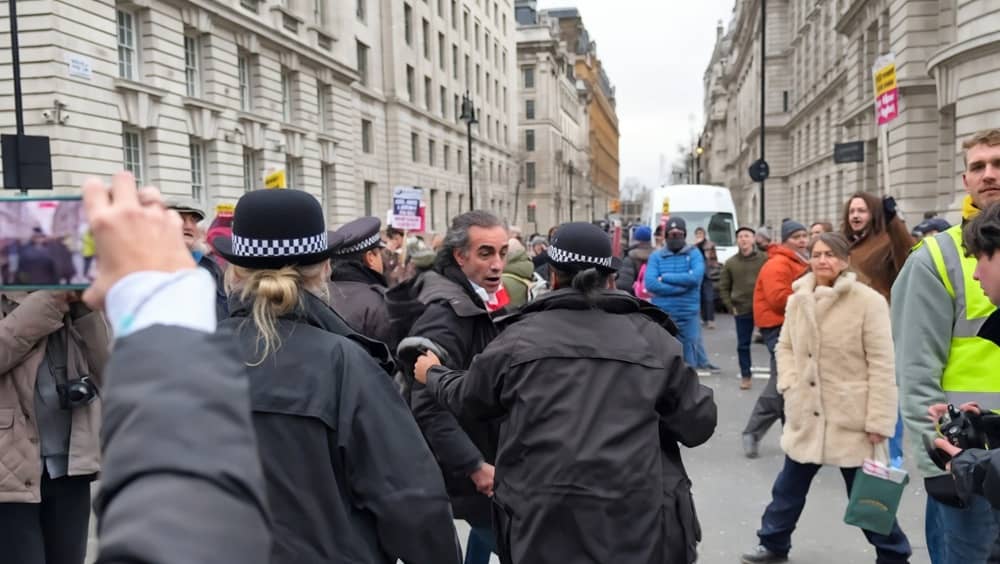
The latest flashpoint occurred on March 28–29, during the Iran Freedom Congress held in London. As participants left the venue after the second day’s sessions, self-identified monarchist supporters launched a surprise attack involving verbal abuse, insults, and threats. Only rapid police intervention prevented physical escalation.
The People’s Mojahedin Organization of Iran (PMOI/MEK) condemned these actions in a statement issued on March 29, 2026, calling out the attackers as “vile, despicable harassment and threats by Shah-worshipping lumpen thugs.”
Supporters of Reza Pahlavi in Texas (US) physically harassed an Iranian woman dissident outside the Conservative Political Action Conference (CPAC). The assailants demanded she chant “long live the king” (Javid Shah), and threatened to “run her over with a truck” if she refused. In London, earlier in March, the police investigated the severe beating of Kurdistan24’s UK correspondent Dilovan Emadaldin by approximately 15 monarchist supporters for reporting on an attack against a Kurdish-owned restaurant.
In Canada, Iranian-Canadian dissident and activist Masoud Masjoudi, a vocal critic of Reza Pahlavi was murdered in February 2026. On March 13, Canadian authorities charged Mehdi Ahmadzadeh Razavi, of Maple Ridge and Arezou Soltani of North Vancouver, with first-degree murder. Both are identified in police reports as associates of monarchist circles and founders of a pro-Reza Pahlavi foundation.
Beyond direct violence, monarchist groups have waged a campaign of economic and social coercion against Iranian, Kurdish, and Afghan-owned restaurants and shops in diaspora centres including London, Toronto, and Los Angeles. Businesses have been pressured to display portraits of Reza Pahlavi or the pre-revolutionary Lion and Sun flag, with refusal reportedly met by aggression, threats of vandalism threats, or online smear campaigns.
Under the rule of the Shah, his secret police SAVAK targeted dissidents abroad, including Iranian student activists in Europe and the US. By the 1970s SAVAK was running European operations that gathered intelligence on Iranian students and even non-Iranians. During the Shah’s 1967 visit to West Berlin, protests by Iranian students were attacked with wooden clubs by SAVAK agents.
“The Guardian” documented the surge in intimidation in the UK and quoted long-term British-Iranians warning of an atmosphere of fear created by pro-monarchist aggression, noting that communities once free of such tensions now face daily incidents. “Politico” painted the monarchists as thugs using “slash-and-burn tactics” online and offline. Le Monde described Reza Pahlavi’s supporters as an army of “cyber-soldiers” who harass any internet user daring to criticize him.
Such behaviour only serves the interests of the current leadership in Iran, handing them a narrative that if they went away, Iran would descend into chaos and internecine violence.
Trump’s View of Pahlavi
US President Donald Trump is aware of the quality of the monarchists and their leader Reza Pahlavi. In an exclusive interview to Reuters Trump described Pahlavi as “very nice,” but questioned his political viability within Iran. “I don’t know how he’d play within his own country,” Trump said. “I don’t know whether or not his country would accept his leadership.” The 65 year-old Pahlavi has not lived in Iran since the 1979 Islamic Revolution.
Sanam Vakil and Alex Vatanka, write in “Foreign Affairs” point out that the diaspora is divided into distinct groups—college students, ethnic minorities, leftists, rightists, and monarchists, to name just a few, and these are frequently at odds. They routinely accuse one another of secretly collaborating with the Iranian regime or with foreign governments. As a result of this fractiousness, they have struggled to capitalize on the Islamic Republic’s weakness.
“If they want to take down the regime, Iran’s opposition groups must learn to work together. They need to adopt a basic, shared program that rests on principles everyone agrees on and postpone debates on everything else. They must come up with a plan to manage the country in the immediate aftermath of the regime’s collapse. Finally, they must be more inclusive, rather than constantly trying to freeze one another out. Otherwise, the Islamic Republic will persist not because it commands popular support but because there is no alternative,” Vakil and Vetanka submit in their review.
Iran also has opposition networks composed of ethnic minorities—including Kurdish, Baluchi, Ahwazi Arab, and Azerbaijani groups—that have substantial organizational capacity. Their leaders call for not only the end of clerical rule but also the recognition of minority linguistic and cultural rights, the decentralization of power, and meaningful autonomy.
These organizations are usually wary of collaborating with each other. But together they fear the emergence of another Persian-dominated, exclusive, and centralized government. On the other hand the majority Persians fear that if these ethnic groups are given too much leeway they will develop secessionist tendencies or worse still, invite foreign meddling along Iran’s porous and conflict-prone borders.
The Iranian diaspora has civil society and rights-based groups made up of lawyers, journalists, feminists, environmentalists, and religious minorities. These have worked to connect street activists with opposition figures in more elite circles. They have provided legal and logistical support to various opposition organizations. But these civil society groups are seen with suspicion by the politicised groups and marginalized.
Then there are figures who currently belong to or once belonged to the government’s opposition. This cohort of hybrid insiders includes former President Hassan Rouhani, who has called for constitutional reforms and a less repressive reading of religious strictures, and former President Mohammad Khatami, who has called for fundamental reform of the current system. It also has former Prime Minister Mir Hossein Mousavi, who helped lead Iran’s 2009 Green Movement protests, and Mostafa Tajzadeh, a former adviser to Khatami who has residual legitimacy among disillusioned loyalists.
In fact, many technocrats from Khatami’s tenure as President from 1997 to 2005 are still part of the state machinery, including the government of President Massoud Pezeshkian. Reza Pahalavi himself told “Fox News” that the reformists must include all including those associated with the current regime who had not indulged in criminal activities or whose hands are not tainted by the blood of the Iranian people.
However, the younger dissidents in the diaspora, who are the most active, do not want to associate themselves with any of these people.
END
