

By Tahmid Hasib Khan/Dhaka Tribune
Dhaka, April 2 – As a millennial, most of our adult life has been plagued by recurring crises. Not just local disruptions but global ones; the kind that take down economies, shake institutions, and push millions into uncertainty within months.
The wars in Afghanistan and Iraq were truly tragic for the Middle East and grieving families across the world, but the global population still carried a sense of optimism in the early 2000s. The turn of the millennium felt like a promise of stability, globalization, and progress, despite the agony felt during 9/11.
Two decades later, that optimism feels increasingly fragile.
At the end of March, Power, Energy and Mineral Resources Minister Iqbal Hasan Mahmood stated that while fuel supply remains officially stable, the system has been strained by a surge in demand and panic buying, leading to unusually long queues at petrol stations across the country.
He urged consumers not to hoard fuel, noting that the pressure is being driven as much by behavior as by supply uncertainty linked to ongoing conflict in the Middle East.
Meanwhile, rationing has begun at fuel pumps, and several fertilizer plants have been temporarily shut down to conserve gas supply.
Images of long queues at petrol stations across Dhaka have revived a familiar question: Are we at the cusp of another global crisis?
Or perhaps the more difficult question is this: Why do global crises seem to be happening more frequently?
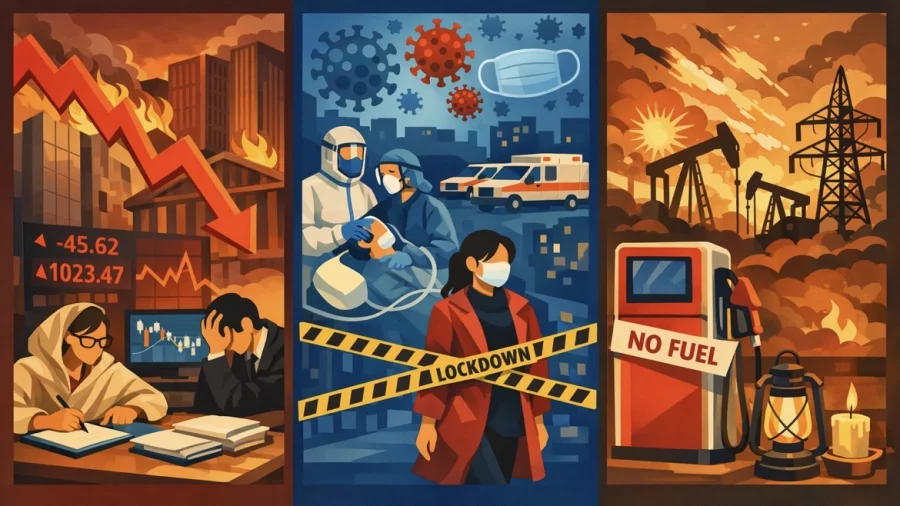
The global financial crisis of 2008 and the Covid-19 pandemic of 2020 may now be followed by another systemic disruption, an energy crisis in 2026. If this pattern holds, the gaps between global disruptions may be getting shorter, which is a worrying sign for a world already under pressure.
Every global crisis brings with it immense human suffering. Economic charts and geopolitical analysis often obscure the real story: Lost livelihoods, disrupted childhoods, and fragile health systems pushed beyond their limits.
For millennials, the 2008 financial crisis marked the first defining shock of adulthood. The crisis was triggered by the collapse of mortgage-backed securities in the United States. These financial products were widely sold to banks and investment funds as safe assets because they were backed by housing loans.
In reality, many of the mortgages behind these securities were linked to an overheated housing market where property values had risen far beyond sustainable levels.
Housing markets collapsed, unemployment surged, and entire families lost their savings. In the United States alone, millions of homes entered foreclosure and homelessness increased sharply in the years following the crisis as per the US Department of Housing and Urban Development.
Economic hardship also translated into health impacts, including rising food insecurity and childhood malnutrition among vulnerable populations. Similar ripple effects were seen globally.
Twelve years later came another systemic shock: The Covid-19 pandemic in 2020.
The pandemic was first and foremost a health crisis, but it was equally an economic and social one. In Bangladesh, lockdowns disrupted employment, reduced incomes, and increased poverty for millions of households. Healthcare systems faced unprecedented pressure while businesses struggled to survive months of economic paralysis.
The world had barely begun to recover when another disruption followed.
In 2022, Russia’s invasion of Ukraine triggered a sharp surge in global oil, gas, and food prices. Energy markets tightened almost overnight, particularly affecting countries like Bangladesh that rely heavily on imported fuel. Inflation rose globally and energy costs surged for both governments and consumers.
The financial crises were also a housing crisis and a public health crisis. The pandemic was simultaneously an economic crisis. The boundaries between them are theoretical.
In health terms, crises affect not just mortality but quality-adjusted life years (QALYs), a measure of how disease, poverty, and social disruption reduce both the length and quality of human life.
This interconnected nature of crises makes the current energy shock particularly concerning. The timeline raises an uncomfortable possibility — the interval between major global disruptions may be getting shorter, and along with it, the quality of human life.
Bangladesh imports the vast majority of its liquid fuels and depends heavily on supply routes through the Strait of Hormuz. The ongoing conflict in the Middle East has disrupted global energy shipments, pushed LNG prices upward and forced Bangladesh to seek costly spot-market purchases to maintain power generation.
The immediate consequences are visible: Rationing discussions, reduced gas supply, and shutdowns of fertilizer plants to prioritize electricity production.
Could it be a food crisis — triggered by fertilizer shortages or agricultural production disruption? Could it be a water crisis driven by climate stress and urban population growth? Or could it emerge from geopolitical escalation if diplomacy continues to erode?
This column is not a Nostradamian attempt to predict the future. It is simply a pessimistic reflection on the pattern of the past two decades.
In recent days, online discussions have resurfaced the commentary of Professor Jiang, a supposed scholar who for years posted speculative analyses on geopolitical cycles before gaining sudden attention after appearing on the political web-show Breaking Points.
Whether or not his theories hold academic weight, the popularity of such commentary reflects a broader public anxiety: People sense that the world is becoming less predictable.
The definition of crisis may change, but the human experience of instability remains constant. If global shocks are indeed becoming more frequent, countries like Bangladesh must prepare for a more uncertain world.
Energy diversification, stronger supply chains with partnerships in the East, and resilient economic planning may no longer be optional. They may be essential for stability in the decades ahead.
The most important question policy-makers should consider today is not whether the next crisis will come, but how prepared we will be when it does.
END
Tahmid Hasib Khan is a public health researcher and communications strategist working at the intersection of global health systems, pharmaceuticals, and nonprofits. Trained in epidemiology, he works across south and south east Asia on healthcare service delivery and international trade.
