

By P M Amza/Colombo Telegraph
Colombo, March 22 – The recent controversy on social media—particularly within Tamil-language platforms—surrounding the declaration of Eid in Sri Lanka has once again brought into sharp focus a recurring tension within Muslim societies: the balance between traditional moon sighting and scientific certainty.
The issue was triggered by claims from four individuals in Puttalam who reported sighting the crescent between 7:00 and 7:15 p.m. However, the local branch of the All Ceylon Jammiyathul Ulama (ACJU), the apex body of Islamic scholars in Sri Lanka, rejected these claims, noting that there was no scientific possibility of the crescent being visible at that time.
According to the ACJU assessment, even under optimal conditions, the crescent, if visible at all on that evening, could only have been observed within a narrow window between 6:23 p.m. and 6:40 p.m.
The Ulama further indicated that what may have been observed was not the crescent but a celestial object such as Venus, which can at times appear crescent-shaped under certain visual conditions.
The four individuals subsequently accepted this explanation and appealed to the public to adhere to the earlier decision to celebrate Eid on Saturday.
This episode has thus moved beyond a mere difference of opinion, raising fundamental questions about religious authority, credibility, and the future direction of Islamic practice in a modern, plural society. In Sri Lanka’s multi-religious context, such public divergences are not confined to internal theological debate. They shape broader perceptions about coherence, discipline, and rationality within the Muslim community. At a time when social harmony requires careful nurturing, contention of this nature risks creating confusion not only among Muslims but also among other communities observing from outside.
It is therefore both necessary and timely to revisit the foundations of moon sighting through the combined lenses of Islamic jurisprudence, scientific knowledge, and social responsibility.
The Scriptural Foundation
The determination of Islamic months, particularly Ramadan and Shawwal, is rooted in a well-known Prophetic tradition, “Fast when you see it (the crescent) and break your fast when you see it; and if it is obscured, then complete thirty days.”
This Hadith, recorded in Sahih al-Bukhari and Sahih Muslim, has often been interpreted as requiring the physical sighting of the crescent. Yet a closer reading of Islamic sources suggests that the matter is more nuanced.
The Qur’an frames the new moon as a means of reckoning time. “They ask you about the new moons. Say, they are measurements of time for the people and for Hajj.”² The emphasis here is not on the act of sighting alone but on establishing certainty regarding the passage of time. In Islamic legal theory, enduring principles such as “certainty is not overruled by doubt” reinforce this understanding. The objective is not merely to see, but to know with confidence that the lunar month has begun.
Classical Scholarship and the Scope for Interpretation
The assumption that Islamic tradition rigidly mandates naked-eye sighting does not fully reflect the diversity of scholarly thought. Classical scholars engaged with the question in ways that allowed for reasoned interpretation.
The eminent scholar Ibn Taymiyyah acknowledged the existence of astronomical knowledge in his time and did not dismiss it outright, even though he preferred traditional methods within the context of his era. Likewise, Ibn Rushd argued in Bidayat al-Mujtahid that legal rulings must be grounded in reliable evidence, suggesting that certainty—however attained—should prevail.
The Islamic intellectual tradition also includes astronomers such as Ibn al-Shatir, whose work on celestial calculations illustrates that scientific inquiry was never seen as incompatible with religious life. In contemporary times, scholars like Yusuf al-Qaradawi have explicitly endorsed the use of precise astronomical calculations, particularly where communal unity is at stake.
Scientific Reality: The Limits of Human Observation
Modern astronomy has transformed the discussion by introducing a level of precision that was unavailable in earlier centuries. Today, the birth of the moon, its age, altitude, and angular distance from the sun can be calculated with remarkable accuracy. These parameters allow astronomers to determine whether the crescent is visible, marginally visible, or impossible to see.
When scientific data establishes that the crescent cannot be seen under given conditions, any claim of sighting becomes highly questionable. Islamic jurisprudence does not accept testimony that contradicts established certainty. This principle is central to evaluating claims such as those reported in Puttalam.
It is well documented that mistaken sightings often occur during twilight, when bright celestial objects—especially Venus—are visible near the horizon. Atmospheric conditions and optical illusions can further distort perception, leading sincere observers to misidentify what they see. In such cases, the issue is not one of intent, but of human limitation.
Saudi Arabia: A Model Often Misunderstood
Saudi Arabia, where the author recently served as Sri Lanka’s Envoy, is frequently cited as the standard for traditional moon sighting. However, this perception overlooks the important role played by modern technology in the Kingdom’s process.
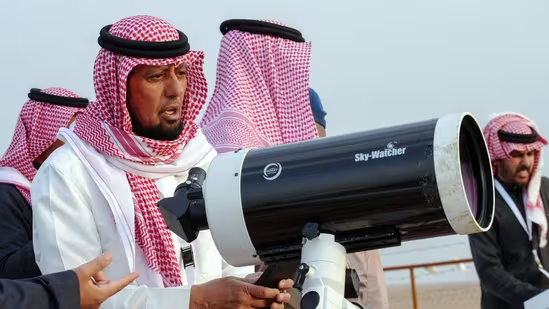
Observations are guided by astronomical data, supported by the use of telescopes, and conducted under formal institutional arrangements. Reported sightings are carefully evaluated within a structured legal framework before official declarations are made.
Even with these safeguards, Saudi announcements have at times been subject to international debate, highlighting the inherent challenges of relying solely on visual observation. For Sri Lanka, which does not possess comparable observational infrastructure, adopting a purely sighting-based approach without scientific validation may increase the risk of error rather than preserve authenticity.
From Observation to Calculation
The movement toward integrating astronomical calculation into the determination of Islamic months is no longer confined to a few countries. It reflects a wider and evolving trend across the Muslim world.
Countries such as Turkey and Malaysia have long institutionalised calculation-based systems, ensuring national unity and predictability. This approach has also been evident in practice in Turkey, where the author served as Sri Lanka’s Ambassador, reflecting a structured and science-led approach to lunar determination. Indonesia, the world’s largest Muslim-majority country, employs a hybrid system in which astronomical calculations determine the possibility of sighting, effectively preventing erroneous claims while retaining symbolic observation. Brunei follows a similarly structured system, with strong state oversight ensuring uniformity
In Singapore, where environmental conditions limit visibility, Islamic authorities rely heavily on astronomical calculations to ensure consistency and avoid dispute—an approach observed during the author’s tenure as Counsellor. In Egypt, where the author also served, and which remains one of the leading centres of Islamic scholarship, official authorities similarly combine astronomical calculations with verified observation, ensuring that declarations are grounded in scientific certainty. Even in North Africa, countries such as Morocco and Tunisia have increasingly integrated scientific verification into traditional sighting processes, demonstrating a pragmatic synthesis of heritage and modernity.
Beyond the Muslim-majority world, Islamic councils in Europe have gone further, adopting fully calculation-based calendars to maintain unity among dispersed communities. This approach has been particularly evident across key European centres—including London, Berlin, and Brussels—reflecting a consistent emphasis on predictability and communal cohesion, including in contexts familiar to the author. Across these diverse settings, a common principle emerges: scientific certainty is not seen as a departure from Islamic law, but as a means of fulfilling its objectives.
Sri Lanka’s Unique Context
Sri Lanka’s Muslim community operates within a diverse national environment where religious practice is closely observed by others. In such a setting, internal disagreements—especially those played out in public—can have wider implications.
When different groups celebrate Eid on different days, the issue extends beyond theological diversity. It raises questions about institutional coherence and can create confusion among the faithful. More importantly, it risks projecting an image of disunity to the broader society, at a time when inter-religious understanding is vital.
The challenge, therefore, is not merely to resolve a technical question of moon sighting, but to ensure that religious practice aligns with the broader responsibilities of living in a plural society.
Towards a Principled Synthesis
The way forward lies not in choosing between faith and science, but in integrating the two within a coherent framework. Islamic tradition itself provides the tools for such integration through its emphasis on certainty, reason, and the public good.
Sri Lanka would benefit from a structured approach that brings together religious scholars and scientific experts, ensuring that decisions are informed by both jurisprudence and astronomy. Such an approach would allow for the validation of sightings against established scientific criteria, reducing the likelihood of error and enhancing public confidence.
Over time, this could evolve into a system where calculation plays a more central role, providing a unified and predictable calendar. Far from departing from tradition, this would represent a continuation of the Islamic commitment to knowledge and certainty.
Conclusion
The controversy in Puttalam is not an isolated incident but part of a broader pattern that reflects the challenges of reconciling inherited practices with contemporary knowledge. Islam, however, has never been a faith that fears reason. On the contrary, it has consistently encouraged reflection, inquiry, and the pursuit of knowledge.
In a time when the movement of celestial bodies can be determined with considerable accuracy, reliance on uncertain visual claims—particularly when they do not align with established knowledge—may affect both unity and credibility. The objective of the Shariah is not necessarily to uphold a method in itself, but to ensure certainty, clarity, and the well-being of the community.
For Sri Lanka, the lesson is both simple and profound. The crescent moon, long a symbol of renewal, can also serve as a symbol of intellectual and spiritual maturity. By aligning faith with knowledge, tradition with reason, and devotion with unity, the community can move beyond recurring controversy toward a more confident and coherent future.
END
,
