

By P.K.Balachandran/Daily Mirror
Colombo, March 10 – Although nuclear weapons are extremely destructive, as was proven when the US bombed Hiroshima and Nagasaki on August 6 and 9, 1945, all rising powers want to have atomic and hydrogen bombs in their arsenal.
Zhuldyz Kanapiyanova, of the Eurasian Research Institute, Kazakhstan, goes into the security, geopolitical, technological, prestige and domestic reasons for States wanting to have the deadly weapon and that in large quantities.
Ever since the United States first used nuclear weapons to end World War II, other countries have been eager to make them because they are more effective than continuous and massive air raids, carpet bombings and land invasions.
There are now eight sovereign States, other than the US, that have successfully tested nuclear weapons. These are Russia, Britain, France, China, North Korea, India and Pakistan. Iran has been trying hard to make them despite stiff opposition from the US, Israel and the Western bloc.
Although Israel doesn’t officially acknowledge it, it is understood that it possesses a nuclear weapons arsenal (although the exact number of warheads is in dispute). Believe it or not, the US opposed Israel’s nuclear weapons program during the John F. Kennedy and, to a lesser extent, the Lyndon B. Johnson administrations. However, Israel was able to make the bomb thanks to funding by private American entities spearheaded by one Abraham Feinberg, a prominent American who served as an unofficial advisor to both President Kennedy and President Johnson.
Nuclear Armed States
Five of countries are recognised as “nuclear-armed states” in accordance with the Nuclear Non-Proliferation Treaty (NPT). These are, US, Russia (successor to the Soviet Union), UK, France and China.
On August 29, 1949, the Soviet Union tested a 20-kiloton bomb named “Joe 1” in the Semipalatinsk region of Kazakhstan. The UK detonated its first nuclear weapon made of plutonium in 1952 on the Monte Bello Islands (120 kms north-west of Australia). France, the fourth largest nuclear power now, tested its nuclear weapon on February 13, 1960. China, receiving aid from Europe and especially the Soviet Union, tested a uranium nuclear weapon in 1964.
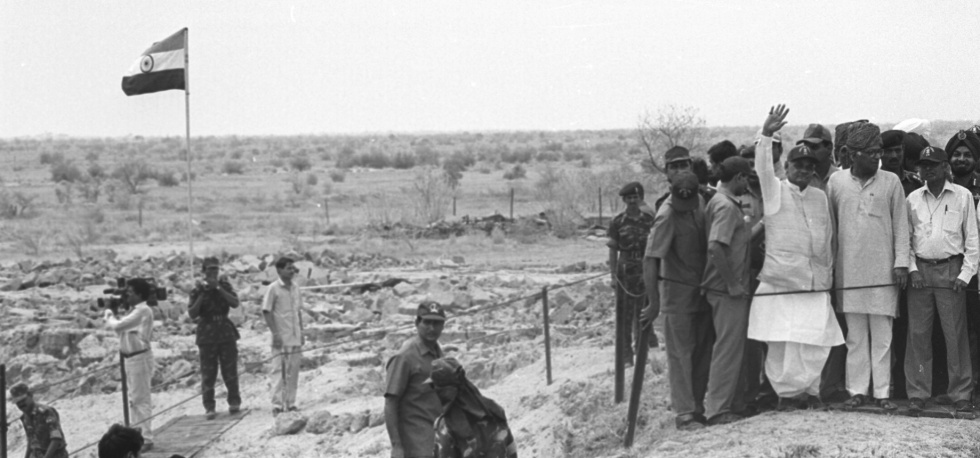
In May 1998, India conducted its first nuclear tests in Pokhran in Rajasthan. Fifteen days later, Pakistan also tests in Chaghi and Kharan in Balochistan. North Korea tested a weapon in 2006 and a hydrogen bomb in 2017. States that carry out successive nuclear weapons tests are counted by the NPT as States that have gained the status of “nuclear power”.
Non-Proliferation Treaty
To prevent the proliferation of nuclear weapons, the Non-Proliferation Treaty (NPT) was opened for signature on July 1st 1968 and was signed by the majority of States. It came into force on March 5, 1970. Every state that signed the treaty, by signing a “Security Audit Agreement” with the International Atomic Energy Agency (IAEA) had to accept the implementation of security controls.
Acknowledging the benefits of nuclear technology used for peaceful purposes, the NPT restricted its use for non-peaceful purposes, since the same technology can also be used in nuclear weapons production. For this purpose, a distinction has been made between “States with nuclear weapons” such as the US, Soviet Union, United Kingdom (UK), France, China, Pakistan, and North Korea, and “States without nuclear weapons”.
According to this regulation, countries that have developed a controlled chain nuclear reaction and detonated a nuclear weapon before the emergence of this treaty need not give up their weapons capabilities.
India’s Objection
India described this exception in the structure of the treaty as discrimination and declared that it cannot be a party to the treaty.
India carried out its first nuclear weapon test in 1974 after this announcement. Pakistan, which has security problems with India, made a similar announcement and conducted its first nuclear weapon test in 1998.
Since these two countries are not a party to the NPT, they do not have the status of “State with nuclear weapons” and are recognised as “de facto States with nuclear weapons” or “States progressing towards becoming a nuclear power”.
Israel
Another country that is not a party to the NPT is Israel. It is claimed that Israel has about 200 nuclear weapons. But Israel prefers to pursue a policy of silence, neither accepting nor denying these claims.
North Korea
North Korea, which started developing nuclear weapons with the idea of protecting itself against Japan and the US with its small State psychology, received significant support from the Soviet Union and China in these efforts. It is known that as of 2004, North Korea, which is believed to have enough plutonium to develop at least two nuclear warheads, had ballistic missiles that could send these warheads to a distance of 1,350 km.
The North Korean administration announced its withdrawal from the NPT with a decision taken on January 10, 2003. It had been excluded from the NPT since April 10, 2003. It is the first country to take such a decision in the history of the NPT. IAEA inspectors left the country and the monitoring devices installed at the facilities were removed.
Iran
Another country that is said to have a serious nuclear weapons programme is Iran. Iran signed the NPT on July 1, 1968, on the day it opened, and ratified this treaty on February 2nd 1970. It also signed the Additional Protocol allowing for immediate inspections in 2003. This was ratified in 2016. But it suspended the protocol in 2021.
Although Iran’s nuclear program is peaceful as per its government’s statements, it is claimed by the US that it is on the way to producing nuclear weapons. For this reason, sanctions against the Iranian government by the West have continued for many years.
Theories On Nuclear Weapon Acquisition
So why have these countries been willing to have nuclear weapons since 1945? Zhuldyz Kanapiyanova of the Eurasian Research Institute, Kazakhstan, lists the reasons under the following categories – Survival Theory, National Prestige Theory and Great Power Status as per the classification of Scott D. Sagan and Joseph Cirincone.
Survival Theory
In 1945, when the US used its first nuclear weapon against Japan, the Soviet Union accelerated its nuclear programme and conducted its first test in 1952. It was a question of survival for the USSR.
India’s desire to develop nuclear weapons can also be explained by the survival theory, as it was related to its security problems vis-à-vis China. Pakistan’s willingness to go nuclear is also related to the security problem arising from India.
Prestige Theory
Later, the UK, France and China desired to have nuclear weapons to gain prestige as a great power and also to survive expected attacks by the USSR. The “prestige” model also emphasises the symbolic value of nuclear weapons. According to this, States that have these weapons see them as a precondition for being a Great Power.
Technological Imperative
If a State has the technology to produce nuclear weapons, it will not be able to resist the temptation to achieve a scientific advancement. Since countries are constantly making technological advancements, they naturally go for nuclear weapons technology advancement.
While Israel’s desire for nuclear weapons is linked to security threats from the Arab neighbours, it also fits the technology compulsion model. States try to acquire these weapons because they see them as a symbol of modernity.
Domestic Politics
States use the power of nuclear weapons as a tool to protect their domestic political interests. Nuclear weapons give a sense of power to the rulers, which helps them subjugate their own people.
Thus, multiple factors go into a country’s decision to go nuclear. It is not just power projection, but has considerations of security and the need to keep up with the Joneses in geopolitics.
END
