

By P.K.Balachandran
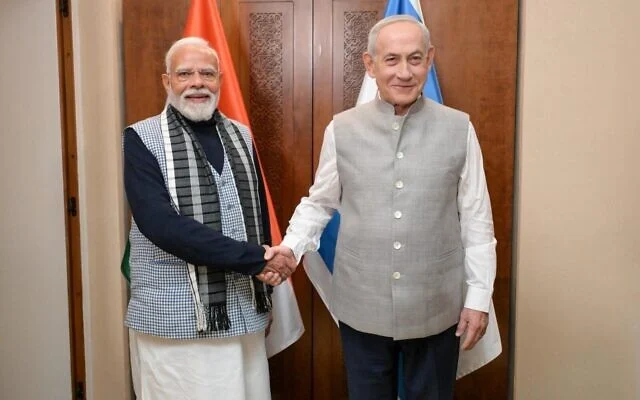
Colombo, February 26 -Speaking to the Israeli parliament, the Knesset, in Jerusalem on Wednesday, Indian Prime Minister Narendra Modi and his Israeli counterpart, Benjamin Netanyahu, pledged to form a strong and lasting alliance to combat “Islamic terrorism”.
“India and Israel will build an iron alliance of countries in the face of extremist Islam,” Netanyahu said. “We are breaking the jihadist axis of evil. India stands firmly with Israel in this moment and beyond,” Modi added.
Calling Israel “a protective wall against barbarism”, Modi said, “India stands with Israel firmly with full conviction in this moment and beyond. I carry with me the deepest condolences of the people of India for every life lost and for every family whose world was shattered in the barbaric terrorist attack by Hamas on October 7, 2023. The massacre of October 7 made it absolutely clear: either the Jihadist axis of evil will break us, or we will break it.”
Netanyahu thanked Modi for his support in the aftermath of the Hamas invasion, saying, “After this murderous attack, you stood in such a clear way, so moral, so sharp… We will never forget this. In a world where antisemitism is rising, India stands out — a civilisation where Jews were never persecuted by the state, only welcomed. We don’t forget that. Thank you, India.”
Support for US Peace Plan
Though he had reservations about US President Donald Trump’s Gaza peace plan, Modi pleased Netanyahau by saying that the plan “holds the promise of a just and durable peace for all the people of the region, including by addressing the Palestine issue.”
Trump’s Gaza ceasefire is in its second phase, which foresees the demilitarisation of Gaza, including the disarmament of Hamas, along with a gradual withdrawal of Israeli forces from the Strip.
Modi concluded his Knesset speech by invoking the respective national rallying cries “Am Yisrael Chai” — Hebrew for “The people of Israel live” — and “Jai Hind” meaning “Long live India.” This drew a resounding applause and chants of “Modi! Modi!” from the packed plenum.
Earlier, welcoming Modi, Netanyahu was effusive.
“Narendra, my dear friend, I am deeply, deeply moved by your visit here today. Because I have to be diplomatic, I will not rank it. I’ll get into trouble. But I’ve never been more moved than by your visit here with us, a great friend of Israel, a great champion of the Indian-Israeli alliance, and a great leader on the world stage. I would almost venture to say [you are] more than a friend, a brother.”
“We’ve doubled our trade, tripled our cooperation, quadrupled our understanding in ways that I cannot begin to describe,” the Israeli PM said.
Israeli Opposition Also Hails Modi
Re-entering the Knesset after boycotting Netanyahu’s speech, Opposition Leader Yair Lapid assured Modi that the opposition walkout had nothing to do with him.
“The entire State of Israel is filled with admiration for your leadership, for your friendship, for the fact that you were here for us in our time of trouble, and for the alliance, the eternal alliance between our two states. So thank you very much for being here. And we are all, both sides of the aisle, looking forward to hearing your speech,” Lapid said.
Economic Ties
Netanyahu stated in his speech that the two countries are jointly developing the IMEC initiative, a US-backed transportation project that aims to connect India to Europe via the Middle East by sea and rail.
“This maritime-land corridor can exist and flourish only if it passes through stable and secure countries. And there are no stronger and more secure countries on this axis than India and Israel,” the Israeli PM said.
India is Israel’s second-largest trading partner in Asia, after China. In 2024, bilateral trade volume between Israel and India reached about $6.5 billion, with Israel exporting more. Israel is the fourth largest supplier of military hardware to India. In September 2025, the Israeli Finance Minister Bezalel Smotrich was in India to sign a bilateral agreement to facilitate mutual investment flows and encourage economic cooperation. Economy Minister Nir Barkat also went to India to discuss an FTA.
The Trump Factor
Modi’s visit cannot be delinked from his current fraught relationship with the US, led by President Donald Trump. Trump has markedly turned against India, single-mindedly circumscribing India’s freedom to pursue its interests, slapping sanctions for non-compliance at the drop of a hat.
In contrast, Israel gives all that Modi wants to implement his foreign and domestic agendas, and that, without asking questions or attaching any conditions. For example, while the US forbids India from buying oil from Russia, Israel has done nothing of that kind. While the US is frowning on Indian investments in Iran, Israel seems unconcerned, even though it is virtually at war with Iran.
Given Trump’s tariffs on Indian goods and the grossly unequal US-India framework agreement on tariffs, certain sectors of India’s economy are at risk, exacerbating the already strained overall economic situation.
Modi’s Compulsions
In view of the external and domestic pressures, there is a pressing need for Modi to make a show of strength by keeping up the military pressure on Pakistan and use strong arm methods to keep the potentially troublesome Muslim minority in check and snoop on and use investigative agencies to rein in the opposition parties.
Both can be done with the help of Israel, which is seen by the Indian ruling class as a role model, given the way it has ruthlessly subdued the Arabs in Gaza and the West Bank and kept the political opposition in the doghouse.
The other advantage in cultivating Israel is that the India-Israel relationship will not antagonise the US. The US has given Israel elbow room to pursue its interests and indulge in any action it deems fit in pursuit of its goals. That will come in handy to Israel in its bid to cultivate close relations with India.
Ideological Ties
Zionism on which Israel is based, and Modi’s ideology of Hindutva (Hindu nationalism), have similar worldviews. Both see Muslims as intruders. The Zionist opposition to Islam and the strong-arm methods Zionist Israel has been using against the Arabs can be replicated in India.
Further, the national security State that Modi has assiduously created since coming to power in 2014, needs Israeli snooping equipment like Pegasus, which was allegedly used against opposition leaders and top journalists some time back.
Growing Military Ties
India has turned to Israeli firms for aircraft, sensors, and weapons that now sit at the centre of several major modernisation efforts. Over the past two years, New Delhi has moved forward on tanker aircraft conversions, advanced radar installations, precision-guided munitions, and joint production ventures that embed Israeli technology directly into Indian platforms. Today, Israeli systems help power Indian fighter jets, extend their range, and improve strike accuracy.
According to www.military.com, India’s current fleet of Russian-built Il-78 tankers is ageing and becoming costly to maintain. To address this gap, the Indian Air Force is moving toward acquiring converted Boeing 767 aircraft that can serve as Multi-Mission Tanker Transport planes, the website said. This work is expected to be handled by Israel Aerospace Industries, which specialises in converting commercial jets for military refuelling roles.
The proposed deal covers six aircraft and is valued at roughly US$ 900 million. These tankers would allow Indian fighters such as the Rafale and Su-30MKI to remain airborne longer and operate farther from base, a critical capability in any extended air campaign.
Israel Aerospace Industries has also indicated that it can meet New Delhi’s “Make in India” requirement by doing part of the work in India itself.
Israeli technology is already embedded inside Indian fighters. India’s domestically built Tejas light combat aircraft incorporates Israeli avionics, including advanced radar and electronic warfare components, www.military.com says. These upgrades bring the jet closer to the capabilities of modern Western fighters. The Israel Aerospace Industries and Indian firm DCX Systems recently announced a joint venture focused on advanced aerospace electronics and radar technologies.
It was in the early 2000s that India became one of Israel’s largest buyers of defence equipment. But it was in 2014, when Modi came to power, that India’s ties with Israel witnessed a sharp upturn; the hesitancy of the past was shed once and for all, Al Jazeera reported.
Israeli defence companies like Elbit Systems and Rafael Advanced Defence Systems (which is also an Israeli company) have also established partnerships with Indian firms, such as Adani Group and Tata Advanced Systems.
Earlier Clandestine Links
India and Israel established diplomatic relations only in 1992, but defence ties existed when before that, albeit clandestinely. During the 1962 India-China war and the 1965 and the 1971 wars against Pakistan, Israel secretly supplied military equipment to India. Help came even during the war in Kargil in 1999, but India had already established diplomatic ties in 1992.
When war broke out between India and China in 1962, the then Israeli Prime Minister David Ben-Gurion wrote to Nehru, offering his sympathies and weapons. India accepted Israeli weapons and munitions, but requested that the ships supplying them not bear Israeli flags, so as not to antagonise New Delhi’s Arab allies.
Through India’s external intelligence agency, the Research and Analysis Wing (RAW), the country began the process of procuring Israeli arms via Liechtenstein. Israeli Prime Minister Golda Meir wrote to Indira, seeking diplomatic recognition for Israel in return, but India demurred. But Delhi said he would respect India’s decision on the matter.
In 1999, Israel helped India during the Kargil war when its troops were trying to force out Pakistan’s military and Kashmiri rebels who had occupied strategic positions on the Indian side of the de facto border between them, known as the Line of Control or LoC. Israel aided India militarily by supplying laser-guided bomb kits and missiles, Al Jazeera said.
The Downside
There is, of course, a downside in Indo-Israel relations – the danger that India’s relations with the Arab world and Iran will be adversely affected by the increasing and openly paraded ties with Israel.
But India does not envisage a destructive fallout because the Arab and Islamic worlds have also been equivocal in this matter and none the worse for it. Thanks to Trump’s disruptive second term as President of the US, the world has been forced to experiment with multi-alignment and strategic autonomy. India, Israel, the Arab countries and Pakistan too, are juggling between multiple alignments.
END
