

By P M Amza/Colombo Telegraph
Colombo, February 26 – For nearly two centuries, the Oxford Union represented the pinnacle of student-led intellectual debate. An invitation to speak there was long perceived as an endorsement from Britain’s most exclusive academic circle—a symbolic ascent into a world of elite discourse, historical gravitas, and intellectual elegance.
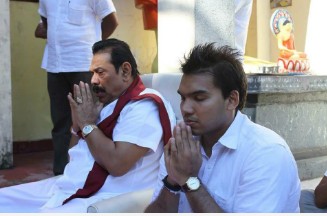
The cancellation of President Mahinda Rajapaksa’s 2010 address, and more recently the withdrawal of the Oxford Union’s invitation to Namal Rajapaksa in 2026, have prompted many to ask how far the Union’s role has evolved. These episodes reveal an institution increasingly shaped not only by tradition but also by protest movements, diaspora activism, digital mobilisation, and internal student dynamics.
They also highlight the importance of careful institutional judgment. Given its global visibility and democratic ethos, the Oxford Union must assess, at the outset, the credentials of a speaker, the political sensitivities attached to them, and the likelihood of internal or external contestation. A rigorous early evaluation would prevent reputational challenges that arise when an invitation is reversed under pressure. The Union’s credibility—and its historic commitment to free debate—ultimately depends on consistent, transparent, and anticipatory decision-making.
With this broader context, it is useful to revisit the institution’s origins, recognise the Sri Lankan personalities who have shaped its legacy, and examine how its place compares to that of its counterpart, the Cambridge Union.
Evolution of the Oxford Union
Founded in 1823, the Oxford Union emerged as a sanctuary for debate at a time when political discussion was discouraged within Oxford’s colleges. Its chamber soon became a crucible for examining ideas, rehearsing persuasion, and refining rhetoric.
Over time, its prestige grew not merely from its architecture or history but from the calibre of global figures who spoke there.
Among the most notable were Winston Churchill, Ronald Reagan, Malcolm X, Benazir Bhutto (a former Union President), Stephen Hawking, and Noam Chomsky.
Their presence established the Union as one of the most recognisable debating platforms in the world.
Sri Lankan Footprints
Sri Lanka’s engagement with Oxford spans nearly a century, with contributions across politics, diplomacy, law, and sport.
SWRD Bandaranaike, while at Christ Church in the 1920s, immersed himself in the Union’s culture. He served as Junior Treasurer and became known for his classical oratory—skills that profoundly shaped his political persona. Lakshman Kadirgamar’s election as Oxford Union President in Hilary Term 1959 remains a landmark. His eloquence and intellectual clarity foreshadowed the diplomatic finesse that defined his later career.
A year earlier, Lalith Athulathmudali—an exceptional legal mind—became the Union’s first Sri Lankan President. His debating reputation at Oxford became integral to his political identity. P Prime Minister Ranil Wickremesinghe addressed the Union in 2018 on Indian Ocean strategy and the Indo-Pacific. Student protests outside signalled the increasingly contested nature of political addresses.
Arjuna Ranatunga (2009) brought cricket into the debating chamber in 2009, while Kumar Sangakkara’s 2011 address linked sport, leadership, and national identity—reflecting the Union’s expanding intellectual horizons.
These individuals collectively illustrate Sri Lanka’s long-standing presence at the Oxford podium.
Cambridge Union
By contrast, Sri Lankan appearances at the Cambridge Union are relatively few. The most prominent in recent years was Ali Sabry’s 2024 address as Foreign Minister, focusing on economic reforms and constitutional issues. Sri Lankans have appeared at Oxford across multiple generations, whereas Cambridge engagements remain limited. This amplifies the symbolic weight of controversies at the Oxford Union for Sri Lankan observers.
When Prestige Met Protest
The cancellation of President Mahinda Rajapaksa’s scheduled address in December 2010 marked a new era in the politics of the Oxford Union platform. Intense protests from segments of the Tamil diaspora led local police to advise against proceeding. The Union withdrew the invitation, raising questions about institutional autonomy.
The episode demonstrated that even the oldest debating society could be vulnerable to external mobilisation.
In 2026, the Union again entered public debate when Namal Rajapaksa, son of Mahinda Rajapaksa and a Member of Parliament was invited to speak. What began as a scheduled event ended in a formal withdrawal of the invitation by the Oxford Union.
In a statement issued through Cherwell (the Union’s independent newspaper), Oxford Union President Katherine Yang clarified the decision: “A core part of the Union’s purpose is enabling direct, open questioning from students. In this case, a significant number of the students most closely connected to the subject matter communicated that they did not feel safe asking questions openly.”
She added that alternative formats—such as taking questions indirectly—were considered, but: “If those most affected cannot participate directly, the event cannot produce the kind of robust debate the Union is intended to facilitate. The President concluded that an address without free, equal engagement “undermines the substance of the forum.”
The Union framed the cancellation not as capitulation to protest, but as protection of its debating principles. Nevertheless, the backdrop of strong student opposition, online campaigns, and diaspora activism undeniably shaped the context.
The twin cancellations of 2010 and 2026 underline a recurring pattern: the Oxford Union increasingly navigates the tension between tradition and a highly mobilised political environment.
A Diplomatic Assessment
The Oxford Union’s aura of history endures. Its chamber still evokes the memory of great speeches. But prestige today is no longer automatic—it is negotiated.
The expansion of the speaker pool has made the platform less elite and more unpredictable. Digital mobilisation and diaspora politics now significantly influence speaker selection and retention. Reversals of invitations—once unthinkable—have become part of the Union’s contemporary reality.
Prestige today depends on how the institution manages these cross-pressures, and how far it can uphold transparency and consistency.
The Oxford Union remains globally recognisable and historically significant. But in the twenty-first century, it also sits at the intersection of free speech, student activism, diaspora politics, and digital mobilisation.
For Sri Lankan public figures, addressing the Union still carries symbolic value—but no longer the unchallenged prestige it once conferred. Today, the meaning of an Oxford Union address is shaped as much by political contestation as by eloquence.
The cancellations of 2010 and 2026 illustrate an evolving truth: prestige is now contingent, negotiated, and increasingly responsive to external sensitivities.
To preserve its legacy, the Oxford Union must adopt thoughtful, transparent, and consistent invitation practices—balancing the ideals of free debate with the complexities of a turbulent era.
END
(Author is a former Sri Lanka’s Ambassador to EU, Belgium, Turkey & Saudi Arabia and a former Sri Lankan Deputy High Commissioner to the UK)
