

By P.K.Balachandran/Sunday Observer
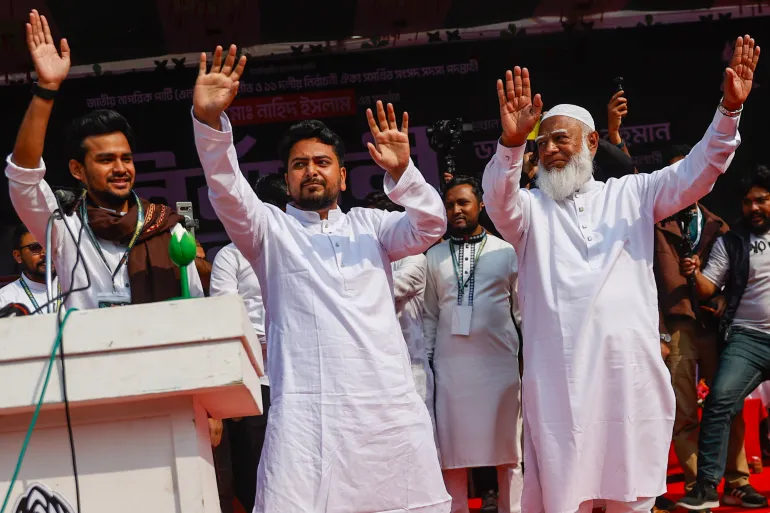
Colombo, February 22 – In the Bangladeshi parliamentary elections, held on February 12, an Islamic party, the Jamaat-i-Islami, won more than 22.5 million votes or 31.76% of the votes cast, and finished second, with 69 seats. The Student-Led National Citizens’ Party (NCP) won 6 seats, and Independents won 8. The Bangladesh Nationalist Party (BNP), a centrist, secular party, won 208 with 49% of the vote. It secured a two-thirds majority.
For the Jamaat-i-Islami or “Jamaat” for short, this was an astounding performance given the fact that in all the previous elections it could get only 5 to 7% of the vote.
Fringe Element
The Jamat was consistently described as a “fringe element” in political discourses. Since independence in 1971, Bangladeshi politics has been dominated by the Awami League (AL), the party which spearheaded the independence movement led by the iconic Sheikh Mujibur Rahman, and the Bangladesh Nationalist Party (BNP) led by another freedom fighter, Gen.Ziaur Rahman. Both the AL and the BNP were centrist and avowedly secular.
The Jamaat was at best a ginger group touting Islamic policies that would help distinguish Muslim-majority “Bangladesh” from the Hindu majority “West Bengal” in India.
Islamisation and its Limits
The Jamaat was partly responsible for the BNP and even the AL, adopting Islam-friendly policies thought to be necessary to satisfy the Muslim majority in Bangladesh, maintain a distance from Hindu-majority India and build relations with the Islamic world. The Jamaat was also responsible for the government-supported proliferation of mosques and madrasahs that marked the country’s landscape from the 1980s onwards.
However, even with all those credentials, the Jamaat was not considered fit to rule the country in place of the AL, BNP or the Jatiyo Party (JP) founded by President H.M.Ershad.
This was because of two reasons – (a) politics was considered a secular vocation and (b) the Jamaat openly sided with Islamic Pakistan during the freedom struggle, even participating in the atrocities the Pakistan army committed against Bangladeshi freedom fighters.
Collaboration with Pakistan was used by the AL to marginalise the Jamaat until July 2024, when the AL, led by Sheikh Hasina, discredited itself in the eyes of the people due to its high-handed and corrupt rule.
Role of July Revolution
The Jamaat seized the opportunity provided by the GenZ-led violent “July revolution” to plunge into the movement and give it the necessary street power and an Islamic veneer to make it appealing to the conservative Islamic sections of society.
When an Interim Government (IG) was formed after the flight of Sheikh Hasina to India, the Jamaat joined it, taking decision-making positions. The Interim Government had lifted the ban on the Jamaat imposed by Hasina. That enabled the Jamaat to function legitimately and use State power to infiltrate the bureaucracy and educational institutions nation-wide. The Jamaat used the new political climate to unify the Islamic parties and strike a political alliance with the students’ revolutionary outfit, the National Citizens’ Party (NCP).
Jamaat Puts on Liberal Mask
To establish alliances with secular groups and to appeal to the secular constituency in the country, the Jamaat put on a secular mask. It portrayed itself not as a promoter of the Islamic Shariah, but as a leftist party based on Islamic values like simplicity, selflessness and honesty.
In a political culture dominated by the dishonest and corrupt politicians of the AL and BNP, the Jamaat’s portrayal of itself as an outfit of a totally different kind began to appeal to a cross-section of Bangladeshis.
The Jamaat therefore, filled an ideological vacuum in Bangladeshi politics. The Jamaat’s ideology was not alien. It was Islamic and homegrown, and therefore, not difficult to understand.
In the run up to the February 12 elections, opinion polls came up with predictions about the Jamaat’s being a real threat to the BNP which was dominating the centrist and secularist political space in the absence of the AL. The AL had been banned by the Interim Government, and its activists were jailed under all kinds of charges, including the murder of 1400 agitators.
Spoils Chances by Over-reach
With the political decks thus cleared and puffed with confidence, the Jamaat and the Islamists felt secure enough to show their true form. In some places, they banned women from playing football. They even pressed for a ban on the teaching of music in schools and opposed physical training for girls. They demanded the cancellation of the appointment of music and Physical Training teachers in schools. Islamic vigilante groups harassed women in modern dress or with heads uncovered.
The Amir of the Jamaat Shafiqur Rahman said that the government should ban the employment of women for more than five hours in day so that they could go home early to look after their families. Shafiqur Rahman even said that women should not hold political offices. He followed his diktat by not fielding a single woman in the February 12 parliamentary elections.
Reasons for Ultimate Failure
If the Jamaat was gaining acceptance, how come it failed to make it at the end. Four reasons are cited –
(a) The political space in Bangladesh is still dominated by the centrist and secular sentiment. The dominant forces in this arena are the BNP and the AL. Since the AL was banned, a good section of AL voters voted for the BNP and the rest stayed at home preferring not to vote. This is why overall polling was low at 59%.
(b) Puffed with overconfidence, the Jamaat used the killing of a young Islamist leader, Sharif Osman Hadi (allegedly by the AL) to set fire to the offices of two prominent news newspapers, The Daily Star and Prothom Alo, accusing them of being pro-India and pro-Hasina. They also wrecked the building of a well-known Bengali cultural organisation. The over-reach alerted many voters to the danger of nurturing and encouraging extremist elements and outfits.
(c) The anti-India tirade of the Jamaat and the student-led NCP also alerted voters to the danger of alienating India, with which Bangladesh shares a 4000 km long border. India is the single biggest trading partner of Bangladesh. Bangladesh depends on India for raw materials, intermediate goods, power and consumer goods. India’s animosity could throttle Bangladesh. India could also encourage anti-government elements. China and Pakistan can be a counterpoise to India, but only to a limited extent, as both are far away.
(d) India had taken a hard stand against Bangladesh following the ouster of its ally, Sheikh Hasina. But later decided to soften its stand to begin cultivating the BNP. It is believed to have encouraged BNP leader Tarique Rahman to come back to Bangladesh from exile in the UK and lead the party in the February 2026 elections. New Delhi is believed to have assured its support to a BNP government. New Delhi followed this up with a formal letter pledging cooperation. It has invited Tarique and his family to visit Indi assuring him of a warm welcome.
New Delhi was prompted to do so in view of the rising power of the Jamaat, other Islamist radicals, and the NCP, all of which are virulently anti-India.
Jamaat Will Restrain BNP Government
However, being the leading opposition party in parliament, the Jamaat, supported by the NCP, will try its level best to sabotage efforts by the BNP government to strengthen ties with India. It will promote the interests of Pakistan to irritate India. It will highlight attacks on Indian Muslims by Hindus nationalists. It could engineer attacks on the Hindu minority in Bangladesh to invite New Delhi’s intervention and exploit it to further its political prospects in Bangladesh.
Such possibilities will put Tarique Rahman’s government on guard. The government will be forced to be cautious in its dealings with New Delhi in order not to be trapped into over-dependence and then paying the price for it as Hasina’s government did.
Outstanding Issues with India
Relations with New Delhi will also be subject to finding a solution to the issue of the extradition of Hasina, who faces a death sentence, which will also haunt Tarique. But an understanding without sending her back is likely to be worked out, given the bonhomie between Tarique and Modi.
There are 54 rivers flowing into Bangladesh from India, with India being the upper riparian country. The Indian barrage on the river Ganga at Farakka causes desertification in Bangladesh in the dry season. The flow in the Teesta river is also subject to restrictions by India, disrupting agriculture and fishing in Bangladesh.
In an effort to minimise the damage from low flow in the Teesta, Bangladesh drew up a plan to develop the Teesta basin with China ‘s help. But this set off alarm bells in New Delhi.
Meanwhile the 30-year Ganga waters treaty signed in 1996 to regulate water flow from the Farakka Barrage will be coming up for renewal this year. India wants to renegotiate the treaty, saying that it needs a bigger allocation of water. But Bangladesh will find it difficult to concede this.
As to how the BNP government under Tarique Rahman is going to deal with these knotty problems, with the anti-Indian Jamaat ready to pounce on it in parliament, remains to be seen. All in all, the road ahead is hard for the BNP even though it has a two thirds majority in parliament.
END
