

By Laxmi/Substack
February 15 – When the Maldives announced a “heroic expedition” to recapture lost seas in February 2026, it triggered a wave of domestic scrutiny regarding the mission’s tactical parameters. A widely reported 2.5-mile discrepancy—the gap between the 106.5 nm ITLOS boundary and the reported 104 nm intercept point—has become a central point of debate, illustrating the friction between nationalist rhetoric and geopolitical constraints.
From the drone piers of Addu to the maritime experts, we analyze the complex optics of sovereignty in the Indian Ocean.
The geometry of a geopolitical strategy
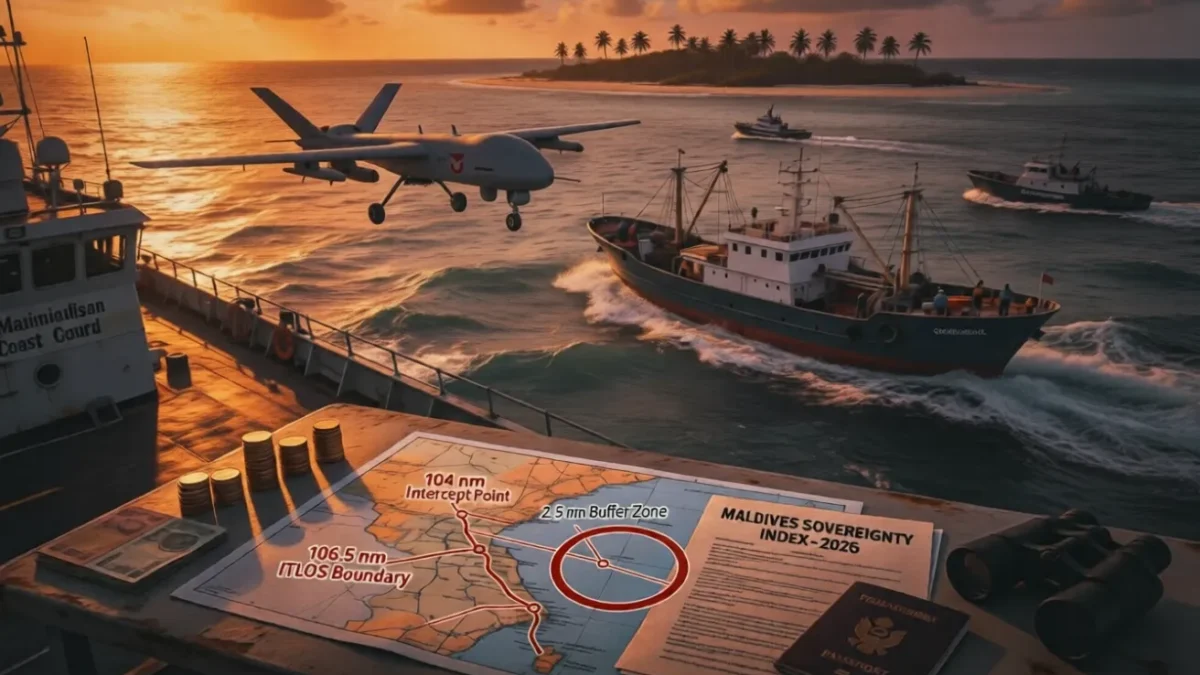
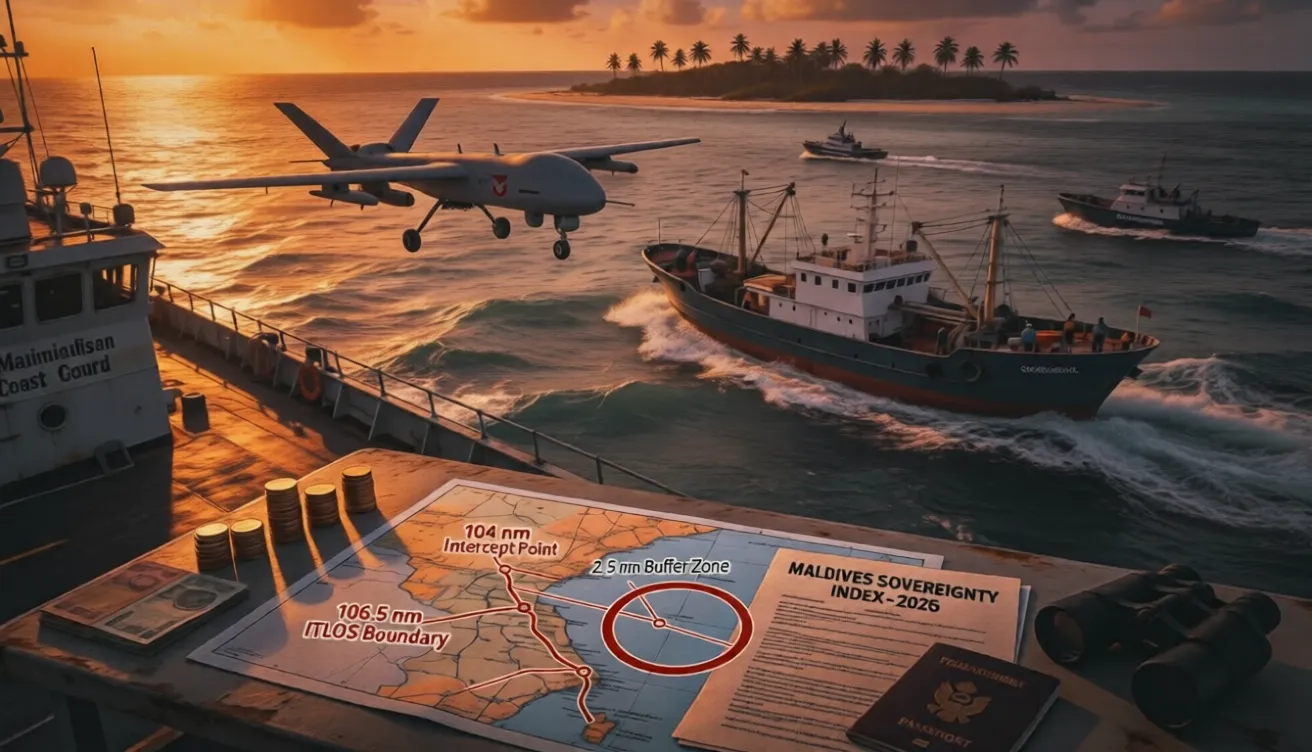
Foreground details capture the Maldives MNDF Coast Guard’s tactical charts, illustrating the 2.5-mile variance between reported operations and international legal parameters.
In the diplomatic archives of the Maldives, October 2016 remains a moment of stark, resentful isolation. The then-Yameen administration, incensed by international criticism of domestic human rights, abruptly withdrew the Maldives from the Commonwealth—a move characterized by many observers as an isolationist retreat rather than a principled stand.
A decade later, in February 2026, President Mohamed Muizzu’s ‘Sovereignty Pledge’ signalled a far more aggressive weather pattern. By formally rejecting the 2023 International Tribunal for the Law of the Sea (ITLOS) ruling on the Chagos maritime boundary and revoking his predecessor’s confidential correspondence with Mauritius, Muizzu has shifted the national posture from ‘defensive shielding’ to a high-stakes “strategic offensive’’.
For the first time since independence, the Maldives is publicly and forcefully saying “no” to a regional order dominated by the US and UK and endorsed by India. In this gambit over the Chagos Archipelago, Malé is no longer content to be a mere spectator; it is stepping into the arena to unilaterally redefine its own “southern frontier.”
Addu Atoll – Ground Zero for Year One of “Autonomy”
As the southern gateway of the archipelago, Addu Atoll sits in a geographic embrace with Chagos. This proximity ensures that sovereignty is never a mere diplomatic abstraction; it is a pulse.
The Southern Gateway – A strategic mapping of Addu Atoll, the Maldives’ southernmost frontier, and its immediate proximity to the Chagos Archipelago.
This quiet maritime corridor, once a silent border, became the frontline of President Muizzu’s 2026 “strategic offensive.” With the roar of Turkish-made Bayraktar TB2 drones over Addu, the Maldives has officially ended its era of “outsourcing” maritime surveillance to foreign nations.
To Muizzu, this is more than a procurement; it is a totem of strategic independence. At the Addu piers, the fishermen’s fervour is visceral.
“Before, when we looked south, it felt like someone else’s territory. Now that the President has sent real warships and our own drones, this sea truly belongs to us,” they said.
For ordinary fishermen, legal latitudes and longitudes feel distant abstractions. They see only the President fulfilling his pledge to “no longer be a backyard for major powers.” This near-euphoric grassroots sentiment has become President Muizzu’s most steadfast ballast amidst the turbulent waters of the 104 nautical miles.
The “Three Scalpels” of Former Presidents
In the power centre of Malé, Muizzu’s radical rhetoric has been met with cold deconstruction by three former Presidents, each wielding a different logic to peel away the nationalist shell.
Ibrahim Solih- The Defeated Former Leader’s Indictment
Ibrahim Mohamed Solih, unseated in 2023, expressed profound indignation in an interview with Raajje.mv. He contends that Muizzu is orchestrating a “demolition of sovereign credibility.” Since the revoked letter bore Solih’s own signature, he sees this not just as a negation of his legacy, but as a reckless act of institutional self-sabotage under international law.
Abdulla Yameen- The Mentor’s Scathing Exposé
Abdulla Yameen, Muizzu’s erstwhile mentor who split with him after the 2023 election, publicly mocked the President’s “heroic delusions” during an early February rally. Yameen bitingly exposed Muizzu’s previous indifference toward Chagos, accusing the current “strategic offensive” of being a pure electoral gimmick for the April 4 local council elections. He condemned the dispatch of warships as a flagrant disregard for international law that would ultimately burden the public. Yameen even likened Muizzu to “Trump attempting to purchase Greenland,” dismissing the performance as a self-deluded political comedy.
Mohamed Nasheed – The Geopolitical “Puppet Theory”
Mohamed Nasheed’s information network operates on a different frequency. In early February, he posted a series of observations on X suggesting that Muizzu’s “sovereignty blitzkrieg” was likely “a script meticulously orchestrated or tacitly approved by the US and UK.” After observing Donald Trump’s softening stance on the UK-Mauritius deal, Nasheed posted: “Trump’s remarks… signal that Chagos’s return to Mauritius is a foregone conclusion. The Maldivian government will advance this matter jointly with the US and UK.” However, Nasheed stressed that Trump’s acknowledgment “does not necessarily mean he genuinely supports transferring the Chagos Archipelago to Mauritius.”
Legal Experts’ Technical Analysis – The “Sovereignty Shell”
Even as Muizzu’s rhetoric soared, the Maldives Independent published a clinical analysis that cut to the heart of the narrative’s flaws. The report argued that the administration is exploiting the public’s unfamiliarity with Maritime Law to create three dangerous technical confusions viz;
Maritime Boundaries – Rejecting the 2023 ITLOS delineation between the Maldives and Mauritius.
Chagos Sovereignty- Claiming a “historical right” to the islands themselves—a claim never formally asserted by the Maldives during the ITLOS proceedings.
The Extended Continental Shelf – Conflating the current EEZ dispute with the 2010 UN submission for seabed rights beyond 200 nautical miles.
Mohamed Munavvar, a premier maritime law authority and former Attorney General for a decade, delivered a brutal verdict- “The Chagos Islands have never belonged to the Maldives—neither in the past nor now.” He warned that Muizzu’s disregard for historical and legal facts is steering the nation toward an “irreversible diplomatic catastrophe.”
Senior legal experts echoed this, stating that since the tribunal has ruled, there is no legal room for manoeuvre. Former Assistant Attorney General Jihad Anees underscored that military posturing cannot replace international law.
Media Narratives on the Chagos Sovereignty Dispute
In the Maldives, the actions surrounding the Chagos Archipelago are not merely manoeuvres at sea, but a high-stakes battle of rhetoric within a compact but politically vibrant society of half a million. Every headline reflects a distinct political hue.
State and Establishment – The “Sovereignty in the Sunlight” Narrative
Led by the state broadcaster PSM News, the official narrative portrays every deployment of patrol vessels as a restoration of historical justice. This perspective finds resonance across popular Dhivehi-language platforms such as Avas and Dhuvas, which describe President Muizzu’s actions as a transition toward “Sovereignty in the Sunlight.” In contrast to the “secret diplomacy” of the past, the current administration is noted by these outlets for its transparency and resolute stance on maritime boundaries.
Furthermore, the Times of Maldives and other pro-establishment media emphasize that these operations—regardless of their specific technical coordinates—establish a necessary “maritime stewardship.” By maintaining a persistent presence in the southern waters, the government is presented as fulfilling long-standing promises to local fishing communities, protecting Maldivian interests from “foreign encroachment” and, in doing so, reclaiming a sense of “diplomatic self-respect.”
However, a closer look at the media landscape reveals a subtle divergence in coverage. Beyond the patrol footage aired by PSM, several pro-government platforms have exhibited a degree of restraint regarding the Chagos issue. In the context of Malé’s active media environment, this low profile remains a noteworthy detail.
On Vaguthu.mv, for instance—a pro-government site that frequently utilizes online polls to gauge public sentiment on policy—topics such as the smoking ban, Presidential approval ratings, and various administrative decisions occupy prominent positions. Yet, the Chagos issue—a central theme in state media’s current discourse—is absent from the site’s polling lists.
Independent Media – The Professional Legal Lens
As a hallmark of professional journalism in the Maldives, The Edition (and its parent, Mihaaru) pulls the focus back to international legalities. Rather than joining the nationalist chorus, it introduces legal expertise to weigh the political demands of sovereignty against the Maldives’ long-term standing as a law-abiding member of the international community. Its reporting subtly suggests that the country’s position within the international legal framework (such as the ITLOS ruling) will ultimately dictate the legitimacy of its future maritime claims.
Investigation and Opposition – The Lens of Technical Calibration
For the Maldives’ investigative and opposition platforms, the State’s “heroic” narrative is subject to a more clinical scrutiny. These outlets shift the focus from political rhetoric to technical execution, seeking to calibrate the official record against real-time maritime data.
The climax of this sovereignty presentation occurred on February 5, 2026, when the MNDF announced that its missile patrol vessel, Dharumavantha, had intercepted two Sri Lankan fishing boats. While framed as a heroic narrative of border protection, subsequent coordinate tracking by platforms like Adhadhu provided a different technical context.
The data revealed that the intercept occurred at 104 nautical miles south of Gan Island. While this action successfully demonstrated the State’s enforcement capabilities within its undisputed Exclusive Economic Zone, observers noted a strategic alignment with international realities – the operation remained exactly 2.5 nautical miles north of the 106.5-mile ITLOS boundary—the very line the administration had rhetorically rejected.
Tactical analysis by Laxmi – Highlighting the 2.5-mile gap between the reported intercept and the ITLOS boundary.
Solidifying this perspective, Republic quoted legal and maritime experts who pointed out that, under the ITLOS ruling, the location of the interception was clearly within waters already allocated to the Maldives. In this view, the “strategic offensive” was characterized as a meticulously calibrated performance. While the Bayraktar TB2 drones demonstrated high technical precision, consistently operating within the parameters of the 106.5-mile line, critics on social media and in outlets like The Sun Online suggested that even with new military hardware, small nations must navigate within the realistic parameters of international law.
The Silent Consensus—A Performance of Collective “Tolerance”
It’s intriguing that despite Muizzu’s remarks constituting a near-challenge to the international legal order, the global response has been remarkably “tolerant.” This restraint stems from Muizzu’s dual strategy: radical rhetoric coupled with cautious action. As long as his patrol vessels do not physically breach the 106.5-nautical-mile line, the major powers remain content to watch the theatre unfold.
More notably, the relevant powers have adopted a posture of “avoiding direct naming while maintaining clear positions”:
United Kingdom (The “Gatekeeper’s” Dismissal- London’s stance was blunt and exclusionary. The Foreign, Commonwealth & Development Office (FCDO) maintained that “The Maldives is not a party to the bilateral negotiations between the UK and Mauritius,” effectively rendering Male’s claims “legally irrelevant.” This “refusal to seat Male at the table” delivered a diplomatic death sentence to Muizzu’s ambitions. Yet, precisely because of this total disregard, Britain felt no need for diplomatic escalation—silence was its most potent weapon.
United States- Trump’s Pragmatic Pivot – Trump’s stance underwent a telling shift. After initially denouncing the Chagos agreement as “weak,” he pivoted in his February 5 statement, calling it “the best outcome available under the circumstances.” However, he immediately appended a decisive military caveat- “The United States reserves the right to take all necessary actions, including military measures, to ensure the absolute security of its facilities.” This reversal sent an unambiguous signal – Washington is indifferent to Maldivian protests. Its focus remains on leveraging “sovereignty ambiguity” to secure indefinite operational control over Diego Garcia.
India -Modi’s Strategic Cold Shoulder- New Delhi avoided direct confrontation, choosing instead to clarify its stance through calculated engagement. Prime Minister Modi pointedly telephoned Mauritian Prime Minister Jugnauth to reaffirm India’s “unwavering support” for Mauritian sovereignty. This posture of “recognizing only the legitimate party while ignoring the disruptor” effectively imposed a state of silent geopolitical isolation on the Maldives.
Turkey- The Merchant’s Neutrality – The Erdogan administration’s statements have consistently prioritized “defense partnerships” over legal disputes. Turkey’s official news agency frequently highlights the “proven combat effectiveness” of the TB2 drones in the Indian Ocean. For Ankara, the Maldives’ “enforcement actions” serve as a live-fire product advertisement. Regarding the sovereignty dispute, Turkey prefers to reap the commercial harvest while sheltering behind the veil of “technical support.”
Mauritius- The Patience of the Victor – Prime Minister Jugnauth has refrained from sharp condemnations despite the provocations from Male. Mauritius’ logic is cold and clear – Chagos sovereignty is an established legal fact, and Maldivian claims are merely “technical interference.” Port Louis refuses to divert precious diplomatic capital to engage in a side-show.
This collective restraint has triggered a peculiar effect. With no major regional player willing to dignify the Maldives’ actions with a formal protest, the international media lacks the friction required to stir a diplomatic storm. Muizzu’s “strategic offensive” has, quite ironically, encountered a wall of strategic indifference.
Geopolitical Aftershocks—The Hidden Calculations Behind Great Power Rivalry
One cannot overlook the “script theory” recently floated by former President Mohamed Nasheed—that Muizzu and the MNDF’s manoeuvres might be tacitly choreographed by the US and UK. For Nasheed, who intimately understands the strategic pulse of London and Washington, this speculation reveals why the Maldives has become an exceptionally “useful” source of strategic noise in the Chagos dispute.
Within this framework, for major powers, “sovereignty certainty” proves far less advantageous than “sovereignty ambiguity.” This logic is vividly exemplified in the intellectual churn within conservative think tanks.
The UK Perspective- Friction as a Delaying Tactic
The UK’s leading right-wing think tank, Policy Exchange, has publicly characterized the Chagos sovereignty transfer as a “strategic defeat.” In their narrative, any territorial claim—no matter how legally tenuous—serves as essential “geopolitical friction” to stall the handover process. For London’s hawks, the Maldivian claim is not a threat, but a convenient complication.
The US Dilemma – The “Sublease” and the Shadow of Delhi
For Washington, the Chagos transfer is less about administrative transition and more about a power review over “who holds the sublease.” For decades, the US has effectively “leveraged India’s security umbrella” in the Western Indian Ocean. However, Mauritius’s deep ties with New Delhi—highlighted by its 70% Indian-origin population and the tradition of an Indian-appointed National Security Advisor—trouble Washington’s hawks. The fear is palpable: once sovereignty fully transfers to Port Louis, could Diego Garcia indirectly drift into Delhi’s sphere of influence?
The China Factor – Washington’s True Red Line
Yet compared to India, China represents Washington’s absolute red line. The Heritage Foundation—closely aligned with the current Trump administration—fears that Mauritius’s defence capabilities remain extremely fragile. They worry that a “demilitarization” pledge could be eroded by Chinese infrastructure and investment. In this view, any “civilian port” on the Chagos archipelago could inevitably serve as a Chinese “electronic eye” monitoring Diego Garcia.
Strategic Neglect as a Bargaining Chip
This security anxiety explains why US and British officials have adopted a posture of “strategic neglect” toward Male’s claims. As long as the Maldives’ assertions remain in a state of “dormant agitation,” Washington and London can legitimately slow-walk negotiations under the pretext of “investigating emerging sovereignty disputes,” without having to tear up existing agreements themselves.
The timing is telling. With a high-level US delegation scheduled to visit Mauritius on February 24, 2026, to discuss sensitive security partnerships, the Maldives’ “assertive sovereignty posturing” provides the perfect backdrop of ambiguity. When the US demands that Mauritius accept stricter security protocols under the guise of addressing “regional instability,” the Maldivian claim becomes an invisible bargaining chip—a tool of pressure to force Mauritius into compliance.
The Geopolitical Fog. A conceptual model of the overlapping strategic pressures from the US, UK, India, and China.
At the center lies the Maldives, navigating a high-stakes balancing act where “strategic autonomy” meets the cold interests of major powers.
A Small State’s Manifesto – Recalibrating Order in Berlin
In mid-February 2026, President Muizzu visited Germany—a trip officially scheduled to celebrate the 60th anniversary of diplomatic relations. While the visit was a routine milestone, the timing turned it into a critical international stage. Speaking at the German Council on Foreign Relations (DGAP) and later Humboldt-Universität zu Berlin, the President articulated a philosophy of small-state survival.
“The Maldives firmly believes that international law is our firmest umbrella,” Muizzu emphasized, arguing that legal structures ensure sovereignty is respected regardless of a nation’s size. He warned that “selective interpretations of international law and unilateral actions” threaten the foundation of global trust. He challenged the notion of small states as passive: “In ocean diplomacy, small states are increasingly becoming norm-shapers. We do not seek hegemony; we seek balance.” At Humboldt, he added a poignant layer: “Vulnerability clarifies what power often obscures.”
However, in the Q&A session, the President asserted that the Chagos Archipelago legally belongs to the Maldives and reiterated that the MNDF would protect the 200-nautical-mile zone he claims the country “lost” following the ITLOS ruling.
Yet, as Corporate Maldives noted in its Feb 13 analysis, “Maldives’ Chagos Claim Meets the World as It Is”, for a nation like the Maldives, consistency of position is the true currency of survival. International law, though imperfect, is the small State’s rulebook. Ignoring final and binding rulings like ITLOS triggers a reputational risk that far outweighs any single dispute.
The Corporate Maldives analysis poses three vital strategic questions – To overturn the ITLOS boundary, the path is law and diplomacy, not patrol vessels. To assert sovereignty over Chagos, it requires historical evidence and alliances, not sudden decrees. To secure continental shelf resources, it must follow the separate, ongoing UN legal process.
“Conflating these distinct issues,” the report warns, “may inadvertently weaken them all.”
The Arithmetic of Sovereignty
The missing 2.5 nautical miles at the 104-mile mark remain the ultimate metaphor for Muizzu’s current strategy – conducting enforcement operations within an undisputed maritime zone while the southern horizon remains cloaked in the fog of great power rivalry. For a small nation in the Indian Ocean, foreign policy cannot be sustained on nationalist slogans alone. It requires a creditworthiness that transcends symbolic gestures.
Ultimately, true sovereignty is found not in the volume of the noise, but in the pragmatic realism of knowing exactly where the legal umbrella ends and the stormy sea begins.
The “Chagos Fog” persists not because the dispute is unsolvable, but because its ambiguity reflects the complex strategic landscape —one where the Maldives has found its voice, only to realize it is echoing within the parameters of a consensus it did not write.
Beyond the Horizon – The Limits of a Geopolitical Gamble
While the coordinates on the chart may seem like a technical detail, they reflect the broader stakes of President Muizzu’s diplomatic high-stakes poker. To fully understand the origins of this “Sovereignty Offensive”—from his strategic interviews with Western media to the historical grievances that underpin his domestic appeal—I recommend revisiting my previous analysis – Read Part I- The Maldives’ Chagos Gamble: Stoking Trump’s Fire to Warm Its Own Pot?
Taken together, these two pieces illustrate a singular truth – The future of this gamble may not depend on the rhetoric in Malé, but on the shifting tectonic plates of global superpowers.
Visualization: Developed by the author using Generative AI (Nano/Gemini), based on proprietary geopolitical data and tactical coordinates.
Fact-Check: Verified against ITLOS maritime records and 2026 regional news archives.
END
