


By Laxmi/Substack
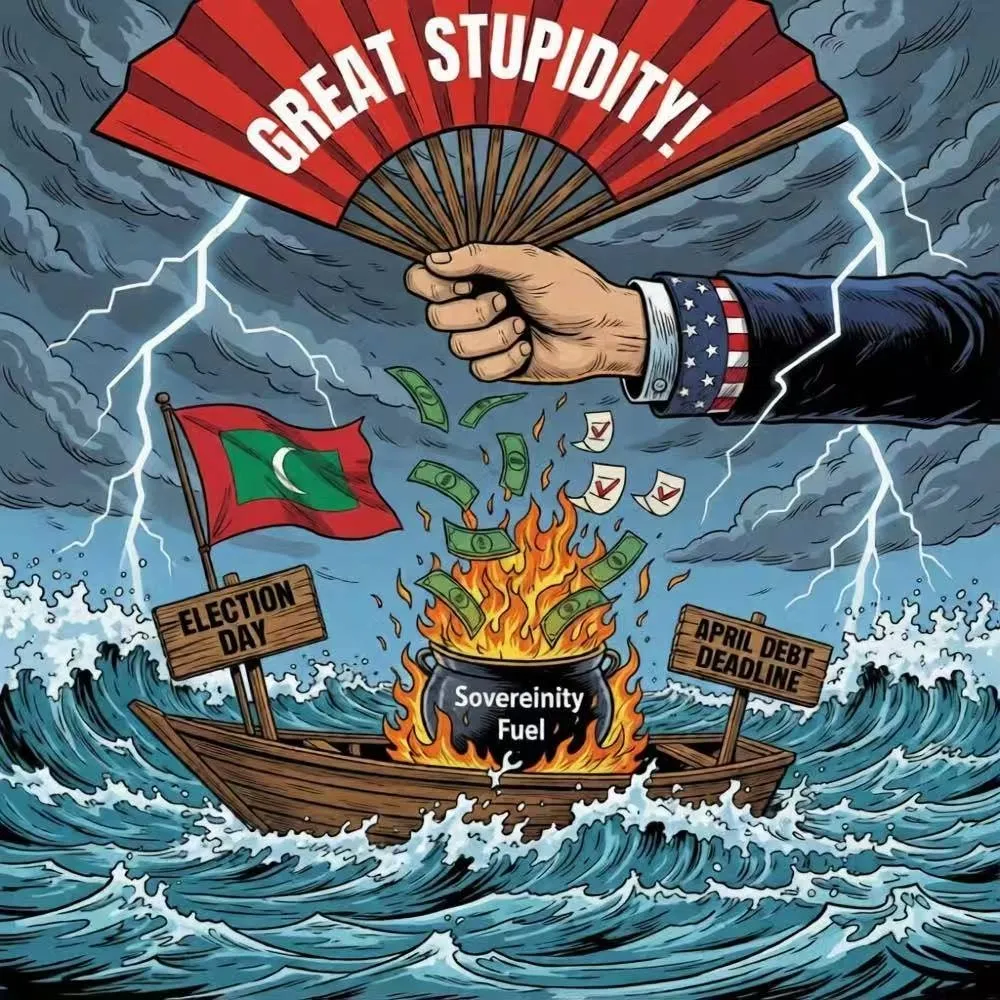
Feb 07, 2026 – An editorial cartoon showing a giant hand with a US flag cuff waving a red fan labelled ‘GREAT STUPIDITY!’. Below, a Maldivian dhoni boat struggles through a storm, carrying wooden signs for ‘ELECTION DAY’ and ‘APRIL DEBT DEADLINE’ and a pot of fire labeled ‘Sovereignty Fuel’.
In the wake of Donald Trump’s ‘Great Stupidity’ brandishing, the Maldives is attempting to transmute its domestic debt and election anxieties into a new Indian Ocean security deal. A small nation’s high-stakes gamble to warm its own political pot by stoking a superpower’s fire.
Fan-Induced Storm
On 20 January 2026, as Donald Trump brandished his red folding fan inscribed with “Great Stupidity” while publicly skewering the Chagos Agreement between the UK and Mauritius, President Mohamed Muizzu in Malé’s presidential palace keenly sensed a shifting geopolitical tide.
While geopolitical pundits were still busy debating whether Trump would actually buy Greenland or simply tear up the Chagos lease for sport, few expected a nation usually reserved for high-end luxury travel brochures to step into the ring. Yet, there was Muizzu, presenting a “Hardcore Plan B” that left London, Washington, and even New Delhi flat-footed.
Though Trump’s stance subtly pivoted from “blasting the deal” to supporting the status quo following his 6 February call with British Prime Minister Keir Starmer, the “first act” of this drama had already fulfilled its primary mission for Malé.
Domestically, the government successfully weaponized the Chagos issue, transforming a complex maritime dispute into an unassailable “fortress of nationalism.”
The “100-Day” Road to a Calculated Storm
This surprise offensive was no impromptu act. As early as the 2023 campaign, Muizzu astutely tapped into local fury over “lost” maritime territory, pledging to reclaim the 45,000 square kilometres of waters allegedly “sold off” by the previous administration.
Upon taking office, this was canonized as Item 14 of his “Week 14 Roadmap,” mandating a legal challenge to the ITLOS ruling.
Far from a sudden pivot, Muizzu had spent much of 2024 and 2025 methodically laying the groundwork for this confrontation. In his 2026 Presidential Address, Muizzu finally declassified a series of strategic maneuvers that had been running beneath the surface for over a year:
The Legal Audit
A secretive review of all correspondence from the Solih era, specifically targeting the “betrayal letter” sent to Mauritius.
The First Protest (8 Nov 2024) – A formal objection sent to the UK’s Labour government on the eve of Republic Day, asserting the Maldives’ “historical bloodlines” over Chagos.
The Warning Call (15 Dec 2025) – A direct phone call to British Foreign Secretary David Lammy, demanding a seat at the table and warning of ecological mismanagement by Mauritius.
The Pre-emptive Strike (18 Jan 2026) – A second formal letter to London, dispatched just three days before Donald Trump’s first “Great Stupidity” blast on social media.
By the time Trump’s “red fan” provided the spark, Muizzu’s long-prepared engine was already running at full throttle. He didn’t just follow the wind; he had anticipated the storm and built a ship ready to sail it.
A Masterstroke – Interviews, Revoked Letters, and Tactical Defiance
Over the past fortnight, the Maldives has executed a series of interlinked moves designed less for actual territorial gain and more for peak political performance:
Global “Security Pitch”
Muizzu bypassed traditional diplomacy, launching a strategic strike in British and American media. In his Daily Express interview, he offered a blunt geographical reality check: “The Maldives is a mere 500 kilometres from Foalhavahi (Chagos), while Mauritius lies a distant 2,100 kilometres away!”
A “Constitutional” Guarantee: Addressing Trump’s transactional nature, Muizzu told Newsweek: “Should the Maldives gain sovereignty, we would establish permanent, stable security arrangements for the Diego Garcia base through ‘constitutional and parliamentary procedures’.” He positioned the Maldives as a more reliable “hardcore landlord” than Mauritius, offering direct security dividends.
Parliamentary “Sovereignty Cleansing”
On 5 February, Muizzu formally revoked former President Solih’s 2022 confidential letter to Mauritius, declaring: “Not an atom, not a grain of sand of Maldivian territory shall be relinquished.” By legislating that maritime changes require a three-quarters majority, he has effectively sidelined the opposition ahead of the April elections.
Naval Assertiveness
When the fast attack craft Daru Manwatta intercepted fishing vessels in disputed waters, the Defence Ministry’s tone was icy: “The Defence Forces will completely disregard the demarcated boundary… as the President has decided to treat this area as Maldivian territory.”
A digital editorial from Maldives Independent (2025/2026), illustrating President Muizzu’s ‘tiger-like’ domestic narrative. The juxtaposition of Maldivian sovereignty and the US flag encapsulates the President’s bid to reposition the nation as a strategic security partner.
The Strategic Heart – Diego Garcia and the Chagos Legacy
To comprehend Malé’s current radicalism, one must look beyond the travel brochures. The Chagos Archipelago—a cluster of seven atolls and over sixty islands—is the strategic “heart” of the Indian Ocean, situated just 500 kilometers (310 miles) south of the Maldives’ Addu Atoll. While Mauritius claims sovereignty from over 2,100 kilometers away, the Maldives is, in every geographical sense, Chagos’s closest neighbor.
The crown jewel of this archipelago is Diego Garcia, a footprint-shaped atoll that serves as a “unsinkable aircraft carrier” for the U.S. military. With its deep-water harbour and long-range runways, it is a vital hub for projecting power across the Middle East and the Indo-Pacific.
Yet, this strategic value is built upon a foundation of colonial tragedy. In 1965, Britain severed Chagos from Mauritius to create the British Indian Ocean Territory (BIOT), subsequently forcing the expulsion of thousands of indigenous Chagossians to clear the way for the American base.
The historical link to the Maldives, however, predates these colonial maneuvers by centuries. Known to Maldivians as “Foalhavahi,” the archipelago appears in 16th-century royal decrees, most notably those of Sultan Hassan IX, who asserted sovereignty over these “seven islands” nearly 463 years ago. Modern archaeological finds—including coral gravestones inscribed in Dhivehi (the Maldivian script)—provide silent testimony to a pre-colonial Maldivian presence that long predates any European claim.
In October 2024, a historic deal sought to bridge this legal abyss: Britain agreed to transfer sovereignty to Mauritius in exchange for a 99-year lease on the Diego Garcia base—a “landlord-turned-tenant” compromise. However, as President Muizzu has astutely noted, this pact remains in a fragile “ratification limbo.”
By seizing upon this vacuum, Muizzu is posing a provocative question to the world. If the 2024 agreement is truly a step toward decolonization, should the islands not return to their original historical sphere—the Maldives—rather than a distant nation that only inherited them as a colonial byproduct?
The Betrayal – A “Sovereignty for Sea” Gamble Gone Wrong
For the Maldives, the Chagos issue is a thirty-year-old wound that cuts through the heart of its maritime identity. For decades, the nation’s position remained unyielding: it would never recognise any sovereignty claim—British or Mauritian—that could potentially undermine the integrity of its 200-nautical-mile Exclusive Economic Zone (EEZ).
However, a “brutal betrayal” occurred in August 2022, when former President Solih secretly wrote to the Prime Minister of Mauritius. In a move that shocked the Maldivian political establishment, Solih pivoted to acknowledge Mauritian sovereignty. His calculated gamble was a form of “sovereignty-for-sea” swap—he hoped that by conceding the land, Mauritius would reciprocate by retreating from overlapping maritime boundaries. Solih’s administration bet that this trade-off would secure a larger, undisputed slice of the Indian Ocean for Malé.
The gamble failed to deliver the promised prize. While the April 2023 ITLOS ruling did grant the Maldives a slightly larger portion of the disputed area—roughly 47,232 sq km compared to Mauritius’s 45,331 sq km—this “victory” felt like a defeat. The total was significantly lower than the full, unencumbered 200-mile claim the Maldives had historically fought for.
The deal ultimately resulted in the permanent loss of over 45,300 square kilometres of prime fishing grounds—a maritime territory nearly 150 times the size of the Maldives’ total landmass.
Muizzu’s current “reckoning” is a public trial of what he frames as a treacherous failure to protect the nation’s ancestral waters.
Deep Observation
The Survival Logic of Strongman Politics
Muizzu’s assertiveness is far from a reckless challenge to major powers; it is a masterclass in extreme pragmatism, born of a desperate need to navigate a “perfect storm” of domestic and financial crises converging in April 2026.
Social Media’s “Nationalist Resonance”
Despite Trump’s erratic pivot on the international stage, Maldivian social media (X and Facebook) has witnessed an unprecedented “internal carnival.”
Local discourse is dominated by Muizzu’s parliamentary pledge: “Not an atom, not a grain of sand shall be relinquished.” In the eyes of many Maldivians, Trump’s initial “blasting” of the UK-Mauritius deal was seen as a divine endorsement of Muizzu’s hardline stance.
Even as Washington backtracks, the domestic narrative is set – Finally, a president has the steel to tear up a “treasonous” secret letter and dispatch warships to defend our ancestral heritage. This wave of nationalism acts as a political flak jacket, rendering any opposition criticism of “diplomatic isolation” practically inert.
The 3 April Electoral “Mid-term” Stakes
This geopolitical storm erupted precisely on the eve of the 3 April local council elections. With major infrastructure projects stalled due to a severe funding crunch, the Chagos case has provided Muizzu with the ultimate patriotic high ground. By framing the issue as a zero-sum struggle for sovereignty, he has successfully trapped the opposition (MDP) in a defensive corner where any dissent—however rational or legally grounded—is framed as an act of national betrayal.
For Muizzu, the Chagos “victory” is a surrogate for the economic dividends he has yet to deliver.
The 8 April Debt “Guillotine”
Behind the flags and naval patrols lies a cold, fiscal reality. On 8 April, just five days after the election, the Maldives faces a $500 million Islamic bond (Sukuk) repayment deadline. With debt obligations for April totalling approximately $625 million and foreign reserves at a critical low, the nation is on a financial knife-edge.
In his 5 February address, Muizzu vowed to repay $150 million upfront while refinancing the remaining $350 million at rates below 9%—a near-impossible feat given the Maldives’ “junk” credit status.
Observers suggest that Muizzu’s “bodyguard pitch” to Trump harbours a profound geo-financial logic. By demonstrating the Maldives’ “irreplaceable role” in safeguarding the Diego Garcia base, he is seeking a form of geopolitical “credit enhancement.” He is eager to prove to the White House that Malé is not a mere aid-seeker, but a strategic partner capable of securing America’s most vital Indian Ocean asset. This export of “security value” may well be his last hidden trump card to secure the bilateral support needed to avoid a sovereign default.
Defensive Resilience and the “B-Plan”
By rejecting the ITLOS ruling and establishing a “fait accompli” in disputed waters, Muizzu has fundamentally shifted Malé’s role from a passive aid recipient to a proactive, if disruptive, player. Against the backdrop of Trump’s known contempt for “multilateral arbitration,” Malé’s offer of “constitutional guarantees” for the base is a calculated play for the long haul—biding its time until the inevitable cracks appear in the implementation of the UK-Mauritius agreement.
The Quiet Giant—New Delhi’s Strategic Patience
While Indian media and strategic analysts have been vocal in their alarm over Malé’s recent maneuvers, the official response from New Delhi has been characterized by a calculated, icy silence. This restraint reflects a complex regional reality. For India, Mauritius is far more than a strategic ally—it is a “kinship state.”
With approximately 70% of the Mauritian population of Indian descent, the bond between the two nations is rooted in a century of shared bloodlines and political history. New Delhi has long been the primary champion of Mauritian sovereignty over the Chagos Archipelago, acting as a quiet architect behind the very 2024 agreement that President Muizzu is now challenging.
From a strategic perspective, Muizzu’s pivot appears less like a declaration of diplomatic war and more like a high-stakes “Strategic Stress Test.” By reopening the Chagos file and signalling closer maritime engagement with other powers, Malé is testing the limits of its “Neighborhood First” relationship with India.
The subtext, of course, is the $500 million debt deadline looming this April. In the cold logic of the Indian Ocean, sovereignty claims can often serve as levers for financial breathing room. Muizzu knows that for India, the stability of the Maldives is a paramount security interest.
By stirring the waters around Chagos, Malé may be signaling that in an era of heightened competition, its continued alignment—and its economic stability—comes with a price tag that its neighbours may yet be willing to negotiate.
Final Reckoning. The Tides and the Pot
Just as the tides of the Indian Ocean wait for no one, Muizzu is not waiting for a great power’s blessing. He has seized a fleeting spark amidst the storm with clinical precision. For a strongman burdened by heavy debt and a ticking financial clock, what matters more than legal purity or international approval is the “hot pot” he can present to his voters tomorrow morning.
He has gambled that by stoking the fire of nationalism, he can keep the state coffers—and his political future—alive for one more season.
Postscript (February 6, 2026)
The “fire” stoked in Malé quickly met a cold front from both London and Washington today, revealing the brutal limits of small-state leverage in the Indian Ocean. Following President Muizzu’s defiant parliamentary address on February 5, the response from the “Big Landlords” was swift and coordinated.
In London, the British government officially dismissed the Maldivian objection, categorizing the sovereignty of the Chagos Archipelago as a “strictly bilateral issue” between the UK and Mauritius. This formal rebuff effectively slams the door on Malé’s attempt to gatecrash the negotiations.
This British “cold shoulder” was almost immediately followed by a strategic pivot from the White House. On February 6, in a dramatic U-turn on Truth Social, President Trump described the UK-Mauritius pact as “the best deal” Prime Minister Keir Starmer could strike under the circumstances—a sharp reversal from his earlier branding of the deal as an “act of total weakness.”
However, Trump’s endorsement came with a “Militarily Secure” clause that serves as a direct warning to the Maldives. While backing the status quo, Trump declared: “If the lease deal ever falls apart, or anyone threatens or endangers US operations… I retain the right to Militarily secure and reinforce the American presence in Diego Garcia.”
By pairing a pragmatic acceptance of the deal with the threat of a direct military takeover, Trump has effectively neutralized Muizzu’s “unsolicited bodyguard” audition.
For the Maldives, the fire is still burning, but the smoke is blowing back towards Malé, where the $500M debt clock continues to tick.
END
