

By P.K.Balachandran/Counterpoint
Colombo, February 3- US President Donald Trump has said multiple times that he wants Canada to be the 51st. State of the United States and not an independent country as it has been all along. Trump’s aim is to bring the entire Western Hemisphere under US control, ostensibly to face a perceived threat from Russia and China or even a European power.
Trump’s plan to annex Canada is in line with the Monroe Doctrine. As President James Monroe did in 1823, Trump is now citing an external threat to justify US dominance over Canada and the entire Western Hemisphere. While James Monroe sought to stem threats from Britain and France in 1823, Trump today is agonising over an economic threat from China.
Referring to a trade deal between Canada and China, Trump warned, “China will eat Canada alive, completely devour it, including the destruction of their businesses, social fabric, and general way of life. The last thing the world needs is to have China take over Canada. It’s NOT going to happen, or even come close to happening!” Trum said as he threatened to impose a 100% tariff on Canadian goods.
Trump feared that the Sino-Canada trade deal will result in Canada sending Chinese electric cars over to the US for sale.
In pursuit of his objective, Trump is exploiting separatist sentiments in the Canadian provinces of Alberta, sentiments rooted in a feeling of being discriminated against by the central government in Ottawa.
With declarations from US officials that regional dominance is their main geostrategic objective, threats from Trump that he intends to annex Canada have rattled Canadians. In 2025, Trump had said that the centuries-old border between the US and Canada was no more than an “artificially drawn line”, a line that, with force and persuasion, could be redrawn.
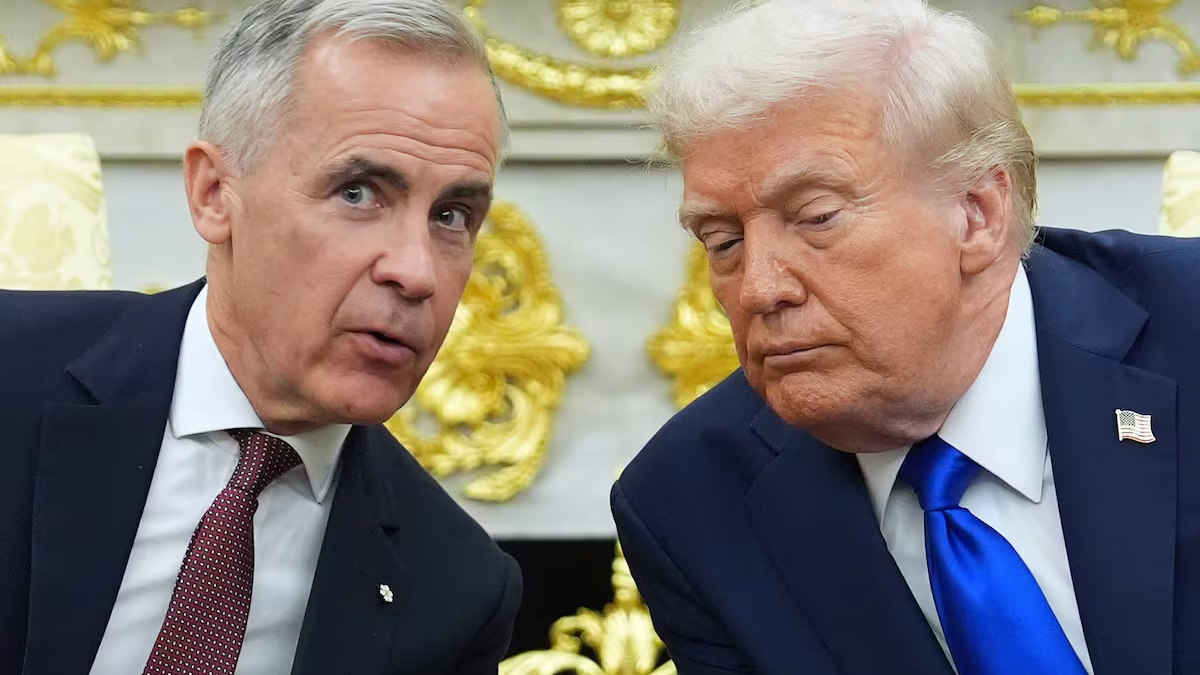
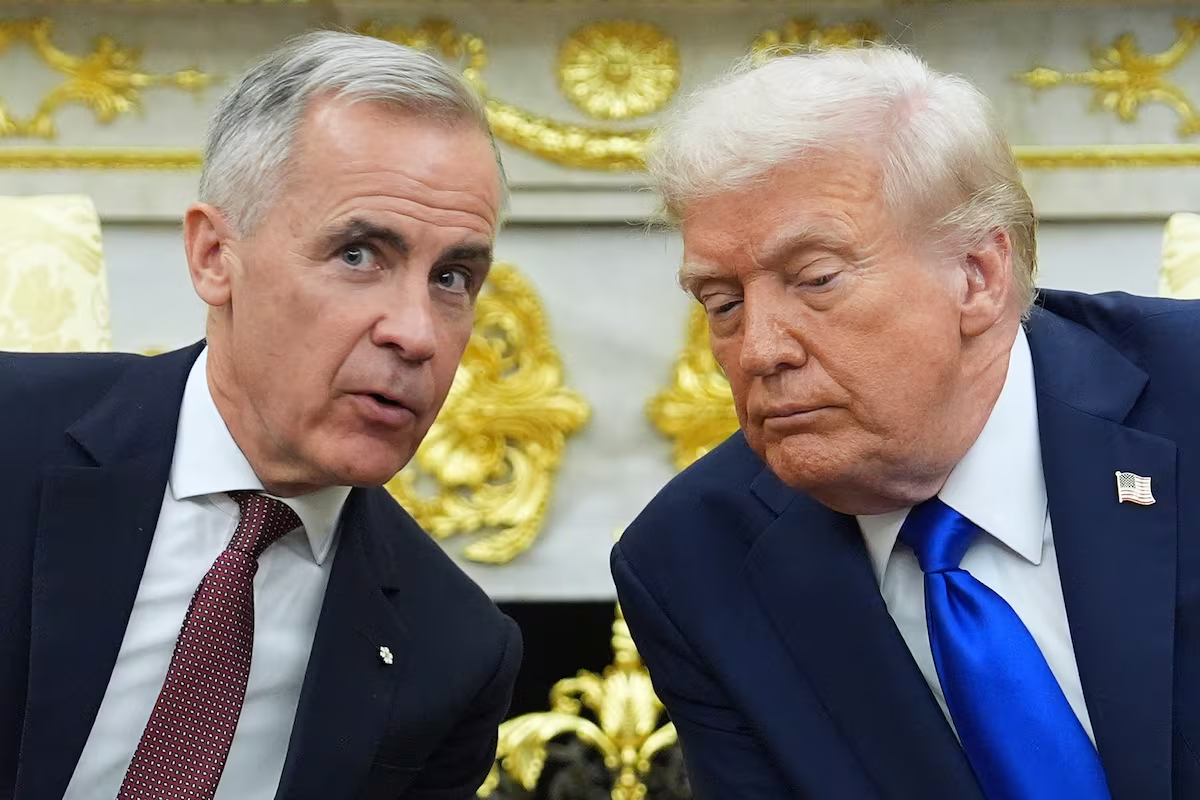
“Somebody drew that line many years ago with, like with a ruler – just a straight line right across the top of the country,” Trump told Canada’s Prime Minister, Mark Carney. A unified continent was the way it was meant to be, Trump added.
On January 20, Trump posted an altered image on his social media account that features the US flag covering Canada, Greenland and Venezuela.
The issue exposed a deep and persistent anxiety in Canada that, despite decades of tight economic integration, Canada remains vulnerable to US aggression.
Historical Background
Fear of a US takeover is not new in Canada, as the two countries have had many clashes before. In the 19th Century, territorial conflicts and flare-ups along the US-Canada border were a frequent occurrence. Americans made multiple unsuccessful attempts to capture Canadian territory during the 1812 War. In 1844, some Americans called for military force if the UK wouldn’t agree to its claims in the Pacific Northwest.
A long period of calm followed till 1927-30, when a fear of a US invasion surfaced again. The US feared a British invasion of Canada and soughy to prevent it by taking over Canada. The US thought that if it lost the war with the British, Canada would demand that Alaska be given to it.
War Plan Red
In 1927, Canadians drew up what was called the “ War Plan Red”. The scenario that was built up for “War Plan Red” was as follows – American forces would strike with poison gas munitions, seize a strategically valuable port city. Soldiers would sever undersea cables, destroy bridges and rail lines to paralyse infrastructure. Major cities on the shores of lakes and rivers would be captured to blunt any civilian resistance.
The multipronged invasion would rely on ground forces, amphibious landing and then mass internments. According to the architects of the plan, the attack would be short-lived and the besieged country would fall within days. However, the feared British invasion of Canada did not take place nor did the US invasion of Canada.
Venezuela and Greenland Revive Fears
After Trump seized Venezuela’s President in a brazen night-time attack, and threatened to take over Greenland, a territory controlled by NATO ally Denmark, his aim of making Canada, America’s 51 st State have revived fears of an American take over of Canada.
“We need Greenland from the standpoint of national security, and Denmark is not going to be able to do it,” Trump told reporters on Air Force One. His vice-president, JD Vance, also chimed in on the issue, telling reporters that Denmark “obviously” had not done a proper job in securing Greenland and that Trump “is willing to go as far as he has to” to defend American interests in the Arctic.
The pursuit of Greenland, where the US already has the unfettered ability to build military bases, represents “outright avarice and greed”, Canadians say. The belief that “might makes right’ and the unabashed use of false accusations have always been basic to US thinking on foreign policy, many Canadians think.
Drug Smuggling Charge
Trump is demonising Canada by saying that the 8,850 km border with the US has been opened to drugs. Side by side, he makes much of the fledgling secessionist bid through a referendum in Alberta. Canadians therefore fear that the US would move troops to the northern Montana border to tell them that Alberta must be allowed to join America as its “51st state”.
In 2025, the then Prime Minister, Justin Trudeau, warned business leaders Trump’s threats to annex Canada were a “real thing” and the President wanted to access the country’s critical minerals.

Globe and Mail Poll
According to Globe and Mail a 2025 poll found that 43% of Canadians believed a military attack by the US within five years was somewhat likely, with 10% deeming it highly likely or certain.
Calls for a “whole-of-society” response have grown and in May, a directive signed by Canada’s Chief of the Defence Staff outlined how the military could train federal and provincial employees to handle firearms, drive trucks and fly drones to bolster the country’s supplementary reserve.
The Canadian military currently has 4,384 personnel in its supplementary reserve, which is largely made up of inactive or retired soldiers. But the new plans could boost that figure to 300,000.
The Cascade Institute also released a plan that suggests a “bare-bones” national service program could be delivered for Canadian $1.1bn, with a more robust plan costing Canadian $5.2bn. Canada would need to deepen its relationship with Scandinavian allies and to adopt their longstanding approach to say to the US, “If you attack us, you may ultimately succeed, but it’s going to really hurt.”
Alberta’s Separatism
As stated earlier, Trump is using separatist sentiments in Alberta to his advantage. Albertans says that despite Alberta’s abundant natural resources, and the revenue it produces for Canada, the federal government in Ottawa continues to act against the province’s best interests.
Anger towards Ottawa has been building in Alberta for decades, rooted largely in disputes over how the federal government manages the province’s vast oil and gas resources. Many Albertans feel federal policies – particularly environmental regulations, carbon pricing and pipeline approvals – limit Alberta’s ability to develop and export its energy.
As a landlocked province, Alberta depends on pipelines and cooperation with other provinces to access global markets, making those federal decisions especially contentious.
Many Albertans believe the province generates significant wealth while having limited influence over national decision-making. In 2024-25, for instance, it contributed 15 percent of Canada’s gross domestic product (GDP), despite being home to only 12 percent of the population. Alberta consistently produces more than 80 percent of Canada’s oil and 60 percent of the country’s natural gas.
Yet, many Albertans say that the federal government does not give the province its fair share from taxes collected. Canada has a system of equalisation payments, under which the federal government pays poorer provinces extra funds to ensure that they can maintain social services. While Quebec and Manitoba receive the highest payments, Alberta – as well as British Columbia and Saskatchewan receive no equalisation payments.
Prime Minister Mark Carney recently signed an agreement with Alberta, opening the door for an oil pipeline to the Pacific, but it faces significant hurdles.
Referendum and Opinion Polls
Recent Ipsos polling suggests that about three in 10 Albertans would support starting the process of leaving Canada. But the survey also found that roughly one in five of those supporters viewed a vote to leave as largely symbolic – a way to signal political dissatisfaction rather than a firm desire for independence.
A referendum on Alberta independence could happen later this year if a group of residents can collect the nearly 178,000 signatures required to force a vote on the issue. But even if the referendum passes, Alberta would not be immediately independent.
Under the Clarity Act, the federal government would first have to determine whether the referendum question was clear and whether the result represented a clear majority. Only then would negotiations begin, covering issues such as the division of assets and debt, borders and Indigenous rights.
Alberta Prosperity Project
The Alberta Prosperity Project (APP) is a pro-independence group that is campaigning for a referendum on Alberta leaving Canada. It argues that the province would be better off controlling its own resources, taxes and policies.
On its website, the APP says, “Alberta sovereignty, in the context of its relationship with Canada, refers to the aspiration for Alberta to gain greater autonomy and control over provincial areas of responsibility.”
“However, a combination of economic, political, cultural and human rights factors … has resulted in many Albertans defining ‘Alberta sovereignty’ to mean Alberta becoming an independent country and taking control of all matters that fall within the jurisdiction of an independent nation,” it adds.
Those who are pushing for Alberta’s independence are preparing a petition signed by 178,000 by May 2 to trigger a referendum on the issue.
Ahead of last year’s election, in March, Alberts’s Prime Minister Danielle Smith threatened a national-unity crisis if Canadian PM Mark Carney didn’t respond to her demand to change federal energy and environmental policies and pave the way for a new bitumen pipeline. Smith then hit the road, holding a series of raucous province-wide town halls through the summer where separatism featured prominently. Throughout, Smith advocated a “sovereign Alberta within a united Canada,” a position described by University of Calgary Political Science professor Barry Cooper as “calculated ambiguity.”
Albertans Meet US Officials
Meanwhile, some Alberta leaders had two meetings with US State Department officials in Washington. The White House and the State Department confirmed those meetings. But these invited accusations of treason from British Columbia Premier David Eby. And Ontario Premier Doug Ford asked Alberta PM Danielle Smith to pick a side.
Smith did not denounce the meetings. She said that she expected the US administration to respect Canadian sovereignty. “But I’m not going to demonize or marginalize a million of my fellow citizens when they’ve got legitimate grievances,” she said and added, “What we need to do is we need to give Albertans hope.”
According to Globe and Mail, so far, despite images on social media showing crowds at rallies and lines to sign the petition, there is little evidence that the movement is growing. However, some academics see the separatist sentiment as a “warning” to Ottawa.
END
