

By P.K.Balachandran/Daily Mirror
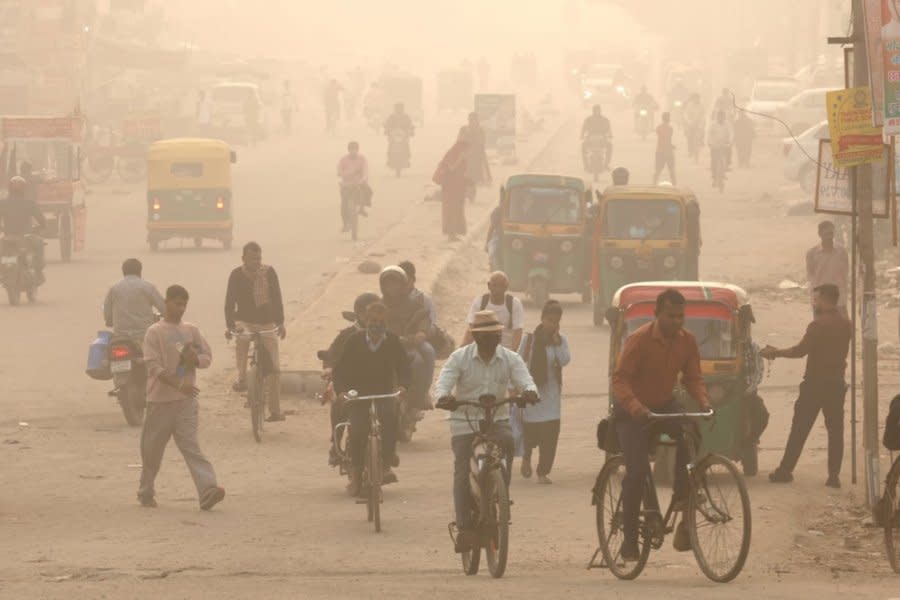
Colombo, January 27 – Air pollution is having a devastating effect on large parts of South Asia, particularly Northern India, Pakistan and Bangladesh. Sri Lanka too is affected, but only seasonally and that too due to cross border flows from its northern neighbours.
The lack of proper Air Quality Management (AQM) in the northern part of the Indian subcontinent is causing diseases and deaths, while also slowing down economic development, says a World Bank report.
The report gained world-wide attention after Harvard Economic professor and former IMF chief economist told the World Economic Forum at Davos last week that polluted Indian air, rather than the 50% American tariff, is the main obstacle to India’s economic growth.
Gopinath explained how pollution adversely affects productivity, increases healthcare costs and slows down overall economic activity, making it a silent but serious drag on growth. While tariffs often dominate debates, it is the environmental factors that are crying for attention.
“India has made progress in expanding its economy and improving infrastructure, but pollution remains a persistent challenge, particularly in major urban centres. From an international investor’s point of view, if you are thinking of setting up operations in India and living there, the environment matters,” she underlined.
She quoted a 2022 World Bank study to show that pollution causes nearly 1.7 million deaths in India each year, accounting for roughly 18% of the country’s total deaths. “Tackling pollution must become a top national priority. It needs to be treated as a mission for India,” she stressed.
In Sri Lanka
Air quality across several parts of Sri Lanka has deteriorated. Dr. Ajith Gunawardena, Media Spokesperson for the Central Environmental Authority, stated to “Climate Fact Checks” that Air Quality Index (AQI) readings recorded since January 18 indicated a noticeable decline in air quality across a wide range of regions.
Officials from the Central Environmental Authority (CEA) say that the decline is linked to transboundary air pollution caused by particulate matter originating from the Indian subcontinent. According to CEA monitoring data, AQI values have fluctuated between 150 and 200 in the Northern, North Central, North Western, Western, and Southern Provinces. Similar conditions have also been reported in the Ratnapura and Kegalle districts.
An AQI reading between 150 and 200 is categorized as “unhealthy,” particularly for sensitive groups such as children, the elderly, and individuals suffering from respiratory or cardiovascular conditions.
Director of the Air Quality Monitoring Unit of CEA , Ms. Vernica Ranawaka Arachchi described to the “Climate Fact Checks” that the current situation as being “somewhat adverse” but stressed that it does not yet pose a severe public health emergency.
She attributed it to seasonal wind movements which transport polluted air masses from neighbouring regions into Sri Lanka. This type of transboundary pollution is not unusual during this period of the year and is influenced by prevailing meteorological conditions.
The primary source of the current particulate matter is the annual burning of agricultural crop lands across the Indian subcontinent, she said.
Due to the dense concentration of particles, solar radiation is partially blocked, preventing sunlight from fully reaching the ground. This has resulted in slightly cooler ambient temperatures in several parts of the country over the past few days.
Ms. Arachchi expressed concern over the lack of effective action in some neighbouring countries, despite repeated warnings and guidelines issued by international organizations such as the World Health Organization (WHO).
South Asia – Global Hotspot
The World Bank’s report entitled “Striving for Clean Air -Air Pollution and Public Health in South Asia” says that the region is a “global hotspot” of air pollution, home to 37 of the 40 most polluted cities in the world.
Pollution in South Asia causes an estimated 2 million premature deaths each year and results in significant economic loss, it said.
An individual takes one breath every three seconds or 38,000 breaths per day. In South Asia, the individual inhales not good air but extremely unhealthy air, especially in densely populated, poor areas.
But the approaches South Asian governments have followed to reducing air pollution have been ineffective as they have been piecemeal and uncoordinated. Since air pollution freely crosses boundaries, an internationally coordinated and multi-pronged approach is the need of the hour.
The World Bank study found concentrations of fine Particulate Matter, such as soot and small dust (PM2.5) in some of the region’s most densely populated and poor areas to be 20 times higher than what the World Health Organization (WHO) considers healthy – 5 micrograms per cubic meter of air (μg/m3).
Exposure to such extreme air pollution creates stunting and reduced cognitive development in children, respiratory infections and chronic and debilitating diseases in others.
Sources of Pollution
Large industries, power plants, and motor vehicles are dominant sources of air pollution around the world. But in South Asia, there are other major contributory factors.
These are the use of solid fuel combustion in residences for cooking and heating; small industries, including brick kilns; the burning of high-emission solid fuel; the current management of municipal waste, including the burning of plastics; the inefficient application of mineral fertilizers; fireworks during festivals; and human cremation.
Significant air pollution also emanates from agriculture, including through the generation of secondary particulate matter in the form of ammonia (NH₃) emissions from unbalanced fertilizer use, and livestock manure that reacts with nitrogen oxides (NOx) and sulphur dioxide (SO₂) gases from energy, industry, and transportation sources.
In the western part of South Asia, natural sources—such as dust, organic compounds from plants, sea salt, and forest fires—are a significant source of air pollution.
Dust Particles
Some 60% of South Asia’s population lives in heavily polluted areas where levels of dust particles exceed the least stringent World Health Organization (WHO) air quality standard.
Dust particles can travel hundreds of kilometres. For example, about 30% of air pollution in the Indian State of Punjab comes from neighbouring Pakistan; 30% of pollution in Bangladesh’s largest cities originates in India due to the predominant wind direction from the northwest to the southeast.
City-by-City Approach Won’t Do
The World Bank study says that it is impossible to improve air quality to healthy levels using the city-by-city approach prevalent across South Asia.
For example, even if Delhi, the most polluted capital city in the world, were to fully implement all technically feasible air pollution control measures by 2030, the city would still not meet the WHO Air Quality Guidelines because pollution is constantly coming from outside the city.
The inflow of pollution from neighbouring States and bordering countries (like Pakistan) accounts for more than 50% of the air Particulate Matter in Delhi.
Therefore, only through cooperation at the Provincial, State, and Regional levels can South Asia hope to beat air pollution. If a comprehensive and correct approach is taken, more than 750,000 lives would be saved annually.
Monitors Across South Asia
South Asian countries should collaborate to install Air Quality Monitors (AQM) at critical points throughout an “airshed” (which is an area where pollution is concentrated). These AQMs should generate credible scientific data. And they should work together to build the institutional capacity to analyse the data. This has been done in other parts of the world, such as ASEAN countries, China, Europe, and the United States.
Once the monitoring systems have been created, countries should establish joint airshed targets to track emissions within and across countries and encourage the adoption of cost-effective solutions.
Carbon Trading
Carbon trading has to be introduced, the report urges. Carbon trading is a market-based system designed to reduce emissions. It allows companies, governments, or individuals to buy and sell permits or credits that represent the right to emit a certain amount of carbon dioxide (CO₂) or other greenhouse gases. A price is put on carbon emissions to incentivize organizations to reduce their pollution.
Even Modest Targets are Far Away
Though progress has been made in legislation and planning for Air Quality Management (AQM), South Asia is not on track to reach even the modest WHO Interim Target 1. That target of 35 μg/m³ (micrograms per cubic meter) is still seven times the concentration that the WHO considers healthy.
Too Much Concern with Cities
The reason for insufficient progress is that, currently, the focus of interventions is almost completely on mitigating pollution generated within cities. Most countries in South Asia have imposed varying emissions standards for vehicles and have mandated low-NOx burners for power plants and filters for some large industrial boilers. But to achieve greater progress, and more cost-effective progress, the policy focus should broaden to include small manufacturing, agriculture, residential cooking, and waste management, which are important sources of air pollution in South Asia.
Implementation of these policies requires incentives for cooperation across different jurisdictions and coordination between nations because airsheds do not recognize national borders. Monitoring systems need to be maintained and updated on an ongoing basis. Creation of credible scientific institutes that improve scientific and analytical capacity in South Asia is crucial.
Facilities Should Not Be Monopolized
But scientific capacity should not be centralized. It should be distributed across the region.
To enhance the credibility and salience of scientific information among the stakeholders of airsheds, and to ensure more equal representation and ownership across countries and jurisdictions, a South Asia–wide scientific community on Air Quality Management should facilitate communication between experts across administrative boundaries and develop a scientific consensus on critical issues.
The capacity of ministries of the environment must be strengthened. These ministries have the main mandate to manage air quality programs, but they do not have the financial resources or the staff required for the needed coordination of environmental policies in agriculture, energy, industry, rural development, transportation, and urban development.
Control On Use Of Fertilizers
Subsidies for fertilizers, another cause of air pollution, should be reconsidered. Fertilizer use should be lowered without compromising productivity. For example, Bangladesh has developed techniques in this area.
Large-scale intensive livestock operations can prevent emissions through the scrubbing of ventilated air both into and out of animal housing sheds. Various types of air purification systems exist, including combination filters that remove more than one pollutant.
Less-polluting and more viable brick kiln technologies are available, but are slow in being adopted. Many brick kilns in South Asia are very small units using old technologies, with inefficient combustion of coal and agricultural waste.
Municipal Waste Management
Municipal waste management is one of the most cost-effective potential interventions in the region. In many cities in South Asia, no waste collection is performed, and even in cities with high collection rates, segregation of waste and recycling hardly takes place.
Recycling, controlled incineration, composting of biodegradable waste, and managed landfills not only reduce air pollution but also generate revenues by recovering precious or rare earth metals from electronic components.
Taxation and Other Measures
Taxation of activities that release pollutants will make cleaner technologies more competitive. Likewise, subsidies can encourage the use of clean industries and technologies that do not harm air quality.
Revenues from taxes on pollutants or from sales of emissions permits generate the fiscal space to create public funds that support abatement activities.
International Funding
The synergies between reductions in air pollution and climate change policies can help mobilize international funds. Strong synergies are found between meeting cleaner air targets and meeting commitments to reduce greenhouse gas emissions. Those synergies can mobilize international funds that can support Air Quality Management.
Some of these funds come from multilateral development banks, scaling up existing programs that link financing to the achievement of air quality improvement targets, the World Bank report says.
END
