

By Viswanath/Counterpoint
Colombo, January 17 – The government has partly shelved its controversial education reforms in view of protests by other stakeholders. Last Tuesday, it brought itself to postpone the Grade 06 reforms until next year. A link to a gay website, in the Grade 06 English module, gave a turbo boost to the Opposition’s campaign against the education reforms. The government may have taken a step backward for its own sake, for agitations have the potential to snowball into a protest movement like Aragalaya. However, the government’s tactical retreat has not helped make protests against education reforms fizzle out.
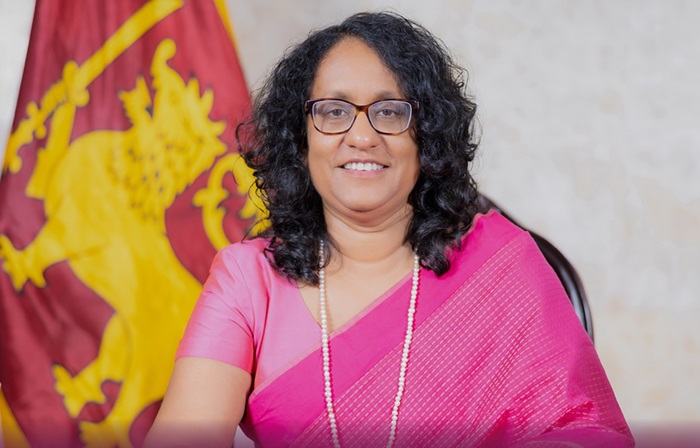
Curiously, the opponents of the education reforms have taken on Prime Minister and Minister of Education Dr. Harini Amarasuriya rather than the government. The Opposition is going to move a no-confidence motion against her, and some of its members and their supporters and propagandists are accused of carrying out personal attacks on Harini, who has become a victim of character assassination. The vilification campaign against her is so intense that a group of academics and activists led by Prof. Jayadeva Uyangoda has condemned personal attacks on her. Issuing a media statement on the education reforms and the vilification of the Prime Minister, they have said, among other things:
“The attacks being directed at the Prime Minister and Minister of Education Dr. Harini Amarasuriya by certain opposition groups and individuals are not only hateful, indecent, and a disgrace to the moral values of any civilized society, they also normalise misogynistic attitudes that belittle progressive women’s political leadership and shrink the space needed for constructive engagement and a meaningful discourse on urgently needed education reforms.”
Personal attacks on the Prime Minister are not only condemnable but also counterproductive for the campaigners against the proposed education reforms, for they have helped the government play victim in a bid to gain public sympathy. Last Saturday, the NPP staged a protest against the vilification of the PM, in Matugama, parallel to a demonstration held by a collective of Opposition parties led by the SJB, in the same township, against the education reforms.
Sri Lanka takes pride in the fact that it produced the world’s first female prime minister, but its politics continues to be dominated by men so much so that special quotas have had to be introduced to ensure that women are adequately represented in political institutions. Women account for more than one half of the Sri Lankan society but the 225-member has only 22 female members. Sri Lanka’s political culture is also tainted with sexism, if not, misogynism. There have been numerous instances where some female MPs complained of verbal sexual harassment at the hands of their male counterparts in the House itself.
Sexism is not limited to the parliament. It was reported in January 2021 that female local government members were denied their right to speak at local council meetings dominated by unruly males. The then Maharagama Urban Council member (SLFP) Chandrika de Zoysa said at a media briefing organised by a collective of female councillors, that their male counterparts heckled them and even shouted them down whenever they tried to speak. A similar situation prevailed in all other councils, the female councillors said. In the same year, SJB MP Rohini Wijeratne complained to Speaker Mahinda Yapa Abeywardena that SJB MP Thalatha Athukorale had suffered verbal sexual abuse at the hands of some government MPs during a debate on a no-confidence motion in the House.
Sri Lanka’s post-Independence history is replete with scurrilous attacks on female political leaders. Some UNP leaders heaped insult on Prime Minister Sirima Bandaranaike during their 1977 general election campaign. Among the UNP leaders who vilified her was Ranasinghe Premadasa, who went on to become Prime Minister and President. The UNP resorted to slanderous attacks on Chandrika Bandaranaike Kumaratunga in the run-up to the 1994 general election. During Kumaratunga’s presidency, her party supporters led by some of her ministers stripped a group of UNP activists including some women naked in public during their North Western Provincial Council election campaign in 1999.
Political debates in Sri Lanka are characterized by ad hominem or the logical fallacy of attacking persons instead of engaging with the substance of their arguments. This practice has taken a turn for the worse due to the expansion of social media, where anyone can say anything about anyone else and get away with it. It is against this backdrop that scurrilous attacks on Harini should be viewed.
The proposed education reforms are not the sole reason why Harini is under attack. In fact, the entire government is responsible for the ongoing reform drive, but she has been singled out for criticism, for she represents the NPP, which enabled the JVP to muster enough popular support, particularly swing votes, to win elections. The JVP’s vote base is small; it is less than 5%. Floating votes made the JVP-led alliance’s victory possible. Sizeable traditional vote bases of political parties no longer exist. So, the Opposition is all out to deprive the government of floating votes, and attacks on Harini can be considered part of its electoral strategy. Even if the government abandons its education reform package, the Opposition is bound to continue its attacks on the PM.
The NPP is not free from internal rivalries, and there are differences between the JVP and the NPP. The PM’s predicament may have gladdened the hearts of some JVP stalwarts who are not well-disposed towards her and want to keep the government under their thumb to make the most of their electoral windfall to strengthen their party, but they won’t do anything that might lead to a rift in the ruling alliance and endanger their government. Therefore, the Opposition’s claim that some JVP seniors are trying to destroy Harini politically cannot be considered tenable. All NPP MPs are bound to back Harini en masse if the Opposition goes ahead with its no-confidence motion against her. This however does not mean that splits won’t occur in the NPP camp; group dynamics and competing ambitions of politicians work in such a way that they render the unity of any ruling alliance fragile. The SLFP-led United Front government (1970-77) suffered a crippling split, and President J. R. Jayewardene collected undated resignation letters from his MPs to prevent crossovers from his government, which had a five-sixth majority obtained under the first-past-the-post system in 1977. The Mahinda Rajapaksa government could not preserve its unity despite having a two-thirds majority, and crossovers led to its downfall in 2015. There were defections from the Gotabaya Rajapaksa government, which also mustered a two-thirds parliamentary majority in 2020. Anything is possible in politics.
The Opposition has got hold of something to beat the government hard, and it will go on flogging the issue of education reforms and using them as an excuse for attacking Harini and the NPP.
END
