

By Ana Vanessa Herrero/Anthony Faiola/Samantha Schmidt/Evan Halper
Caracas (Venezuela) January 16 -Last month, as U.S. forces were massing off Venezuela, government officials here — the political heirs to Hugo Chávez, founder of the country’s socialist state — vowed American intervention would ignite 100 years of war. “If they attack Venezuela,” one senior official said, “not a single drop of oil can leave here for the United States.”
But since the U.S. military’s stealth operation Jan. 3 to capture President Nicolás Maduro, the leaders of a newly pragmatic Chavismo seem to have walked through a looking glass to welcome Los Yanquis with open arms.
Two countries with leaders of sharply different ideologies are moving toward the creation of a neo-colony here in South America, with Washington holding the purse strings (and all the cards). The Venezuelans, whether motivated by the threat of more U.S. force or an assessment that a diplomatic reset with their longtime nemesis to the north is now the best — if not only — course, are moving quickly to reestablish formal ties while working on legislation that could grease American investment in the key oil sector.
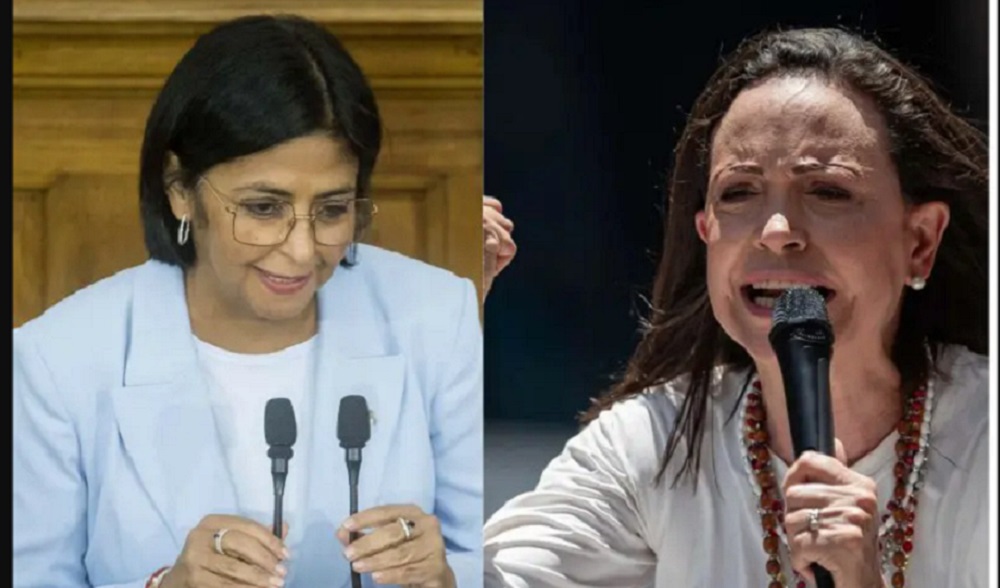
President Donald Trump, who until Maduro’s capture condemned his authoritarian regime, hailed Delcy Rodríguez, Maduro’s vice president and now Venezuela’s interim leader, as a “terrific woman” after they spoke Wednesday. Cast aside has been the pro-democracy movement led by Nobel Peace Prize laureate María Corina Machado — a “nice woman,” Trump said this month, but who “lacks support” and is “not respected.”
Machado, who previously called for the criminal prosecution of the people with whom Trump’s administration is now working, presented him with her Nobel medal during a private meeting Thursday. Meanwhile, a senior Rodríguez emissary — Félix Plasencia, Venezuela’s ambassador to the United Kingdom — was visiting Washington at the same time for high-level talks.
Rodríguez this week called for a new political era, using language that would have been shocking two weeks ago. Her government’s release of some political prisoners, she said, should make clear that Venezuela aims to “allow understanding” and embraces a “political and ideological diversity.” She was seeking energy cooperation with the U.S., she said Thursday, “based on decency, dignity, and independence.”
“If one day I were to have to go to Washington, as acting president, I would do so, on my own two feet,” she said, “carrying the tricolored flag.”
The Chavistas are trying to sell the dizzying about-face as reflecting a years-long quest by Maduro, federally indicted and isolated by U.S. sanctions, for better relations with Washington. With Maduro now in U.S. custody on federal narco-trafficking charges, even his son, Nicolás Maduro Guerra, appears to have embraced the new, pro-American era. The opening of the oil industry, he said, was part of his father’s plan: “We are following his instructions.”
Analysts see the regime’s actions as a campaign to hang on to power. One former senior official involved in Venezuela predicted Rodríguez would measure out goodwill gestures in hopes of winning the Trump administration’s confidence until Trump becomes distracted by the midterm elections or another international crisis.
“I think they’re going to string us along up until the point that we ask Delcy to do something that she can’t or won’t do,” said the former official, who spoke on the condition of anonymity to talk candidly. “Until then, they will give what they can and hope they can drag this out.”
A second former U.S. official said the regime’s release in recent days of American detainees and some political prisoners “is a sign that there isn’t a lot of leveraging going on.”
“Those are two things that traditionally in the past would’ve been a part of a very intense quid-pro-quo negotiation,” the former official said. “The fact that these things might be happening without that kind of quid pro quo signals to me that the regime is pretty shell-shocked by what happened.”
Rodríguez understands, the second former official said, that the more money injected into the Venezuelan economy, the better are her chances of saving the socialist party and the Bolivarian revolution “as a viable political movement in the future.”
The Trump administration this week brokered its first sale of Venezuelan oil for about $500 million, which was deposited into a trust in Qatar, according to people in Venezuela’s oil industry. Officials appear to be laying plans to funnel that money indirectly toward the Venezuelan economy, according to Venezuelan economists and business leaders familiar with the discussions.
Three hundred million dollars is expected to be sold to the four largest private banks in Venezuela, economic analyst Alejandro Grisanti said. The banks would then auction off the foreign currency and direct the proceeds to the economy, prioritizing food and medical sectors. The Central Bank of Venezuela will receive the bolivars generated by these auctions and may use them only to pay salaries and employee benefits.
“It is a fundamental measure for maintaining economic stability in Venezuela,” Grisanti said. “It proves that there is good coordination between the United States and Venezuela to take swift action.”
U.S. Energy Secretary Chris Wright said the U.S. would control the sale of “all of their oil and natural gas.” The proceeds will be directed first to U.S.-controlled accounts at globally recognized banks, an administration official said, to guarantee the legitimacy and integrity of their distribution.
Talks are underway in Venezuela about allowing the dollar to flow freely in the economy, one business leader here said. Rodríguez, as vice president, supported the idea internally, the person said; others in the regime argued it “would mean putting ourselves in the hands of the U.S.”
A person familiar with Rodríguez’s inner circle said her grip on power remains dependent on several factors.
One of the biggest wild cards is Diosdado Cabello, the official who threatened 100 years of war. The powerful interior minister runs the country’s feared intelligence agencies, the police and the colectivos, the armed, motorcycle-riding, Chavismo-defending militias that have long terrorized Venezuelans.
In public, Rodríguez and Cabello have projected unity, as when they stood side-by-side Wednesday before invited journalists. But Cabello, unlike Rodríguez, has also been indicted by the U.S. on charges of narco-terrorism, and his continued presence is viewed as a point of friction with Washington.
“It’s not necessarily that he’s against [better relations with the United States], but it’s more that he’s afraid that he’ll be next,” said Francisco Rodríguez, a Venezuelan economist at the University of Denver.
The U.S. blockade of Venezuelan oil meant that crude filled tankers and storage facilities, leaving little room for more. The regime is now looking to oil traders authorized by the Trump administration to move the undelivered crude urgently. If the glut forces the shutdown of oil fields, they will be costly to restart.
The new setup could be a boon for a sector that has struggled in the vise of U.S. sanctions and Trump’s blockade.
The regime’s compliance “shows how dramatic the blockade’s effect was going to be for them,” said Francisco Monaldi, director of the Latin American Energy Program at Rice University. “Even though a few tankers have escaped the blockade, they completely realized that if the U.S. was going enforce [it], they would have to chop production. They would then have a massive decline in exports followed by a decline in production.”
“They are avoiding a certain sort of collapse of the economy in exchange for something that is uncertain,” he said, but has upsides in that oil proceeds of sales will no longer be black money that needs to be laundered or hidden.
U.S. sanctions have prevented U.S. companies from doing business here without special licenses. The regime now wants the administration to approve more licenses, to get cash flowing in the economy and show that the shift toward the United States has a payoff.
Some oil revenue could be used to fund government contracts for U.S. companies to rebuild Venezuela’s blackout-plagued electricity grid, according to two people familiar with the talks. Rodríguez officials are also discussing U.S. investment in other sectors, including mining, they said.
Some oil executives have been skeptical. Venezuela currently produces little more than a quarter of the oil it did at its 1990s peak. Its infrastructure has fallen into disrepair. Analysts say the sector needs some $100 billion in investment over a decade to return the sector to its former production.
Without “significant changes” to Venezuela’s legal system, “commercial frameworks” and protections, ExxonMobil CEO Darren Woods told Trump last week, the country is “uninvestable.”
“There will be no oil recovery in Venezuela without the return to rule of law and democracy,” said economist Ricardo Haussman, who was the nation’s planning minister and sat on the board of its central bank in the 1990s.
“I think they have it wrong,” said Haussman, who is now at the Harvard Kennedy School. “They think they can engineer an investment boom in Venezuela before political normalization. That is a bad and dangerous idea.”
Internally, the regime is discussing laws that could reduce curbs on foreign investment and offer new legal rights and protections to encourage reluctant American firms.
That’s a radical departure from Chávez, who, after his reelection in 2006, declared the United States “the biggest menace to our planet.”
Maduro, who took control of the regime on Chávez’s death in 2013, called repeatedly for better relations. But having claimed reelection in three elections viewed as fraudulent — a Washington Post review of tally sheets from the 2024 contest showed that Machado’s candidate is likely to have won more than two-thirds of the vote — he was seen by the administration as too toxic.
Former Chavista lawmaker Maria Alejandra Díaz, a constitutional lawyer, said the new relationship, and the possibility that the administration will try to impose it elsewhere in Latin America, is both surprising and worrying. “We don’t know if it’s out of fear or because it was already part of a plan,” she said.
If there’s one thing Chávez ensured, she said, “it was the independent and sovereign management of our resources. … He would be turning over in his grave.”
Juan Barreto, a former Chavista leader who still identifies as a leftist, said Venezuela is experiencing a transition after the breakdown of Chávez’s model under Maduro.
“It doesn’t mean that we’re going to go out and support Delcy now,” he said. “There are people who see things in black and white and don’t understand that transitions are long, hard and painful.”
Faiola reported from Rome, Schmidt reported from Mexico City and Halper reported from Washington. Jacob Bogage in Washington contributed to this report.
END
https://www.washingtonpost.com/world/2026/01/16/with-maduro-us-custody-his-lieutenants-warm-trump
