

By P. K. Balachandran/Eurasia Review
Colombo, January 13 – US President Donald Trump has said that the US will take over Greenland whether the Greenlanders and the Danes, who have sovereignty over the island, like it or not.
Trump’s case is that American control over Greenland is necessary to prevent Russia or China from controlling the Artic island and posing a threat to the US and Western Europe.
The Artic seas will become more navigable due to the ice melting because of climate change. And this possibility has triggered tremendous interest in Greenland in US, Europe, Russia and China.
Trump says that he will first offer Denmark a deal but if that doesn’t work, he will not hesitate to use force to secure Greenland.
Why is Trump fixated with Greenland? The reasons are: (1) it is rich in strategic minerals like rare earths (2) it’s strategic location (3) and the threat of a takeover by Russia and China, a development not in the interest of the West.
According to a 2023 survey, 25 of 34 minerals deemed “critical raw materials” by the European Commission were found in Greenland. US, Canada, China and Russia are now eyeing these resources. Greenland’s rare earth minerals are used in high-tech industry besides the manufacture of batteries.
Strategic Location
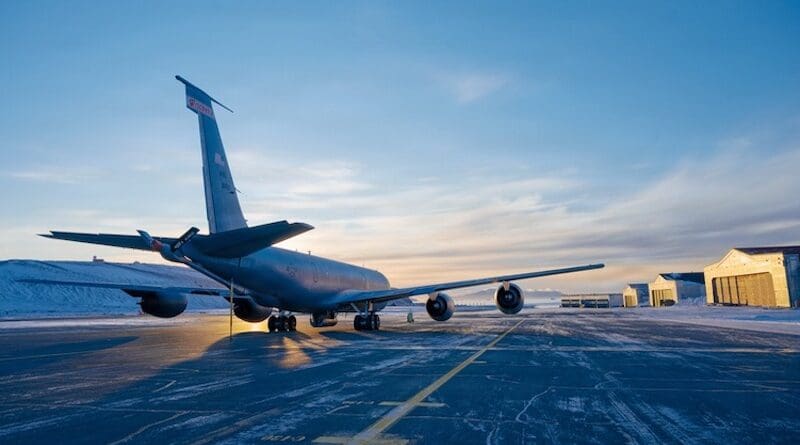
Greenland is at the intersection of North America, Europe, and the Arctic, making it critical for military movement across the northern Atlantic. As geopolitical competition with Russia and China intensifies, the US is focussing on preventing them from gaining a foothold in the Artic region.
The primary concern is Russian naval and missile activity, with Chinese naval activity and investment in Arctic infrastructure being a close second in importance. The US believes that the current Danish-US defence agreement is not suited for meeting a Russian military threat.
Trump believes that Greenland’s seas are bristling with Russian and Chinese ships, though some experts say that he is exaggerating. However, Western security circles are keen that the GIUK Gap, a maritime choke point formed by Greenland, Iceland, and the UK, be fully in West’s control.
Bid to Buy Greenland
When the Cold War began after World War II, the then US President Harry S. Truman, formally offered to purchase Greenland from Denmark, citing its importance for security against the USSR. Denmark rejected the offer but agreed to allow US military access. In 1951–52 the United States established the Pituffik Space Base, a radar station.
Over time, climate change made the Artic waters more useable than before because ice was melting. In the 2010s Russia rebuilt its Arctic military capacities. It is in this period that Chinese investments in Greenland’s infrastructure also began, though due to US intervention, Greenland had to stop several Chinese projects.
During his first term (2017–21), Donald Trump revived the old proposal to purchase Greenland. But Danish and Greenlandic leaders again rejected it. However, the 2022 Russian invasion of Ukraine brought Arctic security to the forefront and Greenland became a matter of concern.
Trump stepped up his demand for Greenland. In late 2025 he appointed Louisiana Governor Jeff Landry as a special envoy to Greenland who even said that he intended to “make Greenland a part of the US.”
Alarmed, Danish Prime Minister Mette Frederiksen warned that a US attack on Greenland would mean the end of NATO. But still she proposed greater military facilities to the US. Trump, however, wanted outright ownership, though Secretary of State Marco Rubio offered to purchase Greenland. NATO suggested that a collective European approach as a compromise. But Trump told “The New York Times” that he wants to own Greenland because “ownership gives you things and elements that you can’t get from just signing a document.”
Russian and Chinese Interest
As started earlier, the Northern Sea Route (NSR), a maritime route in the Arctic Ocean, is becoming easier to navigate now due to melting ice. The NSR can cut shipping time between continents significantly.
Therefore, Russia is hoping to use the NSR to trade more with Asia than Europe, due to Western sanctions. Last year, the number of oil shipments from Russia to China via the NSR rose by a 25%.
Russia and China have been working together to develop Arctic shipping routes because Russia seeks to deliver more oil and gas to China amid Western sanctions and China seeks an alternative shipping route to reduce its dependence on the Strait of Malacca.
Russian President Vladimir Putin said at the March 2025 International Arctic Forum in Murmansk (the largest city in the Arctic Circle), that Russia is beefing up its military capabilities in the Artic circle as Trump was serious about taking Greenland.
According to the Director of Ukraine’s National Security Institute., Bohdan Ustymenko, maritime strategy has long played a significant role in Vladimir Putin’s thinking. In August 2024, Putin ordered the establishment of a Russian Maritime Collegium headed by his close advisor Nikolai Patrushev, who formerly led Russia’s FSB security service and the country’s National Security Council.
Ustymenko says Russia is engaging in a wide range of hostile naval actions, including the sabotage of undersea cables in the Baltic Sea and surveillance activities off the coast of Britain and other NATO countries.
Putin views the Northern Sea Route as part of Russia’s national transport infrastructure and has sought to control access for shipping from other nations. But Russian control is problematic because the Northern Sea Route covers a vast area and some of the areas currently claimed by Moscow are situated well beyond the territorial waters of the Russian Federation, Ustymenko points out.
Geopolitical tensions are likely to be further heightened by the deepening involvement of China in partnership with Russia, Ustymenko says. Arctic waters provide a military advantage to Russia and China because of the North Pole’s proximity to several European nations.
Allowing Russia to gain the ascendancy in the Arctic would lead to unpredictable geopolitical consequences, Ustymenko warns. Control over the oil and gas resources of the Arctic region could dramatically increase Russia’s State revenues and the windfall would be used by the Kremlin to finance its wars.
Daniel Michaels and Sune Engel Rasmussen, write in the “Wall Street Journal” that Chinese research submarines have travelled thousands of feet beneath the Arctic ice, a technical feat with “chilling” military and commercial implications for America and its allies.
According to the US Department of Homeland Security, Chinese military and research vessels have operated around Alaska’s Arctic waters in unprecedented numbers. US Air Force Gen. Alexus Grynkewich has said that Chinese vessels on research missions often serve a military purpose. China has already declared itself a “near-Arctic power,” displaying its strategic aim, he points out.
The US expects China to send armed submarines to the North Pole within a few years. China already has military-grade surface vessels in the Arctic region while expanding its fleet of ice-breaking ships. On their part, the US and its allies are training more Arctic troops in response to new dangers. They have beefed up sub-hunting patrols out of Iceland and other locations.
Last year, Chinese and Russian military planes flew patrols near Alaska for the first time, with Chinese long-range bombers operating from a Russian air base.
In 2015, China updated its national-security law to include defending national interests in polar regions, and seeking unfettered access to new sea lanes and resources, Ryan Martinson, an associate professor at the U.S. Naval War College’s China Maritime Studies Institute, pointed out. On his part, US President Donald Trump struck a shipbuilding deal with Finland to expand the US icebreaker fleet and has pressured Denmark into expanding defences on and around Greenland.
Subsea Warfare
In the Arctic, the US and NATO worry most about “subsea warfare”. Submarine navigation relies on detailed knowledge of ocean-floor topography and undersea conditions. China is cataloguing the world’s oceans to build computer models to guide submarines and help them evade detection.
China sells Russia electronics and components for military equipment and ships civilian products restricted by international sanctions on Russia over the Ukraine war. And Russia is repaying China’s help, in part, by sharing advanced technologies in space, stealth aircraft and undersea warfare. Russia has established a reputation in submarine warfare.
END
